Fairhope High School ranked among Alabama’s best by U.S. News
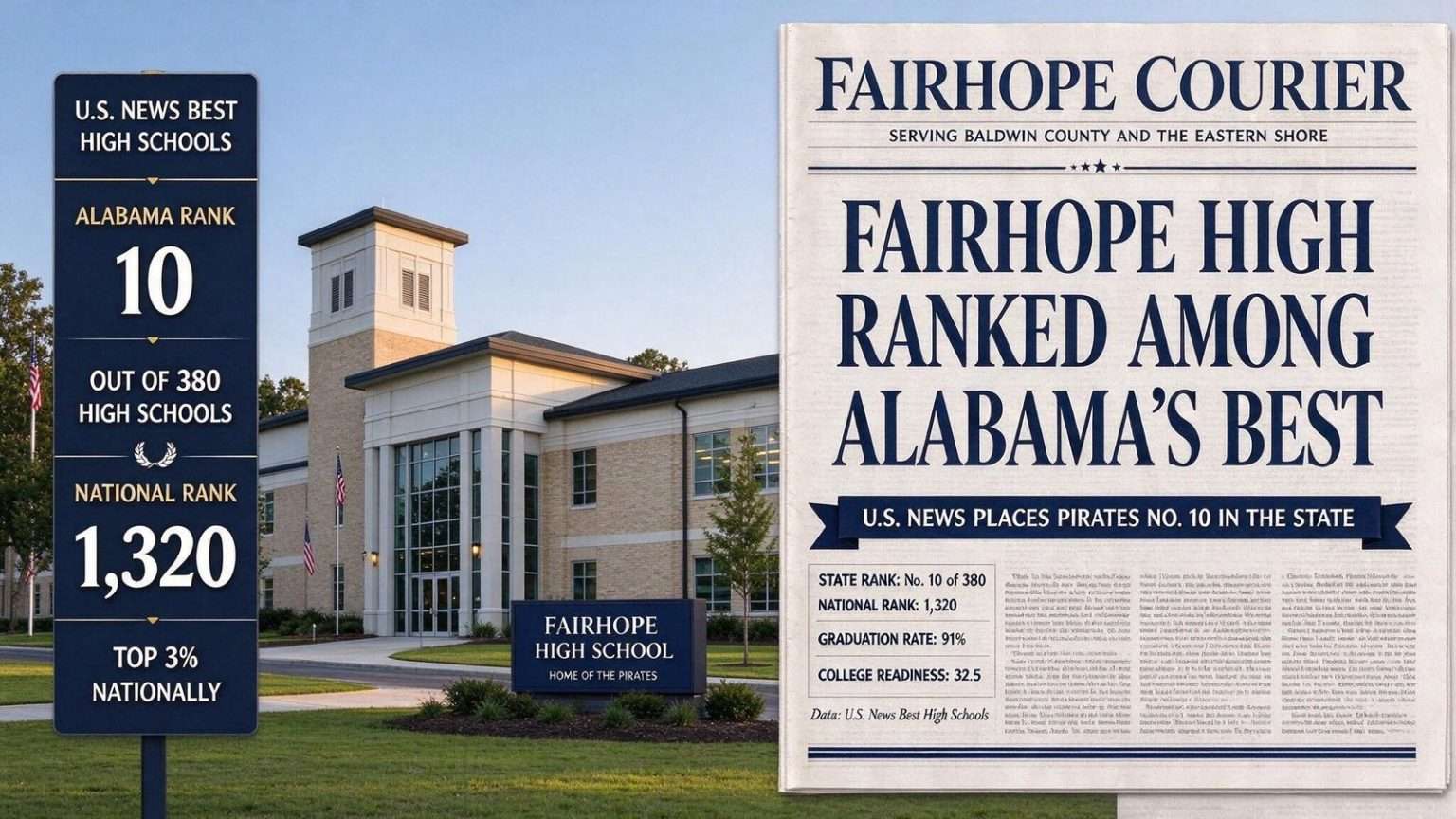
Fairhope High School ranked No. 10 among Alabama high schools in the latest U.S. News & World Report Best High Schools list.
BALDWIN COUNTY, Ala. — Fairhope High School has landed among the top high schools in Alabama in the latest U.S. News & World Report Best High Schools rankings, earning a place that confirms what Baldwin County families have long considered a point of local pride. The publication’s annual list evaluates schools across the country on graduation rates, college readiness and other measures of how well campuses serve their students.
Fairhope High ranked No. 10 out of 380 Alabama high schools in the rankings, the highest placement among schools in the immediate Mobile Bay area. The Baldwin County school posted a 91% graduation rate and a college readiness score of 32.5, and it ranked 1,320th nationally among the thousands of high schools U.S. News evaluated across the United States.
Among schools in the broader viewing area, the next highest-ranked was W.P. Davidson High School in Mobile, at No. 26 in the state. The gap between the two — fourteen spots in a field of 380 — placed both in Alabama’s top tier while giving Baldwin County’s flagship coastal high school the region’s top billing in the national publication’s assessment.
What the rankings measure
The U.S. News Best High Schools methodology is built around outcomes. The evaluation begins with reading and math proficiency — how students perform on state assessments — and then considers whether a school’s disadvantaged students are outperforming expectations, before weighing graduation rates and college readiness, a composite measure drawn from participation and performance in Advanced Placement and International Baccalaureate coursework. Schools that clear those thresholds are then ranked numerically within their states and nationally.
Fairhope High’s 91% graduation rate put it well above the thresholds that U.S. News applies, and its college readiness score of 32.5 reflected the share of students taking and passing college-level coursework — Advanced Placement classes chief among them — during their high school years. A national rank of 1,320th placed the school in roughly the top several percent of American high schools, an achievement that puts a Baldwin County campus in the same numerical company as well-known suburban schools across the country.
The rankings’ emphasis on disadvantaged-student performance also matters for how a school like Fairhope’s earns its slot. A campus cannot score well simply by enrolling an affluent population; the methodology checks whether the school lifts outcomes across its full student body, including economically disadvantaged students. Fairhope High’s top-10 state standing indicated strength across those measures rather than in one narrow category.
Fairhope High and the Baldwin County system
Fairhope High School serves the Fairhope feeder pattern of Baldwin County Public Schools, drawing students from the city of Fairhope and surrounding communities along Mobile Bay. The school’s enrollment has grown steadily as Fairhope itself has grown from a small bayfront town into one of Alabama’s most desirable communities, and its campus anchors a system that has spent decades building new schools to keep pace with the county’s explosive population growth.
Baldwin County Public Schools, one of the largest geographic districts in the eastern United States, has used Fairhope’s feeder pattern as a showcase in recent years, with the city’s schools repeatedly earning recognition for academic performance. Fairhope Elementary, Middle and High schools have collected state and national honors — the middle school has been a National Blue Ribbon School — and the community’s long-standing support for education funding has been a fixture of local politics, with property tax referendums for Baldwin County schools passing repeatedly over the decades.
The high school itself offers the range expected of a large suburban campus: Advanced Placement course sequences across the academic disciplines, career and technical programs, athletics in the competitive Class 6A or 7A ranks, and the band, theater and fine-arts programs that serve a community with an active cultural scene. Its graduation rate of 91% reflects a system focused on keeping students through to the diploma, a measure Baldwin County’s leadership has tracked closely as the district has grown.
Davidson’s placement in Mobile
Across the bay, W.P. Davidson High School’s No. 26 state ranking gave the Mobile County Public School System its strongest showing in the viewing area. Davidson, an International Baccalaureate campus in west Mobile, has long been one of the county system’s academic flagships, drawing students from across the district into its IB program — a curriculum U.S. News counts directly in its college-readiness measure. The school’s placement fourteen spots behind Fairhope High kept both bay-area schools in Alabama’s top 7%, and gave the region two of the state’s top two dozen campuses.
For Mobile County Public Schools — the state’s largest system by enrollment at the time — Davidson’s ranking carried particular significance, coming as the district worked to strengthen its academic reputation amid school-choice competition from Baldwin County and private academies. The IB program’s presence in the rankings formula rewards exactly the kind of rigorous, exam-based curriculum Davidson had built, and its No. 26 slot demonstrated that a large urban-system school could compete numerically with suburban programs.
What rankings mean locally
National and state rankings land differently depending on where a family stands. For prospective residents — and Baldwin County attracts thousands of new households each year, many relocating from other states — the U.S. News list functions as a shorthand for school quality, and a top-10 state ranking feeds directly into the housing market dynamics that have made Fairhope among the priciest communities in Alabama. Realtors along the Eastern Shore have long marketed the city’s schools as a selling point, and an independent national ranking reinforces the pitch.
For the school itself, the recognition carries both pride and pressure. Top-ranked campuses face rising enrollment, higher community expectations and the ongoing challenge of maintaining Advanced Placement participation and passing rates as the student body grows. Baldwin County’s continuing population boom means Fairhope High’s classrooms have absorbed new students year after year, and sustaining a 91% graduation rate through that growth is an operational achievement as much as an academic one.
The rankings’ limits
U.S. News’s list is a data exercise, and educators have long cautioned against reading it as a complete portrait of a school. The methodology rewards measurable outcomes — test scores, graduation, AP and IB results — and cannot capture the arts programs, school culture, special-education services and day-to-day teaching quality that shape a student’s experience. A ranking also reflects a single year’s data, and campus performance can shift as cohorts change and as the publication adjusts its formulas between editions.
The measure also compresses very different schools into one list. A small magnet campus and a 2,000-student suburban comprehensive school compete under the same rubric, and a school’s rank can move several spots in either direction with modest changes in test results. What a top-10 state ranking reliably signals is sustained, system-wide strength — the kind that comes from a stable teaching staff, a supportive community and a feeder pattern delivering prepared students year after year.
Mobile Bay schools on the state stage
For the Mobile Bay region, having Fairhope High at No. 10 and Davidson at No. 26 in the same edition of the rankings was a notable showing. Alabama’s list is dominated by schools from Huntsville, Birmingham’s suburbs and the Montgomery area’s magnet programs — systems with long-established magnet and International Baccalaureate pipelines — so a bay-area campus breaking into the top 10 marked the region’s arrival among the state’s academic leaders.
It also fit a pattern of Baldwin County’s rise. The county’s schools have collected Blue Ribbon honors, A-plus report-card grades under the state’s school grading system, and steady enrollment growth funded by the community’s repeated tax referendums. Fairhope High’s national ranking of 1,320th put a Baldwin County campus alongside schools from far larger metro areas, a data point that regional economic developers cite when recruiting employers and families to the Eastern Shore.
How the school got there is a story of the community around it. Fairhope’s identity has always included its schools — from the Single Tax Colony founders who opened a school on the bluff in 1894 to the modern parents who pack the auditorium for band concerts and Friday football — and that expectation shapes what the campus can attempt. Principals have credited the feeder pattern’s elementary and middle schools with much of the preparation behind the high school’s results, and the district’s investment in teachers and facilities has followed the community’s willingness to fund it.
The rankings arrived, as they do each year, with the familiar mix of celebration and scrutiny — families sharing the news, neighboring schools checking their own placements, and educators noting that the numbers measure a moment rather than a mission. For Fairhope High School, that moment placed it in Alabama’s top 10 out of 380 high schools, with a 91% graduation rate, a 32.5 college readiness score and a national rank of 1,320th — numbers that confirmed the school’s standing and gave the Eastern Shore one more claim to being among the best-educated corners of the Gulf Coast.