Fairhope man rescued after boat crash in Portersville Bay near Bayou La Batre
ALEA Marine Patrol rescued 53-year-old Kevin Olmstead of Fairhope after his boat crashed in Portersville Bay; he clung to a channel marker for four hours.
BAYOU LA BATRE, Ala. — A Fairhope man is recovering after a single-vessel boating crash left him stranded in the waters of south Mobile County for roughly four hours before rescuers pulled him to safety. According to the Alabama Law Enforcement Agency, 53-year-old Kevin Olmstead was operating a center-console vessel that crashed at about 3:30 p.m. on Saturday, May 21.
Marine Patrol troopers later found the boat grounded and unoccupied — and taking on water — in Portersville Bay near Bayou La Batre. The discovery set off a search that would stretch across the open water of the bay and into the Intracoastal Waterway, involving multiple agencies and ending, four hours after the crash, with a man clinging to a channel marker.
Portersville Bay sits at the southern edge of Mobile County, where the waters around Bayou La Batre open toward the Gulf of Mexico. The area is among the busiest working-waterfront zones on the Alabama coast, home to a shrimp fleet and seafood processing operations, but it is also a place where recreational boaters, commercial vessels and shifting sandbars share the same shallow, current-swept water. A vessel that runs aground in that environment can take on water quickly, and a person separated from a boat can drift with the current far from where anyone would think to look first.
Four-Hour Search Ends at a Channel Marker
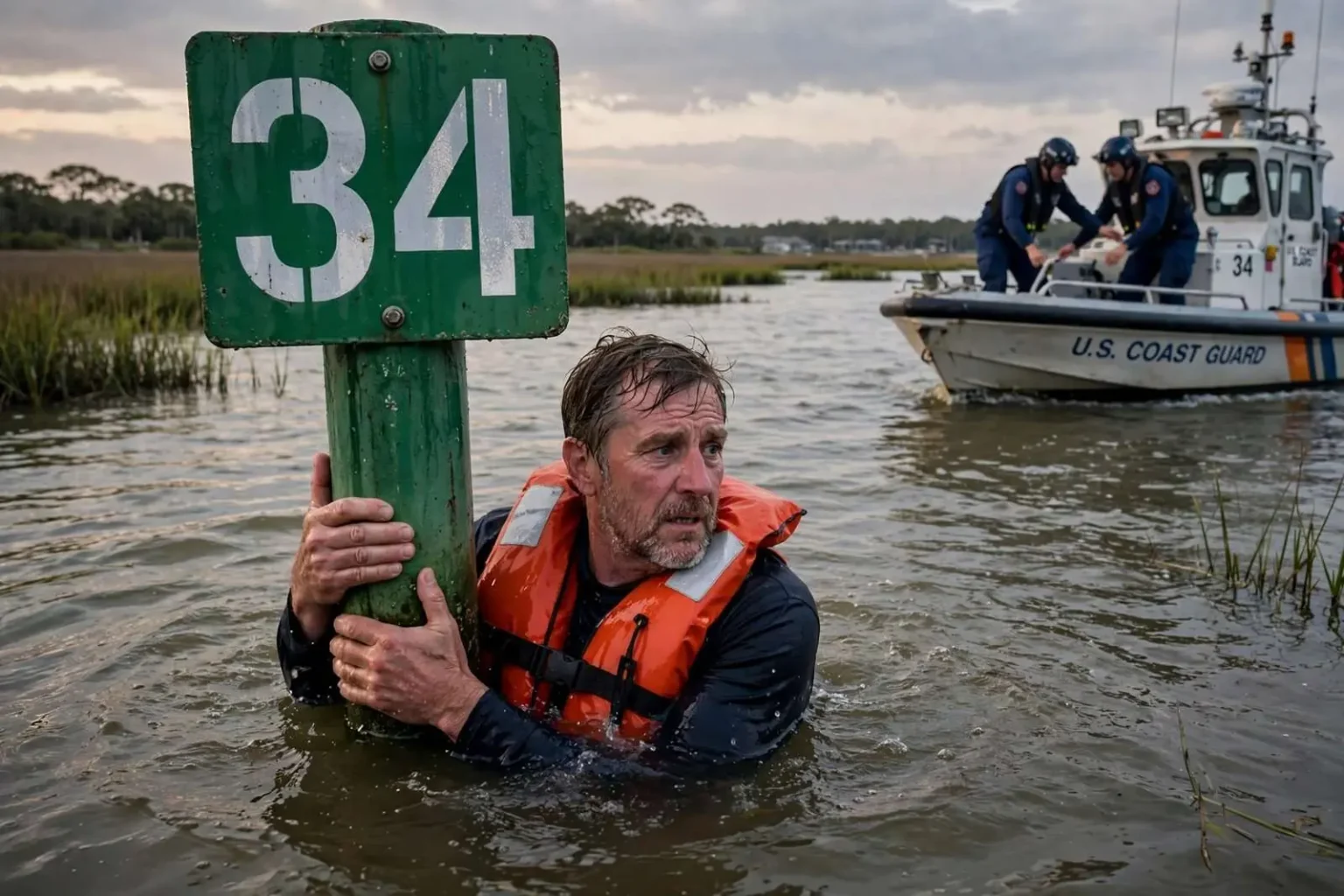
Troopers with ALEA’s Marine Patrol Division launched an immediate search for the missing boater. At approximately 7:30 p.m., troopers working alongside a Good Samaritan spotted Olmstead clinging to Channel Marker 34 in the Intracoastal Waterway.
The sighting ended a search that had grown more urgent by the hour. Four hours in the water — even in late May, when Gulf Coast water temperatures have begun to climb — is long enough for the body to lose heat steadily, and rescue crews treat every such case as a race against hypothermia. That Olmstead was able to hold onto a fixed channel marker likely made the difference between a drifting search target and a findable one; a person holding position on a charted aid to navigation is far easier to locate than one carried along by the current.
A rescue swimmer with the U.S. Coast Guard provided first aid as Olmstead was carried back to shore aboard a Marine Patrol vessel. Once ashore, he was airlifted to University Hospital in Mobile, where he was treated for signs and symptoms of hypothermia. The air transport shortened to minutes a trip that would have taken far longer by ground ambulance from the rural waterfront south of Bayou La Batre, and placed the survivor in the trauma and critical care setting that four hours of exposure demands.
The Intracoastal Waterway, the federally maintained channel that runs along the Gulf Coast behind the barrier islands, carries a steady mix of commercial barges and recreational traffic through south Mobile County. Its channel markers, numbered and charted, serve as reference points for every mariner in the area — and on this evening, one of them served as a life raft. Rescuers have long advised boaters who end up in the water to stay with any fixed object they can reach, both to conserve energy and to give searchers a coordinate to aim for.
Agencies That Answered the Call
Several agencies assisted in the search, including the U.S. Coast Guard, Alabama Marine Resources, the Mobile County Sheriff’s Flotilla, and Daphne Search and Rescue.
The multi-agency response is typical of a rescue on Alabama’s coastal waters, where jurisdiction lines run through the very water a search must cover. The Coast Guard brings aircraft, rescue swimmers and command-center coordination; state Marine Patrol troopers know the local channels and enforce the waterways; Marine Resources officers work the bays and estuaries daily; and the volunteer flotilla and search-and-rescue organizations contribute boats and trained eyes that often make the difference in a shoreline search. In a case like this one, assets from each of those agencies were working the same water within hours of the first report.
The role of the Good Samaritan who helped spot Olmstead was also a familiar element of Gulf Coast rescues. Commercial fishermen, charter captains and recreational boaters frequently end up participating in searches simply because they are on the water, know the channels, and can be on scene faster than any official vessel. Marine authorities consistently encourage boaters to report anything unusual they see — debris, a grounded boat, a person in the water — because those reports have repeatedly shortened searches that might otherwise have ended tragically.
What Investigators Will Examine
ALEA’s Marine Patrol continued investigating the cause of the crash.
A single-vessel crash leaves investigators with a distinct set of questions. Marine Patrol troopers will look at the vessel itself — its condition, its steering and its throttles — along with the route it was running, the speed it was traveling, the condition of the water at the time, and the effects of any hazards that shallow bays like Portersville are known to hold. Weather and visibility, the operator’s experience on those waters, and whether alcohol was a factor are all standard lines of inquiry in crashes of this kind.
They will also study the survival side of the incident: whether the operator was wearing a life jacket, what safety equipment was aboard, and how a single person came to be separated from his vessel and left alone in the water for four hours. Those answers shape both the legal outcome and the safety lessons the agency passes along to the boating public afterward.
Crashes resulting in serious injury are investigated with the same seriousness as roadway collisions, and findings can support charges where negligence or impairment is established. In most cases, though, the public outcome is a reminder of how quickly an ordinary afternoon on the water turns dangerous — and of how much the outcome depends on equipment, planning and the speed of the response.
A Reminder for Coastal Boaters
Safety officials use cases like this one to press a handful of basics that repeatedly prove decisive. Wear the life jacket rather than stowing it — a person floating in a life jacket stays at the surface where rescuers can see them, while a person without one must spend energy just to stay afloat. File a float plan with someone ashore, so that if a boat is overdue, someone knows where it launched and where it was headed. Carry a working VHF radio or a fully charged phone in a waterproof case, and know the channel markers on the waters you run.
The waters around Bayou La Batre and Portersville Bay add hazards of their own. The approaches to the bay are shallow and change with storms and currents, the channels are shared by heavily loaded shrimp boats with limited maneuverability, and the distance between a mishap and help can be measured in miles of open water. Boaters who run those waters regularly learn the markers and the depths; visitors are well advised to slow down, watch their charts and keep daylight on their side.
Hypothermia is also misunderstood on the Gulf Coast. Many boaters assume cold water is a northern problem, but hours of immersion in water that feels merely cool drains body heat continuously, and the fatigue, confusion and loss of grip strength that come with it can overcome even strong swimmers. Rescue crews in south Alabama train for exactly this, and the treatment Olmstead received — first aid at the scene from a Coast Guard rescue swimmer, rapid transport and hospital care for hypothermia — reflects a protocol refined across many such cases.
For now, the focus shifts to the man himself and the investigation behind him. A Fairhope resident whose Saturday on the water turned into a four-hour fight for his life, Olmstead was rescued through the combined work of state troopers, federal rescuers, county and municipal volunteers, and a fellow boater who happened to be looking in the right place. His recovery is the outcome every agency involved works toward, and the grounded, taking-on-water vessel in Portersville Bay stands as the kind of scene coastal officials hope boaters everywhere will learn from rather than repeat.
The search itself illustrated how a water rescue unfolds minute by minute. Once Marine Patrol located the grounded, unoccupied vessel, the boat became both evidence and a search origin point: investigators secured the scene while the crews turned their attention outward, working the waters between the crash site and the channels a person in the current would most likely be carried through. The Intracoastal Waterway’s numbered markers gave searchers a grid to work from, and the four-hour gap between the crash and the rescue was spent covering that grid by boat, and reporting every sighting that might be a person in the water rather than debris.
Residents of south Mobile County know the pattern well. Bayou La Batre has seen its share of maritime emergencies over the years, from fishing vessel mishaps in the Gulf to recreational boaters caught out when weather turns, and the community’s rescue infrastructure — built around a working waterfront — responds with a familiarity that comes from experience. Saturday’s rescue added another chapter, one that ended at Channel Marker 34 with a man alive to be carried home.
Marine Patrol officials urged anyone with information about the crash, or who was on the waters of Portersville Bay or the Intracoastal Waterway that Saturday afternoon and saw the vessel before it grounded, to contact ALEA as the investigation continues.