Fairhope schools within reach of Alabama’s top 10, consultant tells city
Fairhope schools within reach of Alabama's top 10, consultant tells city Reported by South Alabama News from local coverage of the Mobile and Baldwin.
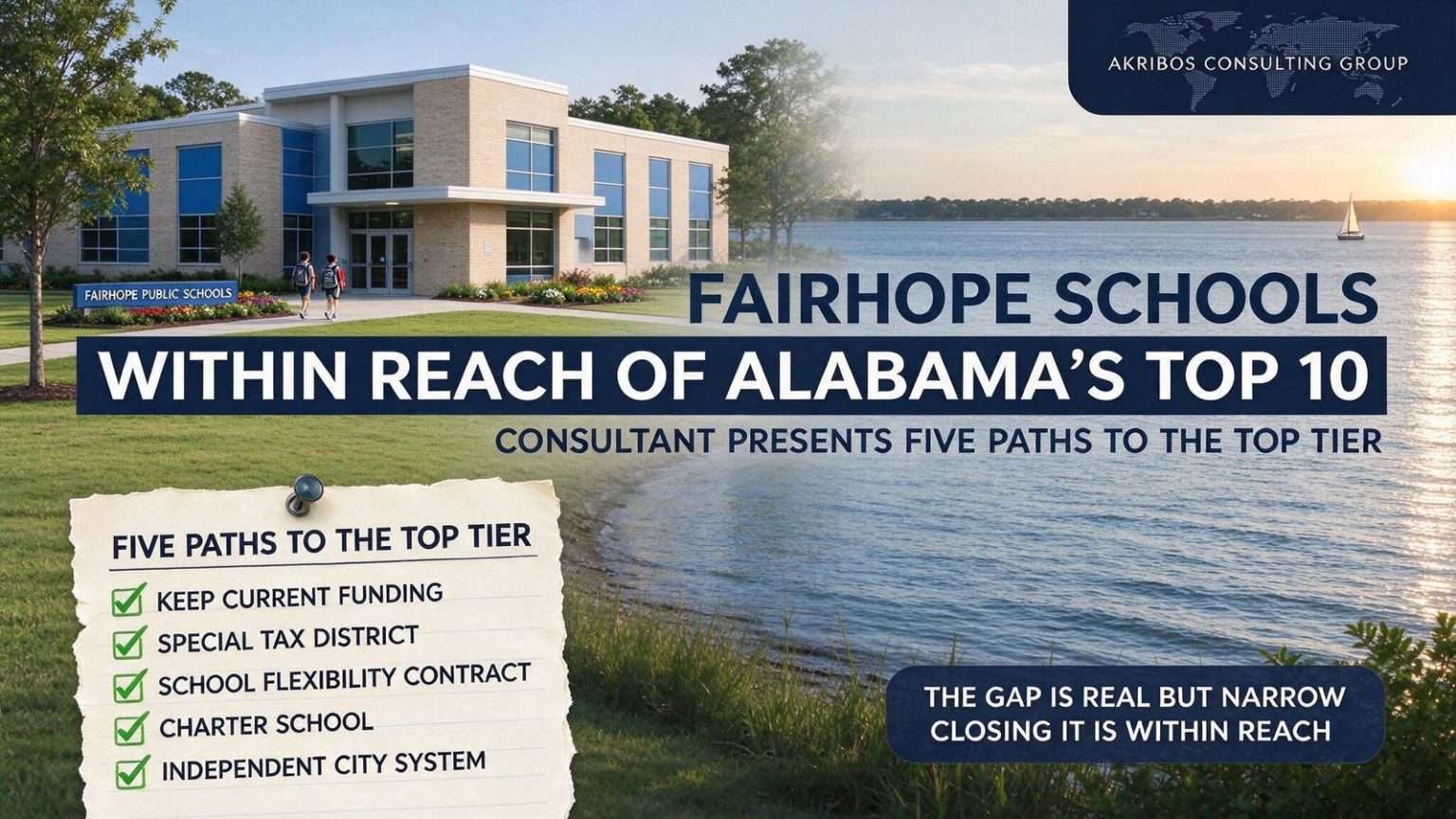
An academic audit commissioned by the city of Fairhope suggests its schools are closer than many might think to ranking among the best in Alabama. The Akribos Consulting Group reviewed the feeder pattern for Fairhope High School using ACT Aspire results, ACT college-readiness metrics, Advanced Placement data, demographics and per-student spending. The firm, which the Fairhope City Council paid $49,000 to conduct the study, compared the pattern to the criteria that define the state’s top 10 school systems.
The findings place Fairhope in rare company. Akribos evaluated the schools that feed students into Fairhope High School — a corridor of campuses serving children from kindergarten through twelfth grade — and concluded that the academic profile already resembles, in several respects, the systems Alabamians typically associate with the top of the state’s performance tables. For a city whose schools operate inside a countywide district rather than their own system, that is a notable conclusion.
Fairhope’s public schools are part of the Baldwin County Public School System, one of the largest districts in Alabama by both enrollment and geography. Baldwin County stretches from the Gulf of Mexico north across the Eastern Shore and into rural timber country, and its schools serve communities as different as Gulf Shores, Daphne, Bay Minette and Spanish Fort. Fairhope itself, perched above Mobile Bay and known for its arts scene, its downtown flower-lined streets and its century-old single-tax colony heritage, has long drawn families who put a premium on education.
“You all are doing a great job, we have no doubt that you could get to being a top 10 school in Alabama,” said Dr. Ruth Ash, a member of the Akribos study team. The assessment was delivered to city officials as part of a presentation on the audit’s conclusions, and it framed the study’s central message: the gap between Fairhope and the state’s elite systems is real but narrow, and the tools for closing it are within the city’s reach.
Where Fairhope stands
Akribos placed Fairhope’s schools, all part of the Baldwin County Public School System, in “the second 10” statewide. In practical terms, that means the feeder pattern sits just outside the club of systems — typically suburban districts with strong tax bases, high levels of parental education and consistently strong standardized test results — that dominate the top of Alabama’s rankings. Those systems tend to share measurable traits: above-average ACT composites, high Advanced Placement participation and pass rates, and graduation rates that lead the state.
The audit leaned on exactly those measures. ACT Aspire results track how students perform against national benchmarks in reading, math and science in the grades that precede the ACT itself, offering an early warning system for where students are falling behind. ACT college-readiness metrics measure how many students hit the benchmark scores that predict success in credit-bearing college coursework. Advanced Placement data show not just how many students attempt college-level courses, but how many pass the end-of-year exams that can earn them college credit.
Layered over the academics, Akribos examined demographics and per-student spending, the two factors that most often separate high-performing systems from struggling ones. Students who arrive at school from households with higher income and education levels tend to score higher on standardized measures, and systems that spend more per pupil — often the product of local property tax bases — can offer smaller classes, more course options and more support staff. Fairhope’s profile, the study indicated, compares favorably to the second-tier districts around it and within reach of the tier above.
Dr. Ash and her colleagues built the comparison by asking what the state’s top 10 systems actually look like on paper, then measuring Fairhope against that template. The result was less a judgment than a roadmap: identify the specific inputs that separate a second-10 feeder pattern from a top-10 one, and then decide which levers the community is willing to pull.
Five paths to the top tier
To reach the top tier, the firm presented five options for the City Council to consider: keeping the current funding structure, creating a special tax district, pursuing a school flexibility contract with the state, launching a charter school, or forming an independent, city-run system. The options ranged from the least disruptive — doing little more than directing existing resources more deliberately — to the most ambitious, a separation from the county system that few Alabama cities have undertaken.
The first option, preserving the current funding structure, would leave Fairhope’s schools exactly where they are: part of the Baldwin County Public School System, funded through the county’s general school taxes and governed by the Baldwin County Board of Education. Under that arrangement, the city’s influence over its schools is indirect. Fairhope contributes to the system’s tax base but does not set its own curriculum, hire its own superintendent or levy its own education taxes.
A special tax district would change that equation at the margins. Alabama law allows municipalities to raise local money for schools within their borders, and communities across the state have used local tax measures to supplement what the county or city system provides. For Fairhope, a dedicated tax district would mean voters or the council directing new revenue specifically to the schools inside the city limits, funding the kind of extras — additional teachers, instructional coaches, enrichment programs — that generic funding often cannot cover.
A school flexibility contract takes a different route. Under Alabama’s flexibility law, districts can negotiate agreements with the state department of education that release them from certain regulations in exchange for heightened accountability on results. Baldwin County could, in theory, seek flexibility that lets Fairhope’s schools innovate — adjusting schedules, staffing or programming — without the cost and upheaval of a separate system. The contract route keeps the county relationship intact while giving the local community more say in how its schools operate.
The charter school option would introduce a publicly funded, independently operated school into the feeder pattern. Alabama’s charter school law, passed in 2015, allows approved charter operators to run schools that are exempt from many district rules. A Fairhope charter could pursue a distinctive academic model aimed at pushing the city’s students toward the top tier, though charter authorization in Alabama remains governed by state law and subject to statewide caps and approval processes.
The final and most consequential option is an independent, city-run system. A handful of Alabama municipalities — including nearby Gulf Shores and Orange Beach on the Baldwin County coast — have broken away from larger county systems in recent years to form their own city districts. The path requires years of planning, a state approval process, the division of assets and liabilities with the existing system, and a sustained local tax commitment, but it gives a city complete control over hiring, curriculum and budget. For Fairhope, that control would come at a substantial price, and the council must weigh whether autonomy would translate into the academic gains the audit projects.
Each option carries different implications for taxpayers, for the Baldwin County system and for the students in Fairhope’s classrooms. Akribos presented them as a menu rather than a mandate, leaving the policy choice — and its financing — to elected officials.
What the recommendations would cost
The recommendations came with price tags, including about $600,000 for added personnel such as a curriculum director and substitute teachers, and $80,000 for professional development. The staffing investment reflects one of the most consistent findings in school-improvement research: the single greatest in-school factor in student achievement is the quality of classroom instruction, and improving instruction requires people with the time and expertise to coach it.
A curriculum director would coordinate what is taught across the feeder pattern, aligning lessons from the elementary grades through the high school so that students arrive at each level ready for the next. Substitute teachers would free classroom instructors for the training and collaboration time that alignment work requires. The $80,000 professional development allocation would pay for that training itself — workshops, instructional coaching and the ongoing teacher development that top-performing systems treat as a core budget line rather than a luxury.
Neither figure includes the larger costs attached to the structural options. A special tax district would shift revenue obligations to local taxpayers; a charter school would redirect per-pupil funding to a new operator; and an independent system would require a full administrative infrastructure, transportation fleet and school facilities budget that Baldwin County currently provides. The city’s leaders now face the question of which investments deliver the most academic value per dollar.
A starting point for the council
Fairhope Mayor Tim Kant said the report is a starting point. “We have a new school board and a new superintendent, and this is a starting point so we can move forward,” Kant said. His remarks underscored the political timing: with new leadership installed in the school system, the city is positioned to act on the study’s findings rather than file them away, and the mayor’s framing suggested the council intends to treat the audit as the opening move in a longer effort.
The recommendations now go before the full council, with Akribos invited back for a question-and-answer session. That session will give council members the chance to press the consultants on the details — how the five options were costed, what the top-10 criteria assume, and which of the five paths the firm believes offers the best return for Fairhope specifically.
For residents, the stakes are practical. Property values in Baldwin County track closely with perceptions of school quality, and Fairhope’s growth as one of the region’s most desirable small cities has been built partly on the reputation of its schools. The decisions ahead — whether to invest in personnel, raise local taxes, pursue flexibility or eventually chart an independent course — will shape not only classroom outcomes but the city’s tax rate and its standing in the region for years to come.
The study’s own conclusion offers the clearest measure of what is possible. Fairhope’s students are already performing at a level that puts them within sight of Alabama’s best, according to the consultants the city hired to find out. Closing the remaining distance, Akribos concluded, is a matter of deliberate investment and community will — a choice that now rests with the Fairhope City Council and the residents it represents.