Family Friend Speaks Out After Deadly Shooting Involving Mobile Pastor and His Wife
A family friend is speaking out after a shooting at a Mobile home left pastor Robert Matthews dead, his wife hospitalized, and his daughter Charity Matthews charged with murder.
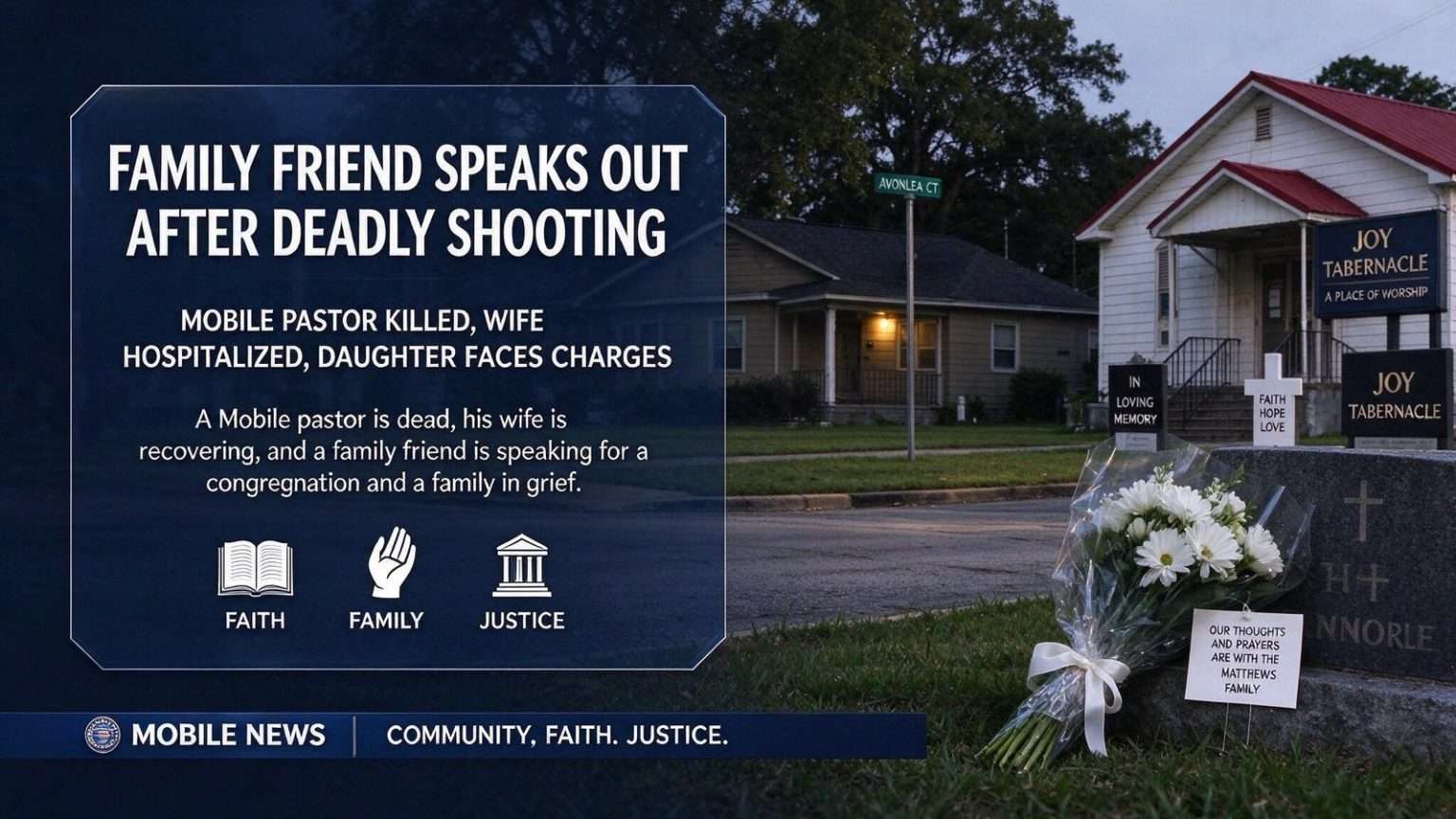
Friends of a well-known Mobile pastor and his wife are grieving after a shooting inside their home last weekend left the pastor dead, his wife hospitalized and his daughter facing murder charges. Robert Matthews, pastor of Joy Tabernacle on Ann Street, was found dead when Mobile police responded to a home on Avonlea Court Sunday night, just before 8 p.m. His wife, Twinetta Matthews, was also shot and taken to the hospital, where a close family friend says she is recovering.
The call brought officers to a residential street in west Mobile just before 8 on a Sunday evening, and what they found touched one of the city’s most familiar congregations. Matthews had led Joy Tabernacle on Ann Street for years, and members of the church community began gathering and mourning almost as soon as word of the shooting spread through Mobile’s faith network.
What police say happened
Police say the couple’s daughter, Charity Matthews, is accused of shooting both of her parents as well as her ex-boyfriend, Samson Moore. Investigators say she also fired in the direction of her brother during the incident. She was arrested hours after the shooting and charged with murder, two counts of attempted murder and reckless endangerment.
Charity Matthews pleaded not guilty during a court appearance Thursday morning. The state has since filed a motion seeking to hold her without bond, and she is scheduled to appear for an Aniah’s Law hearing next week, a proceeding used in Alabama to determine whether a defendant charged with certain violent offenses should be denied bail.
Aniah’s Law takes its name from Aniah Blanchard, an Auburn University student abducted and killed in 2019, and it amended the Alabama Constitution to allow judges to deny bail outright for a defined list of the most serious charges, including murder and attempted murder. Before the amendment, pretrial release in Alabama turned on the classic question of flight risk and danger; after it, prosecutors can ask a judge to hold a defendant without any bond at all. The hearing scheduled for next week will be the forum where the state makes that request formally and the defense answers it.
A family friend speaks
Shavon Buchanan, a close family friend who has been speaking on behalf of the Matthews family, described Pastor Matthews as a devoted spiritual leader and family man known affectionately in the community as “Fun Daddy.” His wife of nearly 50 years is known as “Mama Nett.” The nicknames capture the couple’s public identities in a community that knew them across decades of ministry and family life on Ann Street and beyond.
“When I found out it was the Matthews family there really are no words,” Buchanan said. “Something that you would never expect. It’s almost like living in a nightmare only because they are such a good family.”
Buchanan said she has known Charity Matthews for years and struggled to reconcile the charges with the person she grew up knowing. “I know Charity was a loving person. I know she carried love in her heart. I know that she’s seen a lot and been through a lot just from personal conversations that I will not share,” Buchanan said. “There are just no words. I love her and I’m praying for her as well.”
Buchanan said the family, who she described as strong in their faith, is relying on that faith to get through what she called an unimaginable tragedy, and that immediate relatives have found it too painful to speak publicly right now. “Stay strong and I’m praying for you guys to have peace and that God gives you peace that surpasses all understanding,” Buchanan said, addressing the family directly. “And I know that they’ll be okay.”
She closed by thanking the family for allowing her to speak on their behalf during such a difficult time. “To the Matthews family, I thank you for allowing me to speak on your behalf,” Buchanan said. “I’m grateful that I’m a part of your family and speak on your behalf and just stay strong.”
The arrangement — a family friend serving as the public voice while relatives stay silent — is a familiar one in high-profile cases, and Buchanan’s statements have become the primary public account of how the family is coping. Her words carried the dual weight the case has imposed: mourning a pastor, praying for his accused daughter, and speaking for a household that spans both the congregation grieving its leader and the defendant now in the county jail.
A congregation and a community react
Joy Tabernacle’s place on Ann Street puts it in one of Mobile’s long-established church corridors, where congregations anchor neighborhoods and pastors are public figures across community lines. A pastor’s death is felt institutionally as well as personally — services, ministries and the ordinary calendar of church life all continue in the days after such a loss, carried by members while the family deals with the law enforcement and court process that has engulfed them.
The charges touch every relationship inside the family at once. A mother recovering from gunshot wounds, a son who was fired toward, an accused daughter in custody, and a congregation without its pastor: few cases compress that much grief into a single household, and the court system’s schedule will now govern how each piece moves — the Aniah’s Law hearing first, then whatever the state’s without-bond motion produces.
What the coming hearings will decide
The immediate legal question is bail. At an Aniah’s Law hearing, the prosecution presents the charges and the circumstances of the offense, and the defense may respond with its own account and evidence about the defendant. The judge then decides whether the case falls within the amendment’s list of offenses and whether the state has shown grounds to deny release altogether. If bail is denied, the defendant remains in custody through trial; if not, the court sets conditions and a bond amount.
The case remains under investigation, and additional court proceedings are expected as it moves forward. Beyond the bail fight lies the full path of a homicide prosecution — preliminary proceedings, a grand jury review of the murder charge, and the attempted murder and reckless endangerment counts that travel with it. Each of those stages will unfold in Mobile County’s courts, on a timeline measured in months.
For now, the community that knew the Matthews family has the account Buchanan offered: a beloved pastor known as Fun Daddy, a wife known as Mama Nett now recovering in a hospital bed, a family leaning on the faith the pastor preached, and a daughter facing the most serious charges Alabama law allows. The next word in the story belongs to a judge, at a hearing scheduled for next week.
Aniah’s Law and how it works
Because the state’s motion has drawn attention to Aniah’s Law, the mechanics of the proceeding are worth explaining. The amendment, approved by Alabama voters in 2019 and named for Aniah Blanchard, lists specific charges — among them murder, attempted murder, kidnapping, terrorism, first-degree rape and first-degree sodomy — for which a judge may deny bail entirely after a hearing. The list was written in response to cases in which defendants charged with violent offenses were released, committed new crimes and returned to court as defendants again.
The hearing itself is not a trial. The judge does not weigh guilt, and the standard of proof is far lower than what a jury would apply. Prosecutors instead lay out the facts of the charges and any aggravating circumstances, and the defense can present evidence about the defendant’s ties to the community, her history and the likelihood of her appearance in court. The outcome is narrowly framed: release on conditions, release on a money bond, or no release at all while the case is pending.
In Mobile County, such hearings have become routine for defendants charged under the covered offenses, and next week’s proceeding will follow that pattern. The defense will have the chance to answer the state’s motion before the judge rules, and the ruling can be revisited as the case develops — which means the hearing, while consequential, is the first step in a longer legal contest rather than the last.
The path ahead for the case
Whatever the bail ruling, the underlying charges will proceed through the standard sequence for a homicide prosecution in Mobile County. The murder charge, together with the two attempted murder counts and the reckless endangerment count, will be presented to a grand jury, which decides whether the evidence supports formal indictments. If indictments follow, the case moves to Circuit Court, where arraignment, motions and eventually trial would take place on the circuit docket.
Each stage offers its own decisions. Defense attorneys may challenge the state’s evidence, seek suppression of statements or press for resolution through negotiation. Prosecutors, for their part, will decide as the investigation continues whether the charges as filed reflect what the evidence will ultimately support. Cases that begin with this combination of charges sometimes resolve short of trial, and sometimes run the full course; nothing in the early proceedings predicts which way this one will go.
Through it all, the human stakes remain where Buchanan left them. A pastor known as Fun Daddy is buried, his wife of nearly 50 years is healing in a hospital, his son was fired toward in his own home, and the woman who will answer to all of it in court is the family’s daughter. The community’s grief and the court process now run on parallel tracks, and both have months to go before either reaches an end.