Family of Pensacola Homicide Victim Calls on Shooter to Turn Himself In
The family of Deil Haynes is pleading for the gunman in a fatal Pensacola shooting on Trenton Drive to turn himself in as deputies continue searching.
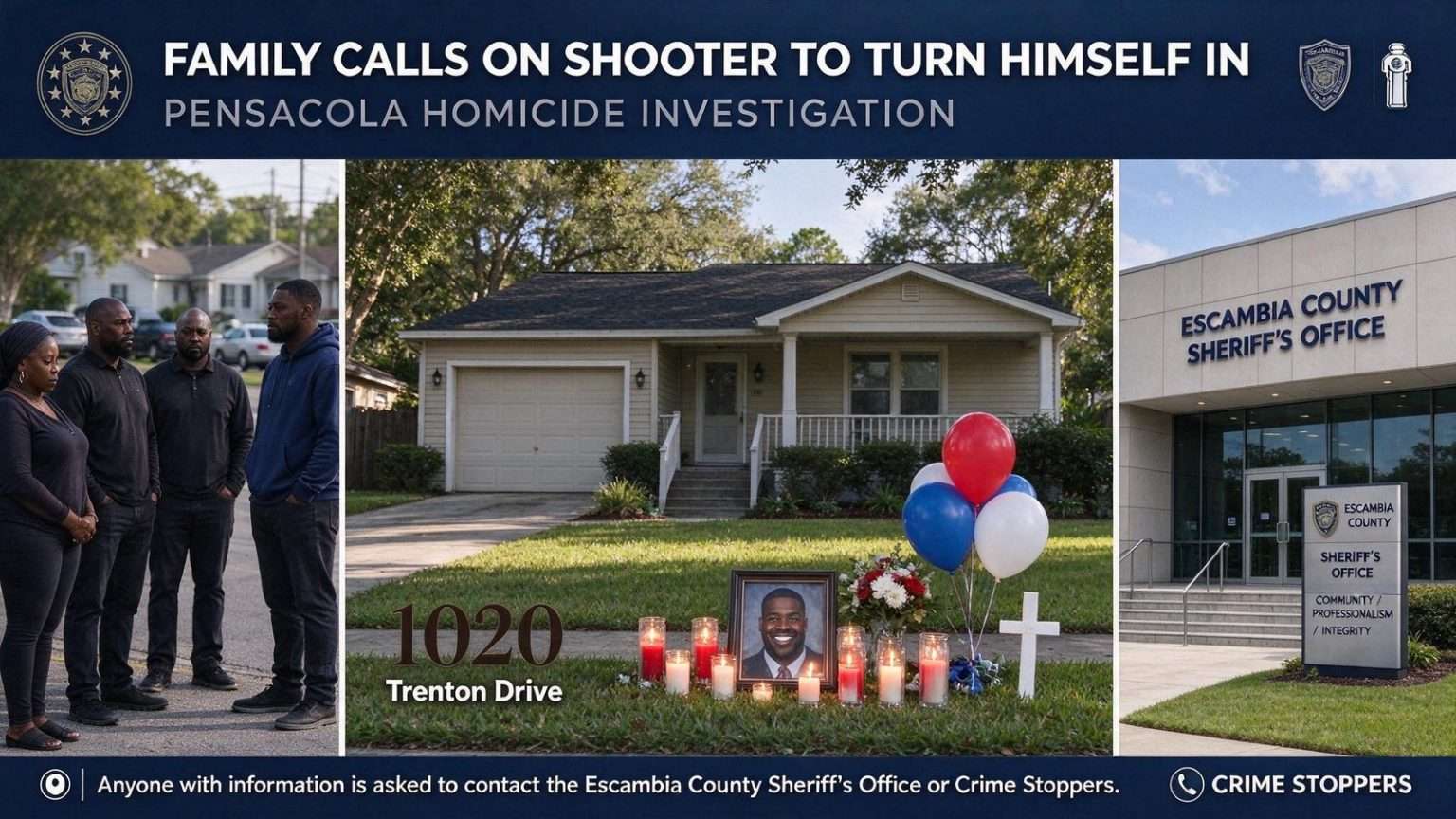
Days after a man was gunned down in Pensacola’s Mayfair community, his family and friends are pleading with the shooter to come forward — and investigators are still searching for answers.
The Escambia County Sheriff’s Office says Deil Haynes was shot Sunday morning outside a home on Trenton Drive. Neighbors say he ran next door to 1020 Trenton Drive seeking help from a friend, but did not survive.
The Mayfair neighborhood, a residential community in unincorporated Escambia County outside Pensacola’s city limits, is policed by the Escambia County Sheriff’s Office rather than the city’s police department, which means the investigation into the killing falls to the county agency’s major crimes investigators. Sunday morning shootings carry particular investigative challenges: fewer witnesses are out, overnight activity complicates timelines, and the first hours after such a shooting — when memories are freshest and physical evidence is intact — are the ones detectives work hardest to capture.
The detail neighbors recounted, of a wounded man running to a friend’s house for help, became a permanent marker of the case. It was at that house, 1020 Trenton Drive, where Haynes collapsed after the shooting, and where the community’s grief has since gathered.
“All I Seen Was Blood”
Antwan Edwards rushed over when he heard his close friend had been shot.
“All I seen was blood. That’s all I seen,” Edwards said.
Since then, he has kept a small memorial outside the house where Haynes died, marked with balloons, candles and his friend’s picture.
The roadside memorial is a familiar sight in American neighborhoods after a violent death, and its function is as much communal as personal. Balloons and candles mark the spot for passersby, signaling that a life was lost here, while giving friends a place to gather, grieve and remember in the days before any funeral. For Edwards, maintaining the memorial has become a daily act of loyalty — a way of keeping his friend’s name visible while the investigation moves forward.
Terrence Norman learned the victim was his brother through a phone call that Sunday morning.
“Deil of all people? How? He is not a person you’d think this would happen to,” Norman said. “He always had a smile on his face. We played poker together, we played basketball together.”
Norman’s words describe the kind of loss that families of homicide victims describe again and again — the shock not only of a sudden death but of its senselessness, and the memory of ordinary brotherhood, poker nights and pickup games, interrupted forever.
A Plea — and an Ongoing Search
Family and friends are calling on whoever fired the shots to walk into the Escambia County Sheriff’s Office and turn himself in.
“Turn yourself in,” Edwards said. “He’s got sisters going through it right now because of this loss. It’s my partner. I’m going through it too.”
The family’s public appeal serves purposes that investigators’ press conferences cannot. Friends and relatives speak in the language of the community, reach the people who might actually know something, and apply a kind of moral pressure — the daily weight of a grieving family’s voice — that no wanted poster carries. In cases across the Gulf Coast, such appeals have preceded tips that broke cases open, either from witnesses who had stayed silent or from the suspects’ own circles, where the sight of a mother or a brother pleading on the news changes the calculus of loyalty.
Deputies had been searching for Jredreck Reese on a second-degree homicide charge, but that charge is no longer active; Reese remains wanted for possession of a weapon by a convicted felon as the investigation continues.
The shift in charging status reflects how homicide investigations actually move. Prosecutors file charges when the evidence supports them, and withdraw or amend them when the picture changes — a witness recants, forensics develop differently than expected, or new information redirects the inquiry. Dropping a murder charge is not an exoneration or a closed door; it is a status change while investigators continue their work. The outstanding felony warrant on Reese, tied to his status as a previously convicted felon in possession of a firearm, remains active, meaning deputies can take him into custody on that charge wherever he is found.
Firearms charges against convicted felons are prosecuted seriously in federal and state court alike, and an arrest on the warrant would give investigators time and leverage to continue untangling the events of that Sunday morning on Trenton Drive.
How Homicide Investigations Progress
Major crimes work in cases like this one follows a well-worn sequence. Detectives canvass the neighborhood for cameras and witnesses, collect shell casings and forensic evidence from the scene, trace the victim’s movements in his final days, and develop the timeline that will eventually support — or fail to support — a criminal charge. Witness statements taken in the first days often change as fear, memory and community pressure interact, which is why investigators revisit witnesses repeatedly and why the public appeals continue long after the news cycle moves on.
Escambia County, like communities across the Gulf Coast, has worked in recent years to close the gap between killings and convictions, using crime stoppers programs, reward offers and community meetings to keep cases moving. Family members of victims frequently become the case’s most persistent advocates, calling detectives for updates and keeping the victim’s name in public circulation — a role the Haynes family has already begun filling in the days since the shooting.
The Weight on the Community
A homicide’s effects ripple outward long past the crime scene tape. The children who play on Trenton Drive, the neighbors who heard the shots, the friend whose house became the place where a dying man ran for help — all carry the event with them. Community leaders in Pensacola-area neighborhoods have long argued that the solution to violence lies in that shared aftermath: in neighbors who report what they know, mentors who reach young men before the violence does, and a justice system that delivers answers to families like the Hayneses while memories are still fresh.
For now, the family’s request remains the one Edwards voiced — that the person responsible for Deil Haynes’ death walk into the sheriff’s office and answer for it. His sisters are grieving. His brother Terrence is grieving. His friend Antwan is tending a memorial of balloons, candles and a photograph on a Pensacola lawn. And somewhere, investigators believe, someone knows exactly what happened on Trenton Drive that Sunday morning — and has yet to say.
Crime Stoppers and the Path to Tips
Residents with information about the shooting have multiple avenues for coming forward. Escambia County’s crime stoppers program accepts tips by phone and online, allows callers to remain anonymous, and pays cash rewards for information that leads to arrests in violent felonies. Investigators stress that even fragments — a vehicle seen leaving the area, a conversation overheard, a person with new injuries or a sudden change in behavior — can fit into a case timeline and point detectives toward the truth.
The sheriff’s office also relies on the public to help locate wanted individuals. Warrants do not expire, and deputies act on tips about a wanted person’s location whenever they arrive. The outstanding felony warrant connected to this case means that anyone aware of the individual’s whereabouts can play a direct role in the investigation’s progress, whether or not they witnessed the shooting itself.
Remembering the Victim
Those who knew Deil Haynes describe a man defined by his relationships — a brother who called to check in, a friend who showed up for poker night and pickup basketball, a fixture in the lives of the people on his street. It is a portrait that family members say they want the public to hold onto, rather than the single violent morning that ended his life. The memorial on the lawn at 1020 Trenton Drive will remain, Edwards said, until the case is resolved — a candle kept lit for a friend, and an open invitation to the person who can end the family’s waiting by walking through the doors of the sheriff’s office.
Anyone with information is asked to contact the Escambia County Sheriff’s Office or its crime stoppers line, where tipsters may qualify for a reward and can remain anonymous. Deputies say the investigation into the Sunday morning shooting remains active and open, and that they continue to pursue every lead connected to the death of Deil Haynes on Trenton Drive.
Until then, the memorial stands. The balloons will fade and be replaced, the candles will be relit each evening, and the photograph will keep watch over the house where a friend ran for help and did not make it — the community’s promise, kept in small tokens, that the man his family knew will not be forgotten and the question of who shot him will not quietly go away.