Family of Woman Who Died in Fort Morgan Rescue Effort Speaks Out
The family of a 54-year-old Memphis woman who drowned at Fort Morgan while helping in a human-chain rescue effort says they are devastated but not.
The family of a Tennessee woman who drowned at Fort Morgan over the weekend says they are devastated but not surprised she did everything she could to help a stranger — because, they say, that is exactly who she was. The woman, 54-year-old Karen Graham of the Memphis area, died after joining a chain of beachgoers who waded into rough surf to reach swimmers in distress, becoming one of the Gulf Coast’s latest victims of the deceptively dangerous waters that line the barrier peninsula at the mouth of Mobile Bay.
“We’ve just been numb,” said Laura Carrigan, the woman’s mother, describing a family struggling to absorb the loss of a daughter they remember as someone who never hesitated when someone else needed help. Graham was on a girls trip she took twice a year, an annual rhythm of Gulf Coast getaways with friends, and was visiting from the Memphis area when the emergency unfolded in front of her.
Graham was among roughly 20 people who formed a human chain to try to reach swimmers in distress, a rescue method that spreads the force of the current across a line of linked rescuers but that has also claimed rescuers’ lives on the Gulf Coast before. “She was the first one in and she was the furthest in the surf, so she got tossed around more than anybody else, and she just didn’t make it,” Carrigan said.
The family said the group was trying to rescue two young women, clarifying earlier accounts that had described a child in the water. The distinction matters to them — not only as a correction to the record, but as part of understanding how a weekend trip ended with a daughter and mother gone.
What happened at Fort Morgan
Fort Morgan occupies the western end of Alabama’s coastline, an unincorporated stretch of Baldwin County where the white-sand beaches run quiet and residential, far from the high-rise neighborhoods of Gulf Shores and Orange Beach. The peninsula shelters the mouth of Mobile Bay, and its Gulf waters can shift from calm to violent in a matter of hours when wind, tide and underwater sandbars combine — conditions that generate the rip currents for which the northern Gulf Coast is infamous.
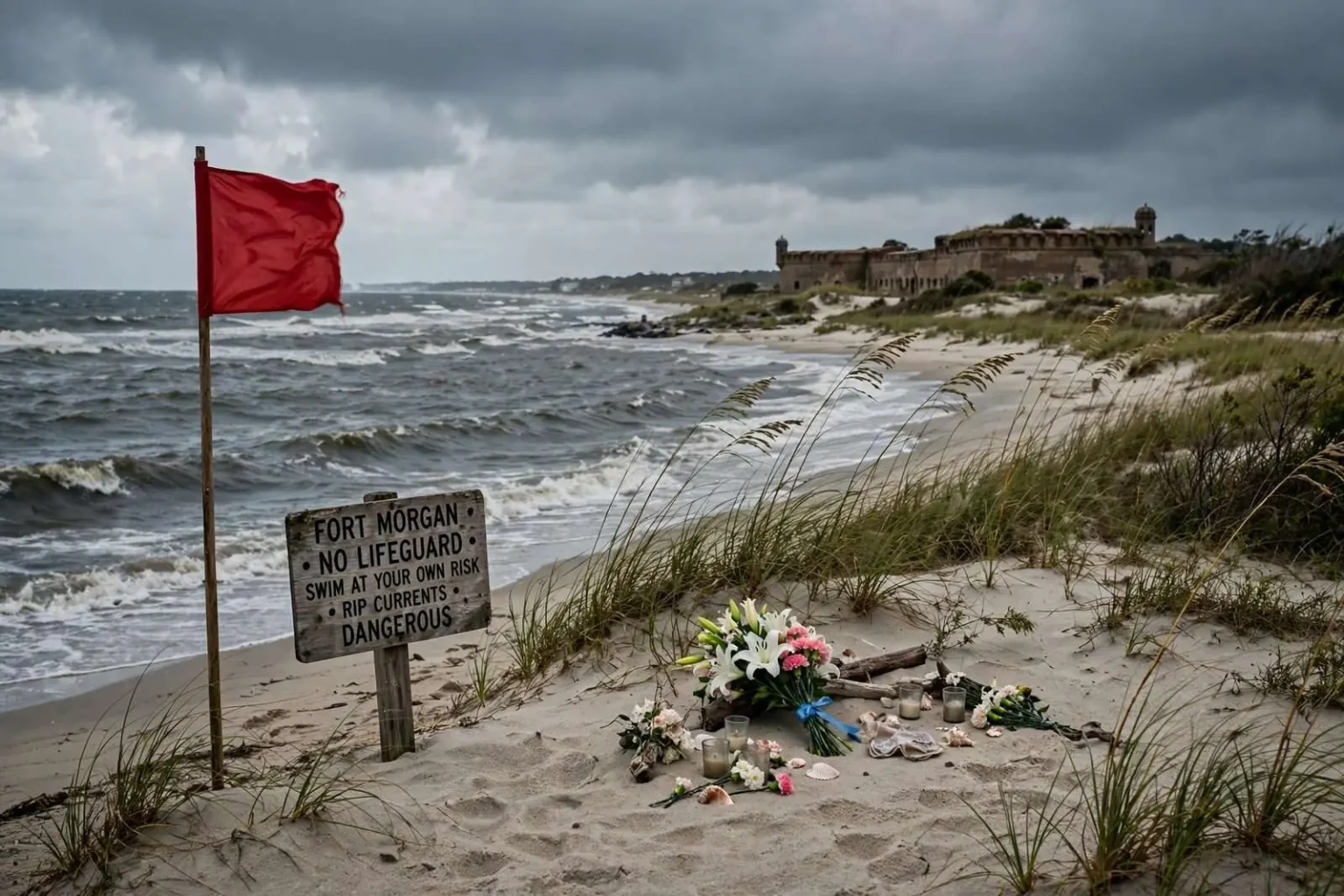
Unlike the public beaches east of it, the Fort Morgan area has no lifeguard stands and no centrally staffed beach access points. Its shoreline is lined with rental houses and old fortifications — including the historic Fort Morgan itself, the masonry work that guarded the bay’s entrance through the Civil War — and visitors swim at their own risk, relying on posted flags and their own judgment. When someone struggles in the water there, the first responders are usually the people standing on the sand.
That is the position Graham and roughly two dozen other beachgoers found themselves in. A human chain is one of the few tools available to civilians in a surf rescue: rescuers link hands and wade together, anchoring the line so the current cannot pull each individual out to sea. It is instinctive, it is brave, and it is fraught — the outermost members of the chain absorb the strongest pull, and when the line breaks or the surf overpowers it, rescuers become victims.
Graham, by her family’s account, took the outermost position. She was the first one in and the furthest out, and the surf threw her harder than anyone else in the line. Bystanders and responders pulled people from the water, but Graham did not survive. Her family’s account makes clear that the two swimmers the chain was trying to reach were young women, not the child some early descriptions described — a detail they wanted corrected for the record of how and why she died.
The dangers of Gulf surf — and what rescuers should know
The northern Gulf Coast’s beauty conceals a hazard that emergency officials repeat every season: rip currents, not sharks or storms, are the region’s deadliest beach hazard. A rip current is a narrow channel of water flowing from shore out to sea, formed when waves pile water between sandbars or against structures and it escapes seaward through a gap. The current does not pull a swimmer under — it pulls them away from the beach — but the instinct to fight it head-on exhausts swimmers quickly, and exhaustion leads to drowning.
The standard advice is counterintuitive: if caught in a rip current, stay calm, float, and swim parallel to the shore until free of the current’s grip, then angle back to the beach. The advice for would-be rescuers is just as clear, and just as often ignored in the moment — do not go in after a distressed swimmer. Throw them something that floats, call 911, and yell instructions to float and swim parallel. More than one rescuer has drowned attempting what Graham attempted, and the human chain method, however noble, has repeatedly produced multiple-victim emergencies on Gulf beaches.
For the Fort Morgan peninsula specifically, officials urge visitors to check the beach warning flags posted at public access points before entering the water: green for calm, yellow for moderate surf and currents, red for high hazard, and double red for water closed to the public. Purple flags warn of dangerous marine life. The flags are only useful if visitors read them, and on an undeveloped stretch like Fort Morgan — where the nearest lifeguard is miles away and response times run long — personal judgment carries the weight that staffing does elsewhere.
A family’s grief, and a legacy of instinct
Carrigan’s words carry the specific grief of a family that lost someone to a good impulse. Graham, at 54, was on one of the twice-yearly girls trips that had become a fixture of her calendar — the kind of getaway Gulf Coast rental owners host by the thousands each season, filled with beach chairs, shared meals and long afternoons by the water. That she stepped into the surf first, and furthest, did not surprise the people who knew her; it only deepened the loss.
Her death lands in a community that has seen this pattern before. Over the years, Gulf and Baldwin county beaches have recorded multiple deaths involving would-be rescuers — swimmers who saw someone struggling and went in, only to be caught by the same current. Emergency managers along the coast have built public campaigns around that lesson, urging beachgoers to reach, throw and row rather than wade in, and equipping access points with rescue tubes and call boxes where possible. Fort Morgan’s quiet, house-lined shore makes fixed equipment scarcer there than on the public beaches to its east.
For the two young women the chain was trying to save, the outcome hinged on the effort those beachgoers made. What is known from the family’s account is that roughly 20 people acted together without hesitation — a spontaneous effort that, whatever the cost, reflected the same instinctive decency Graham embodied. Her family wanted that part of the story told accurately: the risk was real, the intention was selfless, and the people she joined were trying to save two young women’s lives.
The weekend’s tragedy also renewed the questions that follow every such loss along the peninsula: whether flag postings and warning signage are prominent enough on the undeveloped stretches, whether visitors renting beach houses understand what a yellow or red flag means before they walk down the sand, and how to make rip-current awareness stick with the vacationers who arrive each week from Memphis, Atlanta, Nashville and beyond. Baldwin County officials and the National Weather Service offices that issue surf-zone forecasts along the northern Gulf have pushed those messages for years; incidents like this one are why they keep pushing.
What remains is a family’s grief and a coast’s hard lesson. Karen Graham came to Fort Morgan for a trip she took twice a year, in the company of friends, on a weekend that turned the tide against her. She went into the water farther and sooner than anyone else because someone needed help, and the mother who raised her says that was never in doubt. “We’ve just been numb,” Carrigan said — a sentence that holds both the shock of a sudden loss and the pride of a family that knows exactly what its daughter did at the edge of the surf.
For everyone who visits the Gulf Coast’s quieter beaches, the safety rules she died alongside are worth carrying: read the flags, know that rip currents flow seaward in narrow channels, float rather than fight, and remember that the bravest rescue is the one performed from shore with something that floats. The human chain at Fort Morgan showed how many strangers will act for one another. Graham’s death shows the price the water can exact when they do.