Family seeks answers after deadly Thomasville police chase crash
A Thomasville police chase ended in a fatal crash that killed three people. The victim's brother is asking what prompted the pursuit as ALEA investigates.
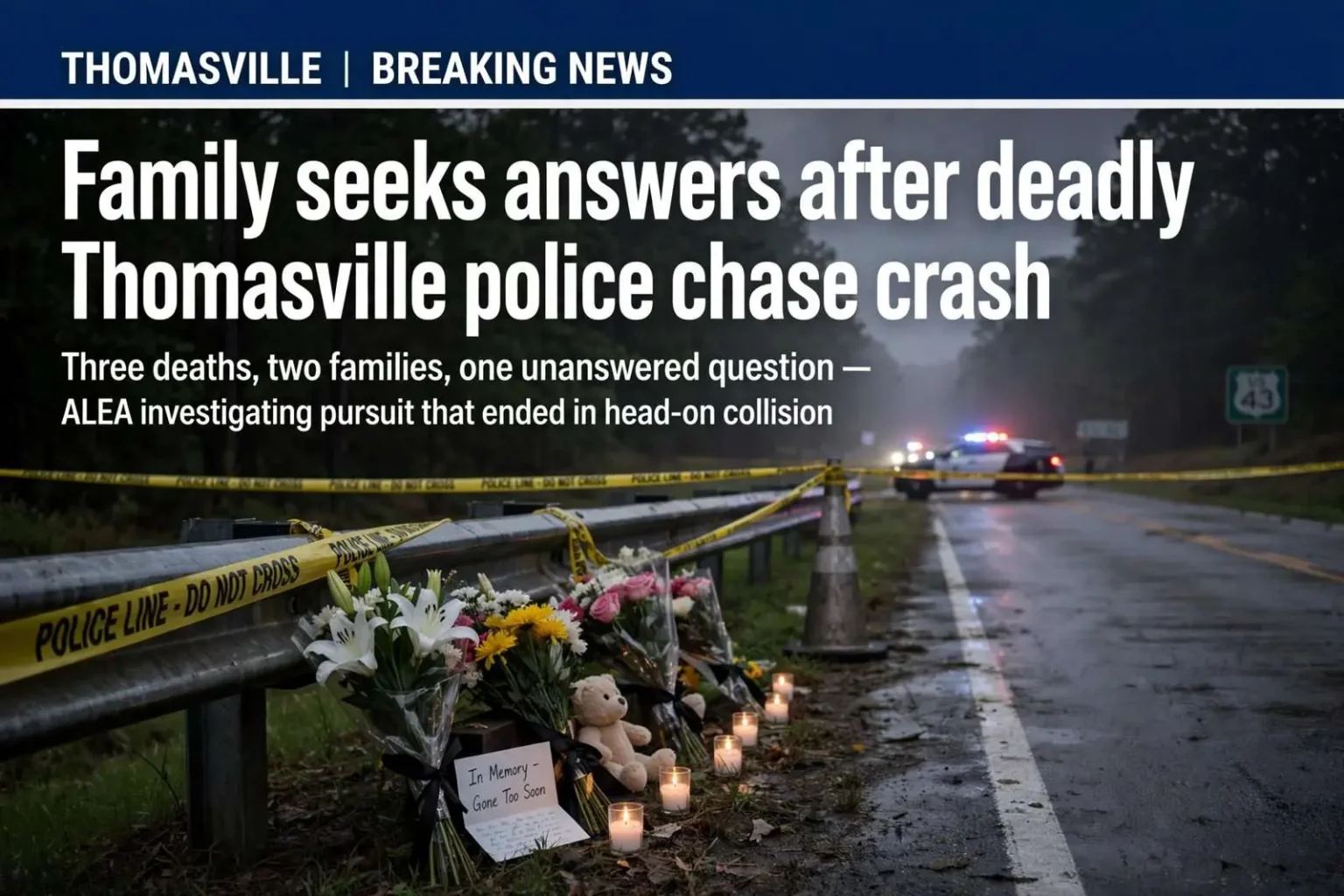
The family of a man who led Thomasville police on a chase that ended in a deadly head-on collision is calling for answers as the investigation continues.
Authorities say Christopher Pritchett fled from Thomasville Police last Friday night and ultimately struck a vehicle head-on. Megan Brunson and her mother, Wanda, were in that vehicle, and all three people — Pritchett, Brunson and Wanda — died in the crash.
Two other passengers, identified as Megan’s daughter Ava and her sister Alyssa, were also in the vehicle and remained in the intensive care unit at University Hospital in Mobile, according to the family.
Christopher’s brother, Jermaine Pritchett, said he wants to understand what prompted the pursuit and what happened to his brother. “This is senseless. This never should have happened,” he said.
The Alabama Law Enforcement Agency is reviewing the case, including dashboard and body-worn camera video from Thomasville officers. Thomasville Mayor Sheldon Day said the city turns such incidents over to ALEA to ensure a fair and honest evaluation.
Three deaths, two families, one unanswered question
The crash claimed three lives in an instant: the man authorities say led the chase, and two women whose only connection to it was being on the road that night. Megan Brunson and her mother, Wanda, died when the vehicle they occupied was struck head-on. In the same vehicle, Megan’s daughter, Ava, and her sister, Alyssa, were critically injured and remained in the intensive care unit at University Hospital in Mobile, where their family has kept watch since the crash.
The head-on collision is the deadliest outcome a pursuit can produce, and it drew two families into the same tragedy from opposite directions. The Pritchett family is grieving a brother and asking how the chase began and why it continued. The Brunson family is grieving two generations — a mother and her adult daughter — while two more of their own fight to recover in a Mobile hospital.
Jermaine Pritchett’s questions are the ones the investigation will have to answer: what prompted the pursuit, and what happened to his brother in the final minutes. His summary of the crash — senseless, never should have happened — speaks for both families’ grief, whatever the eventual findings show about the decisions made that night.
Why ALEA is investigating
The Alabama Law Enforcement Agency’s role in the case follows a practice that has become standard across the state: when a police pursuit ends in death, an outside agency takes over the review, including the dashboard and body-worn camera video from the officers involved. Thomasville Mayor Sheldon Day said the city turns such incidents over to ALEA to ensure a fair and honest evaluation.
The practice serves everyone involved. For the families, it removes the appearance of a city investigating its own police. For the officers, it provides a review conducted by investigators with no stake in the outcome. And for the community, it produces a record — videos, witness statements, data from the vehicles — that stands apart from local pressures in a small city where everyone knows everyone.
ALEA’s review will examine the elements that every pursuit investigation turns on: why the pursuit began, whether it followed department policy, how long it lasted, the speeds involved and the traffic conditions on the route. The dashboard and body-worn camera footage the agency is reviewing will anchor that reconstruction, along with physical evidence from the crash scene.
Findings from such reviews can take weeks or months. They may support the officers’ decisions, identify policy failures or lead to further review by prosecutors. In the meantime, the footage and records remain in the investigating agency’s hands rather than the city’s.
Thomasville and the weight of a small-city chase
Thomasville, the largest city in Clarke County, is a community of a few thousand residents along the U.S. 43 corridor in southwest Alabama. Its police department patrols a compact city where the distances are short — which makes a vehicle pursuit, and its deadly end on a nearby road, an event the whole community absorbs at once.
In small Alabama cities, a fatal crash tied to a police chase touches every institution at once: the police department, the city government, the churches that will hold the funerals and the school community connected to the victims. The victims’ identities — a mother, her adult daughter and two more family members fighting to recover — guarantee that the community’s grief and its questions arrive together.
Mayor Sheldon Day’s statement about handing the case to ALEA reflects both the practice and the politics of such incidents in small cities. Local leaders know that public confidence in the outcome depends on the review being seen as independent, and the transfer of the investigation is the clearest way to signal that.
The city’s daily policing continues while the review proceeds, but the crash leaves the department and the community in the position of waiting on answers that only the state agency’s investigation can supply.
The pursuit policy questions a review must answer
Vehicle pursuits present police departments with one of their most difficult risk calculations. The decision to chase weighs the seriousness of why the stop began against the escalating danger a fleeing vehicle creates for everyone on the road — the exact dynamic that ended here in a head-on collision that killed three people.
Pursuit policies across the country commonly address when a chase may begin, what factors must be continuously reassessed — speeds, traffic, weather, the known identity of the driver — and when it must be called off. Officers involved in pursuits are typically required to notify supervisors, and dispatchers coordinate with other agencies as the route develops.
ALEA’s review of the dashboard and body-worn camera video will place Thomasville officers’ decisions against that framework. Reviewers will reconstruct the timeline: the reason for the initial encounter, the moment the flight began, the duration and distance of the pursuit and the final seconds before the head-on impact.
The results of such reviews take time because the questions compound. There is the factual reconstruction — what happened, in order. There is the policy question — whether the pursuit complied with department rules and standard practice. And there is the legal question, reviewed by prosecutors when the facts warrant, of whether any criminal exposure exists.
For both families, none of that process returns what was lost. It determines, instead, what the record will say about the night a chase through Clarke County ended on a two-lane road with three people dead and two more in a hospital intensive care unit.
The families’ call for answers
Jermaine Pritchett’s public appeal captures the position both families occupy while ALEA’s review runs: they know the outcome — three dead, two hospitalized — but not the decisions that produced it. What prompted the pursuit? What did his brother do, and what did officers do, in the minutes before the crash? The videos the state agency is reviewing hold those answers, and the families’ call for them is likely to continue until the findings are released.
His words about the crash — “This is senseless. This never should have happened” — carry the anger of a family that lost a member to a chain of events it did not control, in a case where the other victims were strangers to him until that night. Families on both sides of pursuit crashes often describe the same disorienting arithmetic: a traffic matter, a flight, and then deaths no one anticipated.
Support networks around the two families have converged on University Hospital in Mobile, where Ava and Alyssa remained in intensive care. The hospital — the academic medical center serving southwest Alabama — receives the region’s most serious trauma cases, and the recovery of the two surviving passengers will be measured in weeks and months rather than days.
Community members in Thomasville and across Clarke County have followed the case closely, and the funerals ahead will gather the same neighbors now asking the questions the investigation is built to answer.
What comes next
The investigation’s next visible steps belong to ALEA. The agency will complete its review of the dashboard and body-worn camera video, reconstruct the crash, interview witnesses and compile its findings. Those findings will go to the appropriate authorities — and, at some point, to the families whose questions began this story.
The city of Thomasville, through Mayor Day, has committed to the process it follows in such cases: handing the review to the state to ensure a fair and honest evaluation. What that evaluation concludes — about the chase, the officers’ decisions and the crash itself — will shape the community’s understanding of the night and any changes the department makes afterward.
For now, the record stands where it began: a Friday night chase that authorities say began with Christopher Pritchett fleeing Thomasville Police and ended in a head-on collision that killed him, Megan Brunson and Wanda Brunson, and left Ava and Alyssa fighting to recover in a Mobile hospital.
The questions Jermaine Pritchett raised — what prompted the pursuit, what happened to his brother — are the same questions the Alabama Law Enforcement Agency’s review exists to answer. Until those findings arrive, both families, and the city where it happened, wait on the same evidence: the videos, the records and the reconstruction that will finally say what happened on the road that night.