Family trapped in storm shelter after Thomasville tornado; no injuries reported
A tornado damaged several homes in Clarke County, Alabama, trapping a family in a storm shelter; the EMA said no injuries were reported.
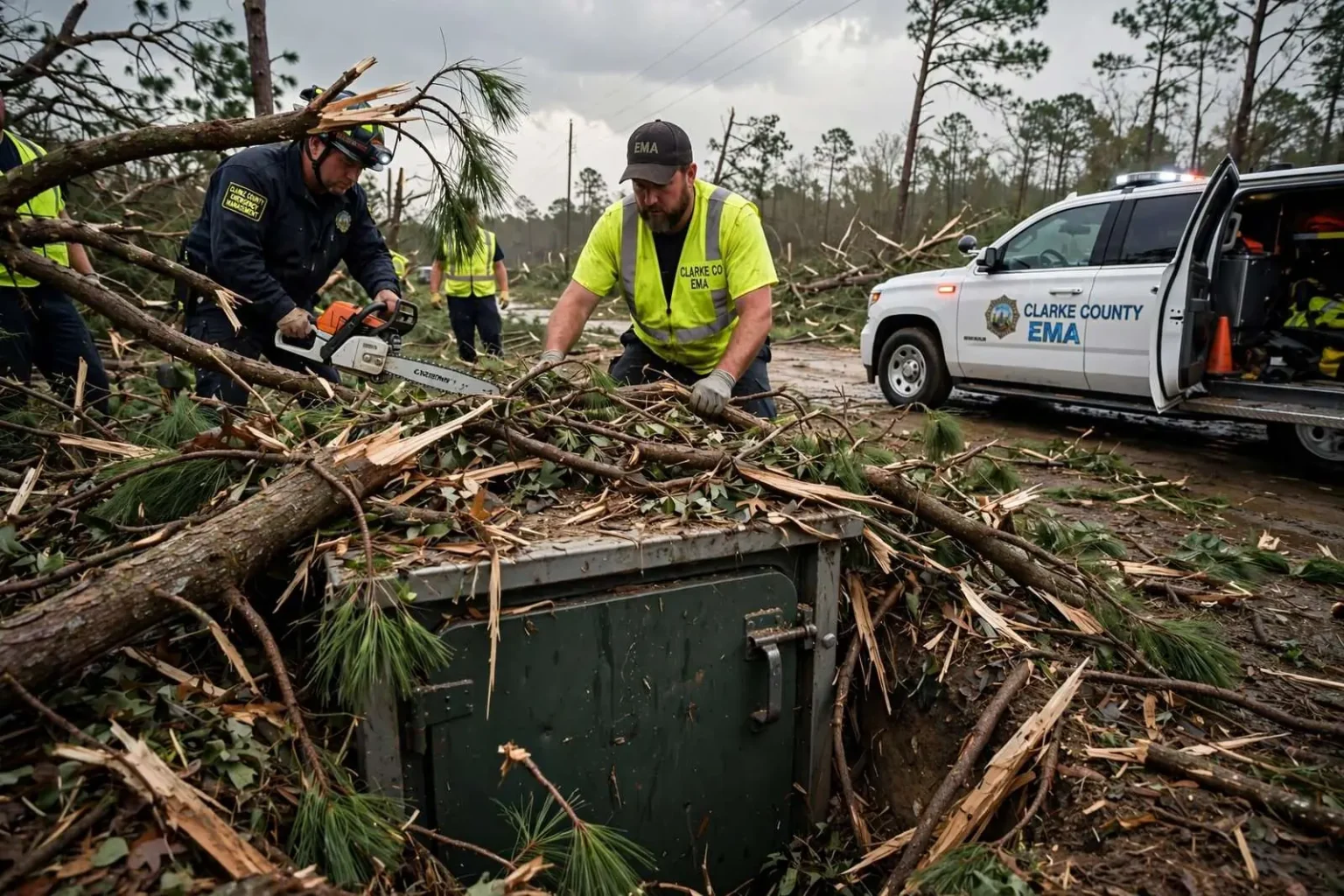
CLARKE COUNTY, Ala. — A tornado moved through Clarke County on Friday, damaging several homes and trapping a family inside their storm shelter as the storm passed overhead, according to emergency officials. The Clarke County Emergency Management Agency reported that rescuers were working to free the family from the shelter, which had become blocked as the tornado moved through the area.
Officials said one of the people inside the shelter was a pregnant woman, a detail that added urgency to the rescue effort. Despite the frightening scene, no injuries were reported anywhere along the storm’s path, and crews worked through the aftermath to make sure everyone affected was accounted for.
A Tense Wait Underground
Storm shelters are common across rural south Alabama, where families in tornado-prone communities have long relied on underground or reinforced shelters as a first line of defense. The devices are designed to protect occupants from wind and debris, but a tornado strong enough to flatten outbuildings can also drop trees, porch structures, and other wreckage across the shelter’s hatch or steps, sealing occupants in even when they are unharmed. That is the scenario emergency officials described in Clarke County, where the family inside could not get themselves out once the storm had passed.
Rescue crews responding to the scene worked to clear the way into the shelter and bring the family, including the pregnant woman, safely to the surface. The Clarke County EMA did not immediately provide a detailed timeline for the rescue, but officials confirmed that the effort was underway as damage assessment was only beginning across the county.
Widespread Tree Damage in Thomasville
In Thomasville, the largest city in Clarke County and the seat of county government, Mayor Sheldon Day said about 25 trees were blocking roadways after the storm moved through. Day said there was no major damage to homes in the city, an outcome he attributed largely to the debris falling across streets and rights-of-way rather than onto occupied structures.
One family’s mobile home did lose its roof and sustained significant damage, according to Day, but the family itself was safe. Mobile homes are among the most vulnerable structures in any tornado, and safety officials have spent decades urging residents of manufactured housing to identify a sturdy shelter location before severe weather arrives, whether that means a community shelter, a site-built neighbor’s home, or an underground storm shelter of their own.
Clarke County and Tornado Country
Clarke County sits in south-central Alabama, roughly midway between the capital in Montgomery and the Mississippi line, and its roughly 23,000 residents live across a patchwork of small towns, pine forests, and farmland. Communities including Thomasville, Grove Hill, and Jackson have all experienced destructive tornadoes over the years, and the county lies within the broad swath of the Southeast that researchers identify as part of Dixie Alley, a region with a pronounced risk of violent, long-track tornadoes.
Unlike the Plains, where tornadoes tend to occur on clear spring afternoons, Southeast tornadoes frequently strike at night, in the fall and early spring, and in hilly or forested terrain where warnings are harder to see coming. Those factors have made preparedness campaigns, weather radios, and storm shelters a sustained public safety priority for county emergency management offices across the region, including Clarke County’s.
The Role of the Emergency Management Agency
The Clarke County Emergency Management Agency is the coordinating body for disasters in the county, responsible for monitoring weather, activating warning systems, coordinating fire, rescue, and law enforcement responses, and conducting the damage assessments that determine what state and federal assistance might be requested. During a tornado event, the EMA serves as the central hub of information, relaying reports from firefighters, deputies, and municipal officials so that resources can be directed to the hardest-hit areas first.
Damage assessment after a tornado is more than an accounting exercise. The tallies compiled by county EMAs feed into declarations from the state and, in significant events, requests for federal aid through the Federal Emergency Management Agency. Even in events that fall below the threshold for individual assistance, documented damage helps counties compete for state grants and public assistance that reimburse debris removal and emergency protective measures.
Cleanup and Recovery Operations
Emergency crews continued to assess damage and clear debris from roadways as conditions allowed after the storm passed. Clearing roads is typically the first operational priority following a tornado in a rural county, because blocked routes prevent responders from reaching damaged homes, delay utility crews restoring power, and can leave stranded residents without a way in or out. County road departments and municipal crews often work side by side with fire departments on that task, moving fallen trees and downed limbs with chainsaws and heavy equipment.
Utility restoration follows closely behind. Tornadoes frequently snap power poles and pull down lines in the wooded areas that dominate the Clarke County landscape, and outages in rural south Alabama can stretch into days when damage is scattered across long distances of line. Residents are routinely urged to treat every downed line as live and to report outages rather than approaching damaged equipment.
Staying Safe When Warnings Are Issued
Emergency managers across south Alabama repeat the same core guidance each time severe weather threatens. Residents are encouraged to identify a safe place in advance, ideally a storm shelter, basement, or an interior room on the lowest floor of a sturdy building, and to put on shoes and a helmet before the storm arrives. Those in mobile homes are urged to plan to be elsewhere, since manufactured housing offers little protection in tornado-strength winds.
Multiple ways of receiving warnings are also emphasized, because sirens are intended to alert people who are outdoors and should never be the only source of information indoors. NOAA weather radios, smartphone alerts from the National Weather Service in Mobile, and local media coverage all provide redundant paths to the same warning, which matters most when storms arrive overnight or while families are asleep. Having a communication plan, including an out-of-area contact for family members to check in with, rounds out the standard preparedness advice.
Looking Ahead
As of the latest reports, the family trapped in the storm shelter was being freed, no injuries had been reported anywhere in the county, and crews remained on the scenes in Thomasville and the surrounding rural areas clearing trees and confirming the extent of the damage. County officials were expected to release further details about the number of homes damaged and the storm’s likely track as assessments continued into the evening.
For residents of Clarke County, the event served as a reminder that tornado season in Alabama is not confined to the spring, and that the counties of south Alabama face severe weather risk in nearly every month of the year. The absence of injuries, despite damaged homes, a destroyed mobile home roof, and a family briefly trapped underground, was the outcome every agency involved works toward.
How Tornadoes Are Confirmed and Rated
In the days after an event like Friday’s, the National Weather Service office responsible for the area typically conducts storm surveys to determine whether the damage was produced by a tornado, by straight-line winds, or by both. Survey teams examine the pattern of the destruction, the direction trees and structures fell, and the severity of the damage to assign a rating on the Enhanced Fujita scale, which runs from EF0 for minor damage up to EF5 for the most extreme. Those ratings matter for historical records, for engineering and building-code decisions, and for the public’s understanding of the risk in their own communities.
Clarke County’s terrain complicates both warnings and surveys. Heavy pine stands can hide funnel clouds from spotters and scatter debris across wide areas, and storms that track through unincorporated farmland may leave a damage path that crosses multiple roads with only scattered homes along it. Survey crews and county EMA staff often spend days canvassing such paths to account for every affected property, which is why preliminary damage counts frequently grow in the hours and days after a storm.
Support for Affected Families
Families whose homes are damaged in tornadoes have several avenues of help. Homeowners with insurance are urged to document damage with photographs before beginning temporary repairs and to contact their carriers promptly, since storm-related claims surge in the wake of any severe weather outbreak. For those without adequate coverage, the Alabama Emergency Management Agency can point residents to state programs, and voluntary organizations active in disasters, which include church groups and nonprofit relief agencies across south Alabama, frequently mobilize to provide tarps, tree removal, and rebuilding labor.
Local officials also remind residents to be wary of contractor fraud after storms, a persistent problem across the Gulf Coast. Damage victims are encouraged to verify contractor licenses, avoid large upfront cash payments, and get written estimates before signing anything. That advice is repeated by EMAs in every county along the tornado corridor because exploiters of storm damage are known to move quickly into affected areas.
A Community That Prepares
Friday’s events in Clarke County and Thomasville illustrated both the value of preparation and the gaps that remain. The family that took shelter underground likely saved themselves from injury by doing so, even though the storm then trapped them in place until rescuers arrived. The mobile home family that survived the loss of its roof unharmed got the same reminder in harder form. And the roughly 25 trees that came down across Thomasville’s roads showed how much damage a tornado can do without seriously hurting anyone, when the debris falls on asphalt instead of living rooms.
County and city crews were expected to continue debris operations until every roadway was passable, and the EMA was coordinating with municipal officials to complete damage assessments. Residents with storm damage were encouraged to report it to the Clarke County EMA so that the county’s totals remain complete, and officials said updated information would be shared as it became available.