FBI arrests Foley man on federal meth distribution charge
The FBI arrested Foley man Jonathan Howard Beck, also known as John Beck, on a federal charge of possessing methamphetamine with intent to distribute.
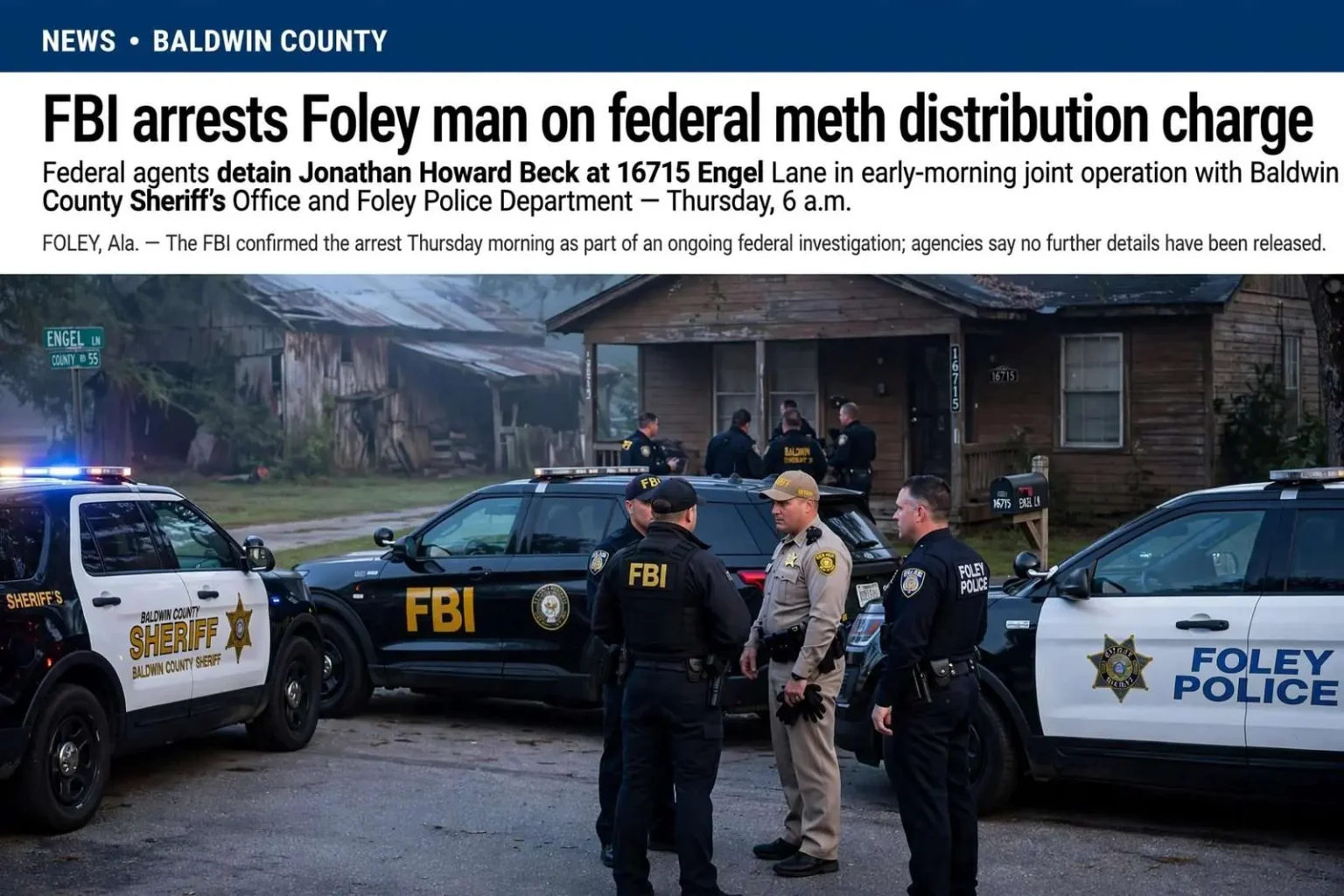
FOLEY, Ala. — Federal agents arrested a Foley man Thursday morning on a charge of possessing methamphetamine with intent to distribute, the FBI confirmed. The FBI said Jonathan Howard Beck, also known as John Beck, was taken into custody around 6 a.m. at 16715 Engel Lane in Foley. He is charged in federal court with possession with intent to distribute methamphetamine, the charge federal prosecutors most commonly bring when the amount of drug recovered and the surrounding evidence suggest supply rather than personal use.
The Bureau described the operation as an “enforcement action” carried out early Thursday near Engel Lane and County Road 55. Early-morning arrests of that kind are a deliberate tactic: agents typically move before dawn, when a suspect is at home and asleep, and the hour both maximizes the chance of taking a subject into custody without a pursuit and reduces the chance of confrontation. The timing — around 6 a.m. — and the FBI’s lead role in the arrest signal that the action was part of a federal investigation rather than a routine street-level apprehension.
The Baldwin County Sheriff’s Office and Foley Police Department assisted with the arrest, according to the FBI. Local and county participation is standard in federal enforcement actions inside city limits: the FBI supplies investigative authority and agents, while the local agencies contribute knowledge of the area, additional personnel and the logistical support that comes from departments that work the same streets every day. The involvement of both the sheriff’s office and the city police department pointed to a coordinated operation rather than a single-agency action.
What the charge means
A federal charge of possession with intent to distribute methamphetamine moves a drug case out of the state court system and into the U.S. District Court system, where penalties are structured by the quantity of drugs involved and, where applicable, a defendant’s criminal history. Prosecutors bringing such a charge must show that the defendant possessed the drug and that the circumstances — quantity, packaging, cash, scales, communications or other evidence — indicate an intent to sell rather than to use. The distinction drives everything that follows in the case, from the applicable sentencing range to the way the investigation is presented in court.
Federal methamphetamine cases have become a fixture of the court system in south Alabama, part of the broader enforcement picture across the Gulf Coast where the drug’s supply has grown in recent years. Cases are typically built by task forces and investigating agents over weeks or months, with the arrest coming at a point chosen by prosecutors and agents rather than at the moment of a traffic stop or a citizen complaint. The FBI’s confirmation that the arrest followed an “enforcement action” rather than a warrant service at the scene of an offense is consistent with that pattern of case development.
Beck’s arrest was the public’s first look at a case that will now proceed through the federal courts. An initial appearance before a federal magistrate typically follows an arrest within days, at which the charge is read, counsel is addressed and detention is considered. From there, the case moves through indictment and, if it is not resolved by plea, toward trial. The FBI said no further details about what was found have been released — a common posture at the arrest stage, when agents and prosecutors decline to detail evidence while an investigation remains open.
The scene on Engel Lane
The arrest drew attention in the neighborhood around Engel Lane, in the part of Foley near County Road 55 where the enforcement action took place. Neighbors told local media that people had been living in a barn on the property behind the home for months, an observation that became part of the account of a property that had evidently drawn concern in the area well before federal agents arrived before sunrise. Residents described the early-morning activity on the street as agents carried out the arrest.
For the residents of a residential street, the sight of a federal enforcement action is unusual by any measure. Foley, one of the fastest-growing cities in Baldwin County, is known for its outlet shopping district and its agricultural surroundings, and arrests carried out by the FBI with county and city support are not part of the city’s ordinary crime blotter. The presence of multiple agencies, the early hour and the location all marked the operation as something different from the municipal and county police work that usually fills the local docket.
Reports of people living in outbuildings are among the details that residents pass along in the kinds of cases that end in federal charges. Investigators evaluating suspected drug activity routinely look at who is coming and going from a property, and extended occupation of a structure that is not a dwelling — a barn, a shed, a camper — is the sort of condition that neighbors notice and report. What role, if any, the barn’s occupants played in the case has not been made public, and the FBI’s statement did not address them.
Federal-local drug enforcement in Baldwin County
The cooperation on display in the Foley arrest reflects the structure of drug enforcement in Baldwin County, where federal, county and municipal agencies work overlapping territory. The FBI’s field office responsible for the area coordinates with the Baldwin County Sheriff’s Office, whose deputies cover the county’s unincorporated roads, and with city departments like Foley’s, whose officers answer the calls that first surface many drug problems. Federal charges tend to enter the picture when the evidence supports them: larger quantities, supply networks, weapons or a defendant whose case fits federal priorities.
The county’s rapid growth has changed the enforcement landscape. New residential subdivisions and commercial corridors have spread across areas that were rural within recent memory, and the drug trade has followed the population. Law enforcement leaders in the region have consistently described methamphetamine as a persistent threat, one that consumes investigative resources across every level of the justice system, from municipal patrol officers through the U.S. Attorney’s office. An arrest like Thursday’s, in a growing city’s residential section, illustrates how far into ordinary neighborhoods the trade reaches.
The agencies’ division of labor in such operations is well established. The FBI brings federal legal authority, investigative manpower and the option of federal prosecution; the sheriff’s office and city police bring local knowledge, area coverage and continuity — the ability to follow up in the neighborhood after the agents leave. The FBI’s public acknowledgment of both agencies’ assistance followed the customary practice of crediting local partners in joint operations, and it identified the range of law enforcement that had a hand in the morning’s work on Engel Lane.
What comes next in the case
From the moment of the arrest, Beck’s case belongs to the federal courts. The charge of possession with intent to distribute methamphetamine will be presented to a federal grand jury for indictment, and the defendant will make an initial appearance before a magistrate judge where the government’s detention request will be considered. In federal methamphetamine cases, prosecutors typically ask that a defendant be held pending trial, arguing that drug charges carry both a strong incentive to flee and, in many cases, a presumption in favor of detention under the federal bail statute.
The information the public has at this stage is deliberately limited. The FBI’s statement confirmed the arrest, the charge and the assistance provided by the Baldwin County Sheriff’s Office and the Foley Police Department, and said that no further details about what was found have been released. The quantity of methamphetamine alleged, the evidence of distribution and the full account of the investigation will surface, if at all, in the government’s filings and at the trial or plea proceeding — not in the announcement of an arrest.
That restraint is standard practice, and it serves the investigation as well as the prosecution. Enforcement actions like the one on Engel Lane are frequently one step in a broader inquiry, and details released too early can compromise cooperating sources, ongoing surveillance and any related cases still being developed. The weeks after an arrest are when investigators complete the work that turns an enforcement action into a provable case, and the silence that follows an announcement like the FBI’s is usually the sound of that work continuing.
The wider fight against meth in south Alabama
Thursday’s arrest in Foley fits into the enforcement picture that south Alabama’s prosecutors and sheriff’s offices describe in nearly identical terms: methamphetamine is the region’s dominant drug problem, and the response is built on cooperation among agencies. Federal prosecutions remove the largest suppliers from circulation for long sentences, while state and local enforcement works the street level, and both rely on residents who report the activity they see in their own neighborhoods — the traffic, the outbuildings occupied by unknown occupants, the properties that draw repeated visits.
The neighbors’ account of the barn behind the Engel Lane home is a reminder of how those cases often begin: not with an agent’s surveillance, but with the observations of the people who live nearby and the patience of the investigators who act on them. The months during which residents reported people living in the structure behind the home were, in all likelihood, months in which a case was being assembled — the same pattern that plays out in federal drug investigations across the Gulf Coast, wherever a complaint about a single property becomes a case in U.S. District Court.
For now, the record in the case consists of the essentials: Jonathan Howard Beck, also known as John Beck, arrested around 6 a.m. Thursday at 16715 Engel Lane in Foley, charged in federal court with possession with intent to distribute methamphetamine, with the FBI leading the enforcement action near Engel Lane and County Road 55 and the Baldwin County Sheriff’s Office and Foley Police Department assisting. The rest — what the search found, what the investigation established, what sentence the charge carries — belongs to the federal courthouse, where the case moves now.