Federal red snapper season in the Gulf cut to nine days
Federal managers limited the 2014 Gulf of Mexico red snapper season to nine days, drawing criticism from Alabama anglers and Rep. Bradley Byrne.
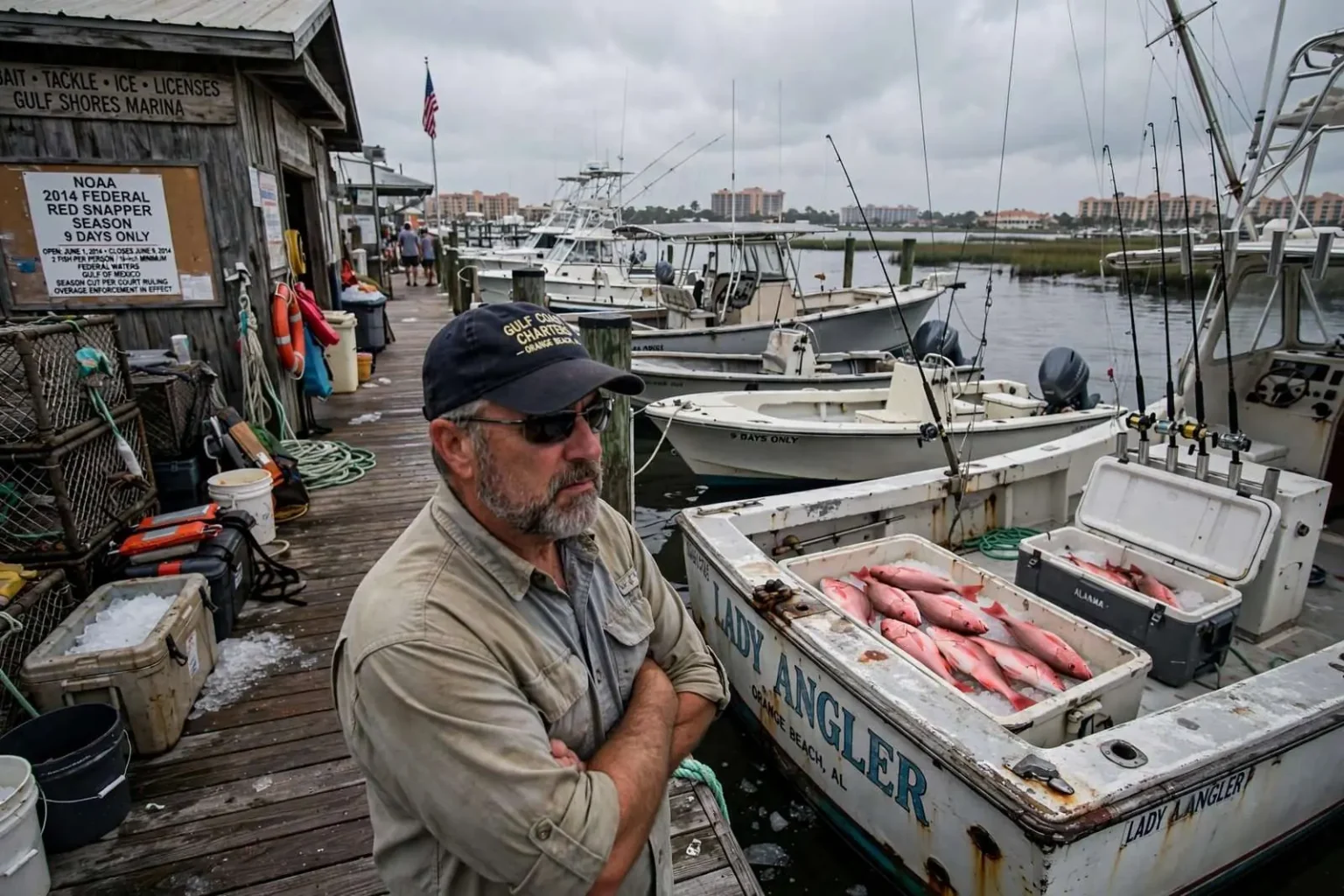
Federal managers sharply limited the 2014 red snapper season in the Gulf of Mexico to just nine days, frustrating Alabama anglers and coastal communities who say the science behind the restriction is flawed. The National Oceanic and Atmospheric Administration announced the shortened season, which opens June 1 with a two-fish bag limit and a 16-inch minimum size. The move follows a federal court ruling that recreational anglers had exceeded their share of the quota in six of the past seven years. For a fishery that anchors much of the summer economy from Dauphin Island to Orange Beach, a season measured in days rather than months landed like a blow.
Red snapper are the marquee catch of the Gulf recreational fleet, and nowhere is that more true than along the Alabama Gulf Coast. The state’s decades-long artificial reef program has built one of the richest reef complexes in the Gulf, and charter boats, head boats, and private anglers from Gulf Shores, Orange Beach, and Mobile Bay have long depended on a dependable summer snapper season to fill their trips. When the federal window shrinks to nine days, every part of that chain feels it — boat ramps, bait shops, marinas, fish houses, and the restaurants that serve visiting anglers.
The 2014 federal season
Under the announcement, the recreational season in federal waters — the zone beyond the states’ nearshore jurisdiction — opens June 1 and closes after nine days, with anglers allowed two red snapper per person per day and a 16-inch minimum size limit. The federal sector applies to waters where the Gulf of Mexico Fishery Management Council and NOAA manage reef fish, while each state retains authority over its own nearshore waters. That split has become the central fault line in the snapper debate, because fish do not recognize the boundary between state and federal zones.
The shortened season was not simply a management choice. It flowed from a federal court ruling that found recreational anglers had exceeded their allocated share of the red snapper quota in six of the previous seven years. Under the Magnuson-Stevens Fishery Conservation and Management Act, the nation’s primary fisheries law, repeated overruns trigger accountability measures that shorten the next season to hold landings within the cap. Managers applied those measures strictly, leaving the recreational fleet with one of the shortest federal seasons the fishery had seen.
The result is a window so compressed that virtually the entire recreational fleet heads offshore at the same time. Charter captains report that every legal day becomes a race, with boats stacked over the same public reefs and party trips booked solid from dawn to dusk. Anglers worry that a nine-day season concentrated in early June also collides with weather, since a single stretch of rough seas can erase a large share of the fishing days available to people who must plan vacations and book charters weeks in advance.
A quota system under fire
Dr. Bob Shipp, a member of the Gulf of Mexico Fishery Management Council and chairman of marine sciences at the University of South Alabama, said the real problem is the quota system itself. Because snapper are large and abundant, anglers blow through weight-based limits almost immediately, he said, so even a 30 or 40 percent quota increase would add only a few days. His argument cuts against the instinct of simply raising the cap: if catch rates remain high, a bigger quota still converts into a short calendar because fishermen reach the poundage target faster than managers can reopen the fishery.
The biology helps explain why. Red snapper gather in dense concentrations around structure — natural hard bottoms, petroleum platforms, and the thousands of artificial reefs scattered off Alabama’s coast — and they are aggressive, willing strikers that are not difficult to hook once a boat is positioned over fish. Modern electronics make those gatherings easy to find, and release mortality adds a further wrinkle, since fish caught deep in warm summer water often do not survive even when anglers throw them back. The consequence is that poundage accumulates far faster than the quota anticipated, and the season collapses to match.
How the fish are counted
U.S. Rep. Bradley Byrne and others in the recreational fishing industry argue the methods NOAA uses to count red snapper are unreliable and not reflective of a healthy population. Recreational landings are estimated through survey systems that combine mail and telephone effort surveys with dockside intercept sampling, a method critics say was never designed for a fishery with millions of trips and a short, fast-paced season. Small errors in estimating the number of trips or the average catch per trip multiply across the fleet, and with a quota set in pounds, those errors translate directly into days on the calendar.
Byrne said the federal framework is broken and called for returning management to the states. That position reflects a broader movement among Gulf Coast delegations, who argue that the states have demonstrated the ability to manage inshore and nearshore fisheries responsibly and that federal managers are working with data too coarse to reflect what anglers see on the water. Critics of the current system point to the disconnect between anecdotal reports of plentiful snapper and a rigid federal accounting that treats every extra pound as evidence of a problem rather than a sign of recovery.
The dispute over the data has grown more pointed as the fishery has changed. Anglers and some scientists contend the stock has rebounded substantially since the deep cuts of earlier management plans, while federal assessments have remained more cautious, citing uncertainty about how many fish live in un surveyed habitat and how many are removed by discards. Each side reads the same season outcomes differently: managers see quota overruns as proof of bad estimates by anglers, while fishermen see overruns as proof that the underlying population estimates are too low.
States chart their own course
Louisiana and Florida have set their own longer state-water seasons that do not follow federal rules, deepening the divide between state and federal management of the fishery. Both states extend their authority well beyond the narrow federal nearshore band and have deliberately kept snapper fishing open longer inside their boundaries, gambling that their own assessments justify the extra opportunity. For anglers in those states, the practical difference is immediate: a fish caught inside state lines is governed by state rules, no matter how brief the federal season runs just offshore.
That patchwork has real consequences for Alabama, whose state waters reach only three nautical miles from shore. Alabama anglers can fish state waters under state rules, but the bulk of the productive reef habitat — including the sprawling artificial reef zone the state has built over decades — lies in federal waters where the nine-day limit controls. Boats based in Gulf Shores and Orange Beach cannot simply shift their effort inside the state line, because the structure that holds snapper sits beyond it. That geography, more than anything, explains why the shortened federal season stings harder in Alabama than in states with broader jurisdictions.
The split also creates enforcement and fairness questions that managers have struggled to answer. A boat leaving a harbor can cross from one legal regime to another within minutes, and determining where a fish was caught is difficult once the run home begins. State officials in Louisiana and Florida argue their longer seasons simply reflect the reality that the stock can support more harvest, while federal officials warn that inconsistent rules undermine the catch levels that have rebuilt the stock and expose the fishery to legal challenge.
What it means for the coast
The compressed season ripples through coastal economies well beyond the charter fleet. Marinas that service transient boats, tackle shops that stock bait and ice, hotels and vacation rentals that fill with fishing families, and tournament organizations that anchor their calendars to the summer season all depend on having enough open days to spread demand across the season. A nine-day window concentrates that spending into a single burst, leaving little flexibility for weather delays or family schedules, and some events that depend on open seasons are forced to adjust or risk folding entirely.
Charter operators describe a squeeze on both ends of the business. Trips must be booked into a handful of guaranteed days, which means the boats that survive are the ones that can fill every hour, and customers who wait too long find the season closed before they ever get offshore. Crews feel pressure to run farther and fish faster, and safety officials have long cautioned that compressing effort into fewer days puts more boats across more bars and inlets in a shorter span of time.
Consumers feel the effect too, though indirectly. Local seafood markets depend more heavily on commercial harvests, which operate under separate rules and a year-round or longer season, but the cultural presence of red snapper on the coast is tied to the recreational experience. For communities that market themselves to visiting anglers, a shrinking season is a shrinking invitation, and business owners along the coast argue the federal framework undervalues the economic engine the fishery supports when it is open.
The road ahead
Advocates for change are pushing several directions at once. Some back legislation in Congress that would shift management authority for certain reef fish from the federal government to the Gulf states, allowing each state to set seasons and bag limits in both state and federal waters off its coast. Others favor reforming how recreational catch is counted, arguing that better data collection — more dockside sampling, electronic reporting for charter vessels, and modernized survey methods — would produce estimates accurate enough to lengthen seasons without threatening the stock. Still others want the accountability measures softened so that a single overage does not automatically carve days from the following year.
The Gulf of Mexico Fishery Management Council, the body that drafts the federal rules, sits at the center of that debate, and its members must balance the law’s requirement to prevent overfishing against the political reality of a coastal constituency that has lost patience. Shipp’s presence on the council gives Alabama a voice in that conversation, and the argument he advances — that the structure of the quota system, not just its size, is the problem — has increasingly shaped the regional discussion about how a rebuilt fishery should be allocated and measured.
For the 2014 season, the practical advice for anglers is straightforward: know the dates before leaving the dock, verify the current rules rather than relying on last year’s, measure every fish against the 16-inch minimum, and keep accurate counts of the two-fish daily limit. Anglers who catch snapper in state waters should confirm which rules apply to where they actually fished, and charter customers should book early and build in a weather margin, since a nine-day season offers no make-up days.
Beyond this season, the fight is likely to define Gulf fisheries politics for years. The recreational community enters the debate with unified congressional support, working examples of state management in Louisiana and Florida, and a stock that many believe is healthier than the federal numbers admit. Federal managers enter with a legal obligation to keep harvest within scientifically set limits and a court ruling affirming that obligation. Bridging that gap — with better data, clearer authority, or a restructured quota — is the work ahead, and until it happens, Alabama anglers will continue to face a season measured in days and a summer measured in frustration.