‘Fill the Bus’ School Supply Drive Serves Saraland-Area Students
A weekend school supply drive held at a Saraland Walmart collected donations benefiting roughly ten Mobile County schools ahead of the new school year.
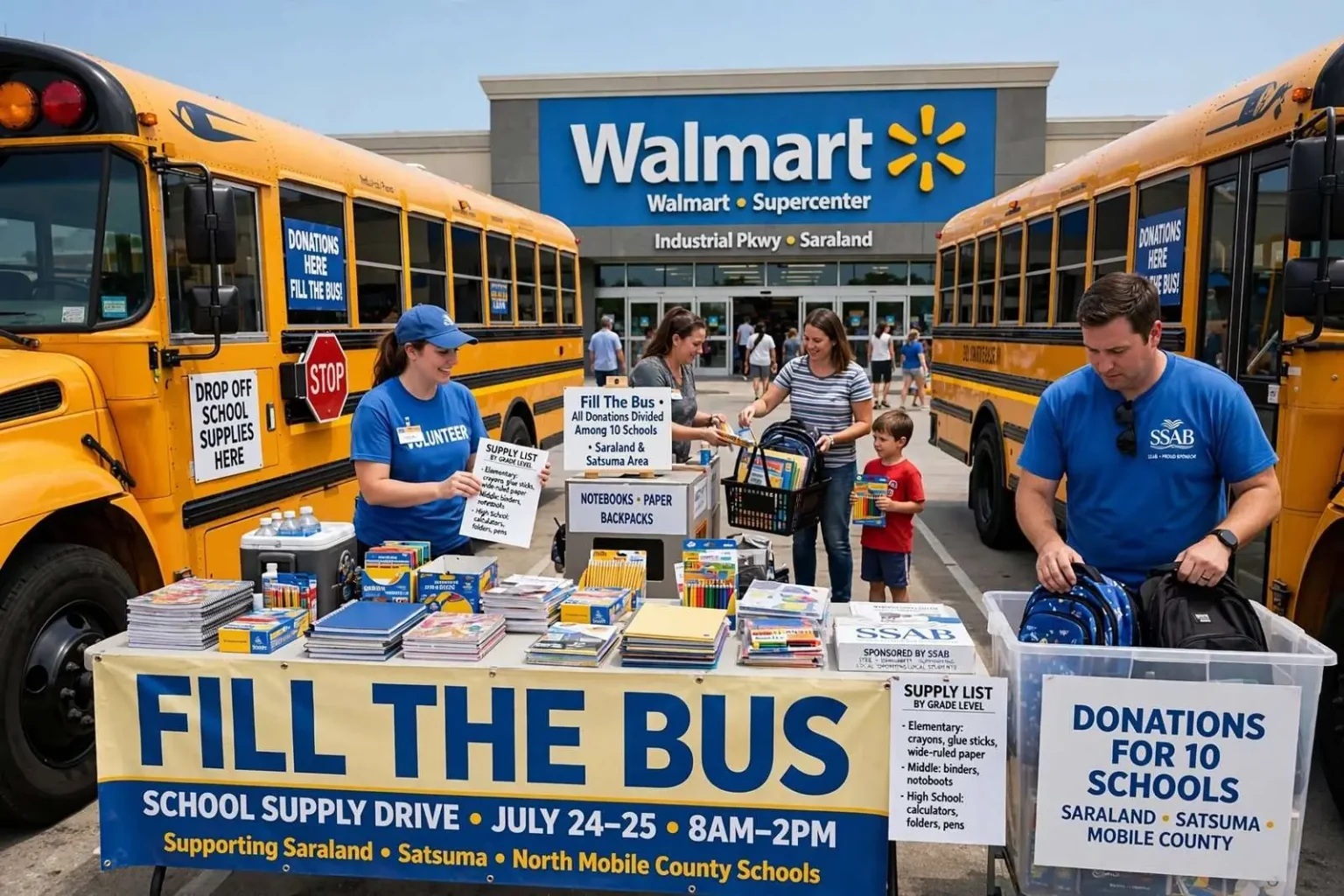
Families across Saraland and the surrounding Mobile County area got a chance to head into the new school year with a little less financial stress this summer, thanks to a community-driven school supply drive called “Fill The Bus.” The two-day event ran from 8 a.m. to 2 p.m. on Friday, July 24, and Saturday, July 25, in the parking lot of the Walmart on Industrial Parkway in Saraland. The format is about as simple as charitable giving gets: a retail parking lot, a couple of school buses, and a steady stream of shoppers willing to add a pack of pencils to their cart.
Organizers parked two full-size school buses outside the store with a simple goal: fill them both with donated supplies before classes resumed. Shoppers were encouraged to either bring supplies from home or pick items up right there in the store, making it easy to give without much extra planning. The buy-on-site approach is what separates this kind of drive from drop-off donations collected at churches or schools — a shopper who forgot to prepare can still participate on the spot, and the store’s back-to-school inventory guarantees the donations match what classrooms actually need.
Volunteers staffed tables near the entrance throughout the weekend, handing out supply lists tailored to different grade levels and collecting whatever shoppers were willing to donate, from notebook paper and pencils to backpacks and folders. The lists served double duty, guiding donors toward the most useful items while reminding shoppers heading inside of what their own children’s classrooms were about to require. The drive was structured so that anyone stopping in for their own errands could contribute in just a few minutes without disrupting their day.
One parking lot, ten schools
What set this particular collection apart was the scale of its distribution network. Rather than benefiting a single school, donations gathered during the weekend were divided among roughly ten schools spanning elementary, middle and high school grade levels across Mobile County, including campuses in Saraland and Satsuma. That reach meant a single trip to one Walmart parking lot translated into support for students throughout the broader north Mobile County school community, an area that includes a mix of suburban and rural households where back-to-school costs can strain family budgets.
The multi-school model changes the economics of a supply drive. A collection aimed at one campus can be overwhelmed by a good weekend; a collection spread across ten campuses absorbs volume evenly and puts useful supplies in front of counselors and teachers at schools of every size. Dividing the haul by grade level also matters, since an elementary classroom’s needs — crayons, glue sticks, wide-ruled paper — look little like a high schooler’s binders and scientific calculators. Coordinating that distribution across district lines is the quiet logistical work that determines whether a drive’s generosity actually reaches the students who need it.
Corporate backing from a hometown employer
The drive was made possible through sponsorship from SSAB, the steel manufacturer that operates a mill in nearby Axis. Corporate involvement from a major area employer helped underwrite the logistics of the event, including the coordination needed to get two school buses parked, staffed and later routed to drop off collected goods at each participating school. The company’s role illustrates how industrial employers along the Mobile River corridor increasingly plug into community life in the small towns that surround their operations — Axis, Satsuma, Saraland and the other north Mobile County communities that supply much of the workforce for the region’s heavy industry.
For SSAB, a school supply drive is a natural fit for community investment: it touches employees’ own children, requires no specialized program to administer, and produces visible results within weeks. For the schools, corporate sponsorship covers the costs that volunteer efforts typically can’t — bus scheduling, signage, printed lists and the transportation of pallets of notebooks to a dozen campuses.
Why supply drives have become an August ritual
Back-to-school supply drives like this one have become an annual fixture in many South Alabama communities, filling a gap for families who face added expenses each summer as school lists grow to include everything from basic pencils to specialty technology items requested by individual classrooms. The cost of a fully stocked backpack has climbed well past what many households can absorb in a single week, particularly for families with several school-age children. A family with three students can face well over a hundred dollars in list items before clothes, shoes and fees are counted — expenses that land in the same stretch of summer as utility bills at their seasonal peak.
For teachers, community donations of this kind often mean fewer supplies purchased out of pocket once the school year begins. Surveys of the teaching profession have consistently shown educators spending their own money on classroom materials, and while no public figure attaches to this particular drive, the dynamic it addresses is familiar to every campus: when a child arrives without paper or a backpack, the gap gets filled by whoever is standing in front of the classroom. Stocking school counselors with a reserve of donated supplies means those gaps get filled from a closet rather than a paycheck.
The case for low-barrier giving
Organizers framed the event as a simple, low-barrier way for area residents to support local students without needing to coordinate directly with individual schools or teachers. That design philosophy matters more than it might appear. Charitable participation rises sharply when the act of giving takes less than five minutes and requires no commitment beyond a single shopping trip. Positioning volunteers at the entrance of a store that thousands of north Mobile County residents visit anyway converts ordinary weekend traffic into donations that no amount of direct-mail appeals could match.
By concentrating the effort at a single, well-trafficked retail location over a single weekend, the drive aimed to make giving as convenient as possible while still generating enough donated material to meaningfully help students across multiple campuses as the new academic year approached. The timing was deliberate as well. A late-July collection puts supplies in school hands before the first day, when need is highest and teachers are setting up classrooms, rather than arriving weeks into the semester when routines have already formed.
The community behind the buses
Events like Fill The Bus also serve a social function that goes beyond the supplies themselves. The sight of a school bus parked outside a grocery or retail store is a familiar one across Saraland, Satsuma and the surrounding communities, and the weekend gives residents a visible, shared moment of investment in the coming school year. Volunteers staffing the tables included local residents giving up part of their weekend, and the interactions at those tables — handing a list to a shopper, thanking a child who picked out a backpack for another student — are the kind of small civic exchanges that build the habit of giving across a community.
As the new school year opened across north Mobile County, the donations gathered over those two days were already being routed to the campuses they will serve. For the roughly ten schools that share in the collection, the drive’s value will show up quietly: a counselor with supplies on hand when a family asks for help, a classroom closet stocked before October, and a few dozen students starting the year with the tools on their grade-level list rather than without them.
How north Mobile County’s schools fit together
The drive’s footprint covers a part of the county where school community boundaries weave together tightly. Saraland operates its own city school system, Satsuma broke away to form its own district in recent years, and the remaining campuses in the area fall under the Mobile County Public School System — meaning a single weekend of donations crossing all of those lines requires coordination among multiple central offices. That the organizers pulled it off with two buses and a parking lot speaks to how practical the model is, and to how much of the region’s school supply need concentrates in a handful of ZIP codes along the U.S. 43 and Highway 158 corridors.
The area’s mix of household types is part of what drives demand. North Mobile County includes rapidly growing suburban subdivisions around Saraland and Satsuma alongside long-established rural communities closer to the Mobile River, where the distance to a retail store alone can make back-to-school shopping a half-day errand. Families in those outlying areas are exactly the ones least able to make an unplanned supply run mid-semester, which is why getting the donations to each campus before the first bell matters so much.
For the volunteers and sponsors who staged the event, the measure of success was simple: two buses full, ten schools served, and hundreds of north Mobile County students starting the year with what their lists asked for. On all three counts, the Fill The Bus drive delivered.