Filmmaker and Gulf Shores Police Give Conflicting Accounts of Beach Confrontation
Filmmaker Marguerite Cravatt says a Gulf Shores officer harassed her while she filmed an ambulance call; police say she interfered with patient care.
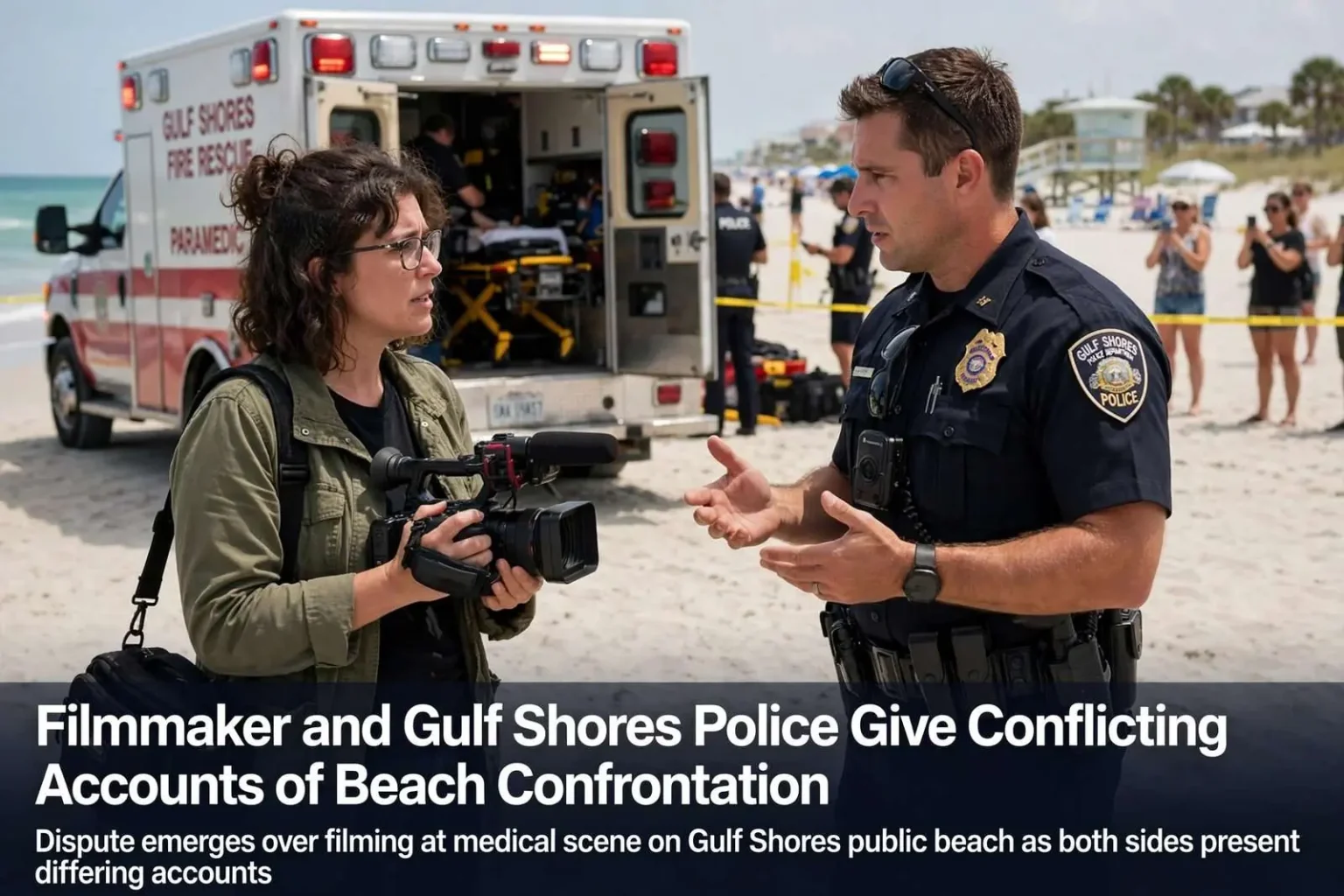
A filmmaker and the Gulf Shores Police Department are offering sharply different accounts of an encounter that unfolded on the city’s public beach as officers and paramedics responded to a medical call.
Filmmaker Marguerite Cravatt said she was recording an ambulance crew responding to an emergency at the public beach when she was confronted by a Gulf Shores police officer. Cravatt posted video of the exchange online and said the officer’s conduct toward her amounted to harassment.
The incident quickly drew attention precisely because it sits at the intersection of two matters the public watches closely: how police officers treat people who film them, and how emergency responders manage crowds at the scene of a medical call. Video of police encounters spreads rapidly on social media, and disputes like this one are increasingly argued in public before any official account of what happened emerges.
Gulf Shores’ public beach is one of the most heavily visited stretches of sand on the Alabama Gulf Coast, drawing tourists from across the region throughout the year. The city’s police department patrols the beach and the surrounding tourist districts, where the mix of large crowds, alcohol-related calls and medical emergencies keeps officers and fire-medical units busy — particularly during peak season, when the population of the barrier-island city swells far beyond its year-round resident base.
Medical calls on the beach are routine work for Gulf Shores first responders. Heat illness, water rescues, injuries and cardiac events send paramedics onto the sand regularly, and the responses unfold in public view — on a beach crowded with bystanders, many of whom carry phones capable of recording everything that happens.
Police cite interference and privacy concerns
The Gulf Shores Police Department disputed Cravatt’s characterization of the encounter, saying she interfered with first responders who were actively treating a patient. Department officials also said her filming violated the privacy of the person receiving medical care in the ambulance.
Those justifications rest on principles that emergency responders apply at scenes everywhere. Paramedics and EMTs working on a patient need space and freedom from distraction; a bystander standing close enough to film can physically obstruct movement around the ambulance and force crews to divide their attention between the patient and their surroundings. Emergency scenes are dynamic environments, and responders describe even well-meaning bystanders as a factor they must actively manage.
The privacy argument addresses a different concern — one that medical professionals have raised with growing insistence in the smartphone era. A person receiving emergency care in the back of an ambulance is in a vulnerable and exposed state, often unconscious or unable to consent to being recorded. Images of that moment, once posted online, can circulate to family members, employers and strangers before the patient has even been discharged, and medical privacy expectations do not evaporate because the emergency happened in a public place.
The competing accounts leave key questions about the encounter unresolved, including how close Cravatt was standing to the medical response and what, if anything, was said between her and the officer before video began circulating publicly. Those details matter to any assessment of the encounter: the law gives photographers considerable latitude in public spaces, but it does not license interference with an active emergency, and the line between the two often turns on distance, positioning and the specific instructions given at the scene.
Broader questions about filming public officials
The dispute touches on a recurring tension in public spaces: the right of bystanders to record police and emergency personnel performing their duties versus the need for first responders to work without interference, particularly when a patient’s privacy is involved.
Courts have consistently affirmed that recording police and other public officials conducting official duties in public is protected activity, and that officers may not order a bystander to stop filming or seize a recording device without cause. The principle has been affirmed repeatedly in federal courts, and police departments across the country have updated their policies to acknowledge the public’s right to record.
But the right to record is not unlimited in practice, and emergency scenes test its boundaries more than almost any other situation. A medical call involves a patient who has not consented to publicity, responders who need unrestricted access to their work area, and decisions made in seconds under pressure. Officers managing such scenes must balance the public’s recording rights against the immediate needs of the person being treated — a judgment call that looks different depending on which side of the camera it is viewed from.
Beachfront communities like Gulf Shores face these situations regularly during tourist season, when a single medical call can unfold in front of hundreds of bystanders on a crowded strand of public sand. The city’s public beach is one of the most heavily visited in Alabama, and the volume of people — and phones — concentrated there means every significant response happens in front of an audience.
No charges or formal complaints tied to the incident have been publicly detailed by either side. The Gulf Shores Police Department has not indicated whether it plans any internal review of the officer’s conduct, and without such a review, the competing accounts are likely to stand as the final public record of the encounter — Cravatt’s video and characterization on one side, the department’s statement on the other.
What the dispute leaves behind is a question that coastal communities will keep confronting as long as phones are present at every emergency: where, exactly, the line sits between the public’s right to document its government at work and the responders’ need to do that work without interference — and who gets to decide, in the moment, where it falls.
The legal landscape around filming police has been shaped by a decade of litigation. Federal appellate courts have held that the First Amendment protects the recording of on-duty officers in public, and several departments have paid settlements after confiscating phones or arresting people who filmed them. Those precedents have made departments cautious about directly ordering bystanders to stop recording, shifting disputes like the Gulf Shores encounter toward questions of interference and scene management rather than the recording itself.
At the same time, courts have recognized that officers may establish reasonable perimeters around emergency scenes and direct crowds as needed to protect those being treated and the personnel treating them. The practical rule that has emerged is roughly this: a bystander may film from wherever the public is otherwise allowed to be, so long as the filming does not physically impede responders or cross a cordon that has been legitimately established. Arguments arise when the parties disagree about whether such a perimeter was in place, whether it was communicated clearly, and whether the person filming was obstructing anything at all.
Emergency medical scenes add the privacy dimension that pure police encounters lack. Hospital privacy laws govern medical records, but the person filming at an ambulance is not a hospital employee — the legal exposure, if any, runs through other theories, and in practice the issue is usually governed by the responder’s instructions and the responder’s judgment rather than by any statute a bystander could cite. Ambulance crews routinely ask onlookers to back up and stop filming, and most comply; disputes arise in the rare cases where someone declines.
For first responders, the presence of cameras cuts both ways. Recordings have documented misconduct and protected officers against false accusations alike, and many departments now equip their own personnel with cameras that capture every encounter. The bystander’s phone has become an ordinary fact of police work, and officers are trained to expect it — to work their scenes while being filmed, and to reserve their interventions for situations where the filming genuinely interferes.
Cravatt’s decision to post the video and characterize the encounter as harassment fits a pattern that has become familiar: citizens using their recordings to hold officers accountable in the court of public opinion, and departments responding with official statements that frame the same events differently. In most such disputes, the video itself becomes the central evidence — what it shows, and what it fails to show, determine how the public reads the exchange.
In this case, the video’s own limits leave the dispute open. A recording captures what the camera saw and the audio it picked up; it cannot settle how close the camera operator was standing to the ambulance, what instructions she may have received before recording began, or whether her presence affected the care being delivered. Those are the questions an internal review, had one been conducted, would have addressed — reviewing the footage, interviewing the officer and the responders on scene, and reconstructing the positioning of everyone involved.
For now, the encounter stands as an unresolved disagreement between a citizen and the department she filmed — one more instance of the friction that the smartphone has inserted into emergency response, played out on one of Alabama’s most visible public beaches. Neither side has announced further action, and neither account has been formally vindicated.
What remains instructive for the public is the framework both sides invoked. Filming public officials in public is a protected right; emergency scenes impose real obligations of non-interference; and patients receiving care retain a claim to privacy even in the open air of a public beach. Every encounter of this kind is an argument about where those principles intersect — and Gulf Shores, like every beach town with a busy summer, will see the question again.