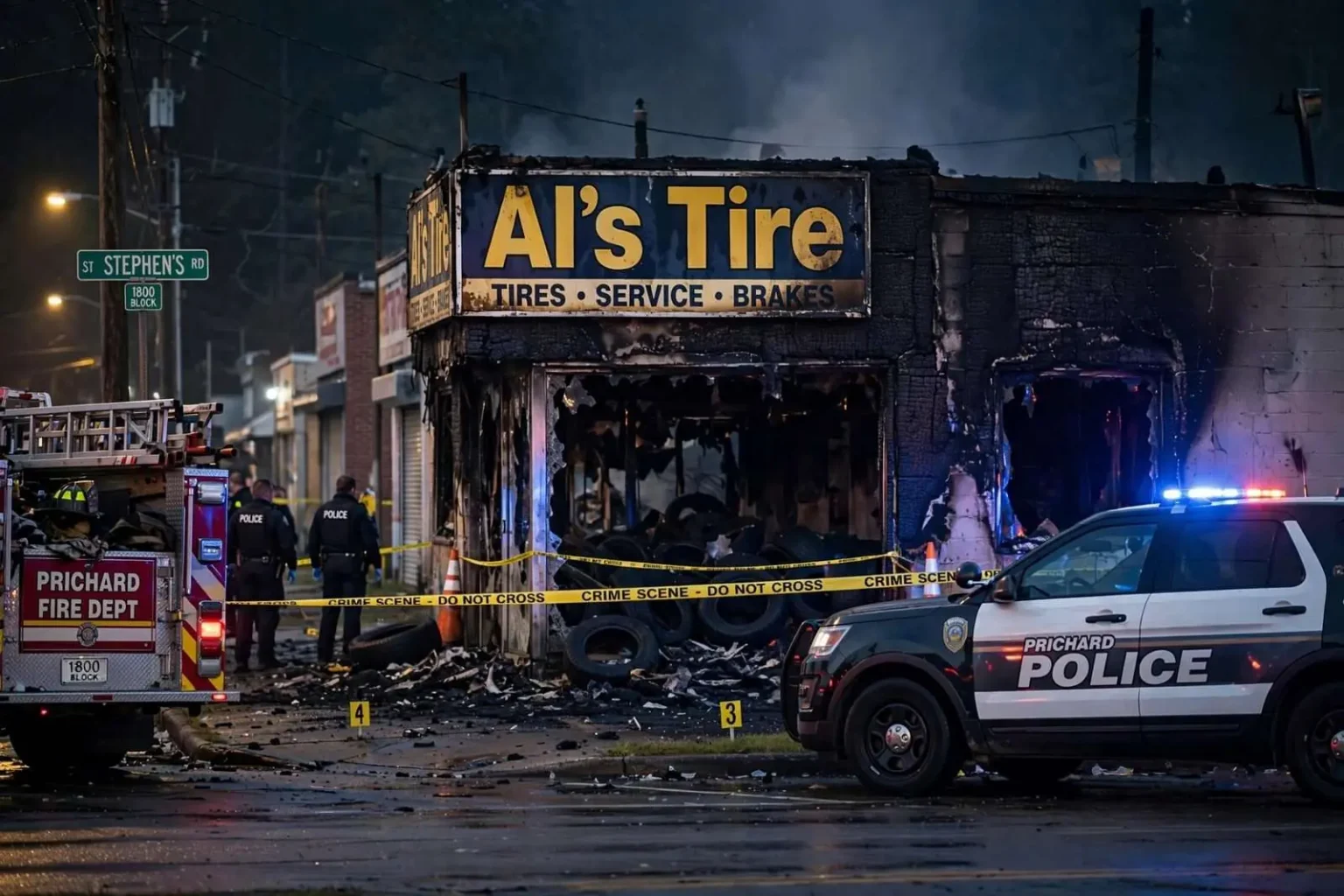
A fire that broke out early Thursday morning at Al’s Tire on St. Stephen’s Road in Prichard has been officially ruled an arson by the Prichard Police Department, turning what was first treated as a commercial fire into a criminal investigation with no announced suspect.
The fire was reported at approximately 1 a.m. on April 14 at the tire business. Firefighters responded to the scene and were able to bring the blaze under control, preventing the flames from spreading to neighboring structures along the busy commercial corridor. No confirmed injuries were reported as a result of the fire, and the extent of the damage to the business was not immediately disclosed.
From Fire Scene to Crime Scene
Prichard Police Department investigators determined the fire was intentionally set, a conclusion that reshapes every element of the case. Commercial fires of this kind are examined by fire investigators who read burn patterns, examine points of origin, and look for the chemical and physical signatures that distinguish an accidental blaze — an electrical fault, a discarded flame, a mechanical spark — from one that was started deliberately. When that examination supports an arson finding, the scene becomes a crime scene, and the investigation shifts from cause to culprit.
That shift is now underway. Officials have not released information about whether they have identified a suspect or person of interest in the case, and police have stopped short of saying what evidence led them to the arson determination. The investigation remains ongoing, and detectives continue to canvass the area, review any surveillance footage from nearby businesses, and follow up on tips as they come in.
Anyone with information about the fire is encouraged to contact the Prichard Police Department. Investigators in cases like this one rely heavily on early tips, because the accounts of residents who saw vehicles or activity along St. Stephen’s Road in the hour before the 1 a.m. report can establish a timeline that no amount of scene examination can reconstruct after the fact.
St. Stephen’s Road: A Corridor Under Strain
Al’s Tire is located on St. Stephen’s Road, a major thoroughfare in Prichard that runs through the heart of the city. The area is home to numerous small businesses and residential neighborhoods, the mix of storefronts, service shops, churches, and homes that defines Prichard’s commercial spine. A fire at a business on that corridor is never just a private loss; it is visible to an entire community that passes the site daily.
The business district along St. Stephen’s Road reflects both the endurance and the fragility of Prichard’s economy. Small, family-run operations — tire shops included among them — serve a customer base that depends on affordable car maintenance, and a business damaged by fire faces not only the immediate destruction but the interruption of income and customer relationships that small operations cannot easily absorb. The undisclosed extent of the damage leaves open the question of how long the business might be closed and whether it can reopen at all.
For neighboring businesses and residents, the arson ruling also raises security questions. An intentionally set fire in a commercial corridor prompts owners along the street to review their own lighting, cameras, and closing routines, and police typically increase attention to the area in the days that follow.
How Arson Investigations Work
The arson ruling sets a demanding legal path in motion. To prosecute an arson case, investigators and prosecutors must establish not only that a fire was intentionally set but who set it and, in many jurisdictions, that the person intended to damage the property. That burden makes arson among the more difficult crimes to prove, which is one reason police departments move deliberately before naming suspects and why the absence of an announced person of interest weeks into an investigation does not mean the case has gone cold.
Modern arson work leans on tools that earlier generations of investigators lacked. Surveillance cameras from nearby businesses and residences, license plate readers along major corridors, cell-tower records, and laboratory analysis of debris samples all contribute evidence that did not exist in earlier eras of fire investigation. The 1 a.m. timing of the blaze, in an area with businesses on multiple sides, gives investigators a reasonably bounded window to work with: whatever happened at Al’s Tire happened in the late-night hours along a road where, even overnight, there is typically some traffic and some watching.
Fire departments and police in Mobile County coordinate on such cases, and the Prichard Fire Department’s suppression work — bringing the blaze under control without reported injuries — also preserved evidence. The way firefighters knock down a commercial fire affects what investigators can later determine; an aggressive but controlled response can protect the point of origin from total destruction, which is often the most valuable piece of the scene.
Prichard’s Context
The case lands in a city that knows the cost of vacant and burned commercial property. Prichard, a city of roughly 20,000 residents just north of Mobile, has spent decades working through economic challenges that have hollowed out parts of its commercial base, and vacant structures along its corridors have been a persistent concern for city officials and residents alike. Fires in such environments are both a public safety matter and a neighborhood stability issue: a burned building that sits unaddressed drags down the block around it, while a prompt cleanup and rebuild can restore confidence.
Because Al’s Tire is an operating business rather than a vacant structure, the arson is notable for targeting commerce rather than abandonment. Police have not suggested a motive — whether insurance fraud, a dispute, or vandalism gone further than intended — and they caution against speculation while the investigation continues.
The city’s police department, which handles the full range of investigations for a community of Prichard’s size, treats commercial arson as a serious matter both for the direct harm and for its effect on the city’s efforts to maintain viable business districts. Mobile County’s smaller municipalities often lean on county and regional resources for specialized investigation support, and the Prichard Police Department’s ability to carry the case will matter to how it resolves.
The Night of the Fire
The timeline as authorities have described it is narrow: a fire reported at approximately 1 a.m. on April 14 at the tire business on St. Stephen’s Road, a response from firefighters who brought the blaze under control, and no confirmed injuries. Early-morning commercial fires carry particular dangers for responders — buildings that are closed and dark, no employees present to describe the layout, and the possibility that the fire has been burning unseen long before it was reported. That firefighters contained it without injuries, either to responders or to any person, was the night’s most fortunate outcome.
Tire businesses present specific hazards when they burn. Stockpiled rubber ignites readily, burns at high temperatures, and produces thick, toxic smoke that complicates suppression and requires responders to manage runoff and air quality concerns that ordinary structure fires do not raise. The volume of material at a tire shop also means fires of this kind can reignite and demand extended monitoring even after the main body of fire is out, keeping crews on scene well beyond the initial knockdown.
The damage assessment, which police have not disclosed, will account for all of that — the structure, the inventory, and the equipment that a tire business depends on — and it will shape what recovery looks like for the business and its owner.
What Comes Next
With the arson ruling official, the case now moves through the stages common to unsolved fire investigations. Detectives will complete their scene documentation, process any physical evidence collected, and evaluate the surveillance and tip information gathered since the fire. If the evidence identifies a suspect, the case would go to prosecutors for charges; arson of an occupied business in Alabama carries felony exposure that grows with the presence of people and the extent of the endangerment involved.
In the meantime, the department’s public appeal stands: anyone with information about the fire is encouraged to contact the Prichard Police Department. Tipsters can remain anonymous through standard crime-reporting channels, and investigators have consistently emphasized that small details — a vehicle seen leaving the area, a person on foot near the business before 1 a.m., anything out of the ordinary on the block that night — can be the thread that unravels a case like this.
For the community around St. Stephen’s Road, the coming weeks will show whether Al’s Tire reopens and whether an arrest follows. The fire itself was contained in a night; the questions it raised — who set it, and why — will take longer to answer, and the Prichard Police Department’s investigation remains the avenue through which those answers will come.
Residents and business owners along the corridor who noticed anything unusual in the early morning hours of April 14 are urged to come forward, as the department continues to build its case in an investigation that remains ongoing.