Fire at Pensacola’s Carter Paint and Body declared a total loss
Escambia County Fire Rescue responded to a fire at Carter Paint and Body in Pensacola; the owner called it a total loss and officials are investigating.
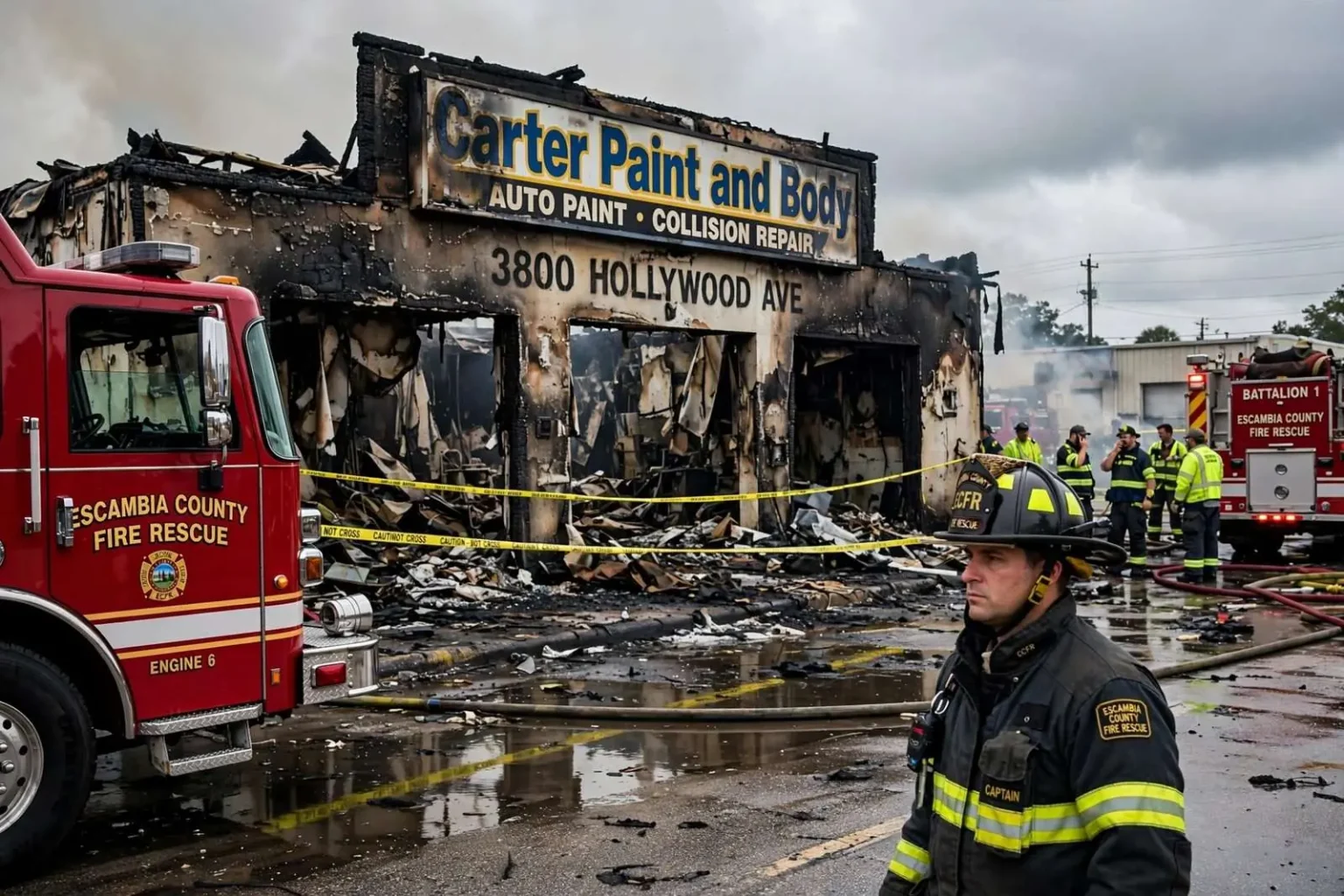
Escambia County Fire Rescue crews responded Saturday afternoon to a fire at Carter Paint and Body, an automotive paint and collision repair business located at 3800 Hollywood Avenue in Pensacola. The blaze brought multiple fire units to the commercial corridor west of downtown, where smoke could be seen from several blocks away as firefighters worked to keep the flames from spreading to neighboring structures along the street. No injuries were reported in the initial response, and crews focused their early efforts on protecting nearby buildings while knocking down the fire inside the shop.
The business owner, surveying the aftermath after crews brought the fire under control, said the structure is a total loss. For a small, family-run operation like an auto body and paint shop, that assessment represents more than the loss of the building itself. Equipment inside a shop of this type typically includes paint booths, compressors, lifts, welding stations, frame-straightening machinery, and shelves of customer parts and finishes, much of which is either destroyed outright by fire or rendered unusable by heat, smoke, and the water used to extinguish the blaze.
A Call That Tested Afternoon Crews
The fire was reported Saturday afternoon, a time when residential streets across Pensacola quiet down and commercial strips like Hollywood Avenue see little traffic. That timing meant the responding units from Escambia County Fire Rescue arrived to a scene with few bystanders in the immediate area, which simplified both firefighting and scene safety. Crews established a perimeter, checked for anyone who might have been inside the building, and began an aggressive attack on the fire from the exterior before moving in as conditions allowed.
It was not immediately clear how the fire started or whether weather played a role. Investigators typically weigh a range of possibilities in commercial fires of this kind, from electrical faults in aging wiring to accidents involving the flammable materials that are part of everyday work at a paint and body shop. Saturday weather on the Gulf Coast can vary widely by season, and officials declined to speculate until the formal investigation produced answers. Until that determination is made, the cause officially remains undetermined.
Why Paint and Body Shops Carry Elevated Fire Risk
Auto body and paint businesses are, by their nature, among the more fire-prone categories of small commercial buildings. Automotive paints, primers, lacquers, thinners, and reducers are solvent-based products that give off flammable vapors at room temperature. A paint booth is designed to manage those vapors with controlled airflow and suppression systems, but the rest of a shop often stores quantities of these materials in drums, cans, and spray guns awaiting use. A single spark from grinding or welding work, or an electrical malfunction, can ignite vapors that flash through a workspace in seconds.
Fires in these settings also burn hot and fast. Solvent-fed flames can compromise structural components quickly, and the synthetic materials common in modern vehicles, from seat foam to wiring insulation, produce thick, toxic smoke when they burn. Firefighters responding to a shop fire must account for the possibility of ruptured aerosol cans, pressurized tanks, and fuel in customer vehicles parked inside the building, all of which complicate an interior attack and can force crews to fight the fire defensively from outside.
The State Fire Marshal Steps In
Because the structure was declared a total loss and the cause was not apparent at the scene, the Florida State Fire Marshal has been called in to investigate the blaze. The State Fire Marshal’s office, part of the Florida Department of Financial Services’ Division of State Fire Marshal, is the state agency responsible for investigating fires where local officials need additional expertise, where the cause is suspicious or unclear, or where the loss is significant. Its investigators are trained in fire origin-and-cause analysis, evidence collection, and, when necessary, the criminal side of fire investigation.
An origin-and-cause investigation of a commercial fire typically begins with a careful examination of the burn patterns inside the ruined structure. Investigators look for the point of lowest burning, the depth of char, and the direction of heat and smoke movement to determine where the fire started. From there they work backward, examining electrical panels, appliances, equipment, and any potential ignition sources in the area of origin. In a total-loss fire, where the structure has collapsed or been heavily compromised, that work can take days and often involves sifting debris by hand.
The involvement of the State Fire Marshal does not by itself indicate that investigators suspect arson. Large commercial losses routinely draw state assistance simply because local departments may lack the specialized staff or laboratory resources to complete a thorough investigation while continuing to handle their normal call volume. The findings will ultimately be documented in a report that can inform insurance claims, building code reviews, and any follow-up actions that may be warranted.
What the Loss Means for Hollywood Avenue
Hollywood Avenue sits in a working, west-side section of Pensacola that developed through the mid-twentieth century as a corridor for small industry, auto-related businesses, warehouses, and service shops. Streets like this one form the practical backbone of the city’s economy, housing the collision shops, muffler shops, suppliers, and contractors that keep the area’s vehicles on the road. When one of these businesses burns, the loss registers well beyond the property line, among customers who now need new arrangements for repair work and neighboring owners who watched the fire and wondered about their own buildings.
Commercial fires also raise familiar questions for surrounding property owners, particularly older buildings that may share construction styles, aging utilities, or close clearances with the structures beside them. Fire officials generally encourage business owners in any commercial corridor to review their own fire protections after a nearby loss: checking that electrical panels have been inspected, that flammable liquids are stored in rated cabinets, that extinguishers are charged and current, and that any suppression systems are serviced on schedule.
Support Systems for Displaced Businesses
For the owner of a destroyed business, the days after a fire are consumed with practical steps. Insurance notification comes first, followed by securing the property against weather and trespass, since a burned commercial building remains an attractive hazard until it is fenced or boarded. Escambia County and City of Pensacola code enforcement officials typically become involved to assess whether a ruined structure must be demolished or stabilized, and utility providers disconnect service to eliminate ongoing electrical and gas hazards in the ruins.
Florida businesses affected by fire can also draw on established support networks. The Florida Small Business Development Center network, which has a presence in the Panhandle, offers no-cost consulting to business owners facing disaster recovery, including guidance on insurance documentation, disaster loan applications through the U.S. Small Business Administration, and planning for reopening at a temporary location. Local chambers of commerce and neighboring business owners frequently help spread the word about temporary relocations, which can make the difference between a permanent closure and a comeback.
There is no timeline yet for the State Fire Marshal’s findings in the Carter Paint and Body fire, and no estimate has been released of the dollar value of the loss. What is known is what the owner stated plainly in the hours after the flames were out: the shop that had served drivers from across the western side of Pensacola is gone, and the work of determining why it burned now belongs to the state’s fire investigators.
How Escambia County Fire Rescue Operates
Escambia County Fire Rescue is the primary fire and emergency medical service provider for the unincorporated areas of Escambia County, one of Florida’s two westernmost counties bordering Alabama. The department operates from stations spread across the county and handles structure fires, vehicle fires, brush fires, medical calls, and technical rescues. In the Pensacola area, jurisdiction is a patchwork: the City of Pensacola has its own fire department for addresses inside the city limits, while county crews cover the surrounding unincorporated communities and, through automatic aid agreements, assist municipal departments when a call is large enough to require it.
A Saturday afternoon commercial fire draws on that mutual aid framework automatically. Dispatchers send a first-alarm assignment based on the type of occupancy reported, and a structure fire at a commercial building typically brings engines, a ladder or rescue truck, a battalion chief for command, and often an additional engine beyond what a residential fire would require. Each additional unit carries water, hose, and staffing that the incident commander can commit as the size of the fire becomes clear. For a fire that ultimately destroys the building, crews may remain on scene for hours performing overhaul, the labor-intensive work of pulling apart burned material to find and extinguish hidden hot spots that could rekindle.
The Investigation Timeline From Here
Once the scene is safe, control shifts from firefighters to investigators. The State Fire Marshal’s investigators will document the scene with photographs and diagrams, interview the owner, employees, and any witnesses who saw the fire in its early stages, and request records that often prove decisive, including utility billing histories, maintenance records for equipment in the building, and any permits on file for work done at the address. Statements from the first-arriving fire crews about the color, speed, and behavior of the flames and smoke also feed into the analysis.
In cases where the origin area contains electrical equipment, investigators may send components to a laboratory for examination under magnification to look for arc damage or other signs of electrical failure. Where accelerants are suspected, debris samples are sealed and submitted for laboratory analysis. The process is deliberately methodical, because the conclusions need to withstand scrutiny from insurance companies, and potentially from attorneys, if the findings are later disputed. Businesses and property owners involved in the fire’s aftermath are generally advised to preserve whatever records they have and to avoid speculating publicly about the cause until the official report is issued.
For now, the official record of the fire is short: an afternoon blaze at 3800 Hollywood Avenue, a structure declared a total loss by its owner, no reported injuries, and an investigation handed to the Florida State Fire Marshal. Those facts frame the questions that residents and neighboring business owners along Hollywood Avenue will be watching for in the weeks ahead, as the county’s fire crews return to their stations and the state’s investigators take over the slow work of reading the ruins.