
Fire departments across Florida get decontamination buckets to cut cancer risk for firefighters
More than 4,200 decontamination buckets have been delivered to Florida fire departments to help firefighters wash carcinogens from gear.
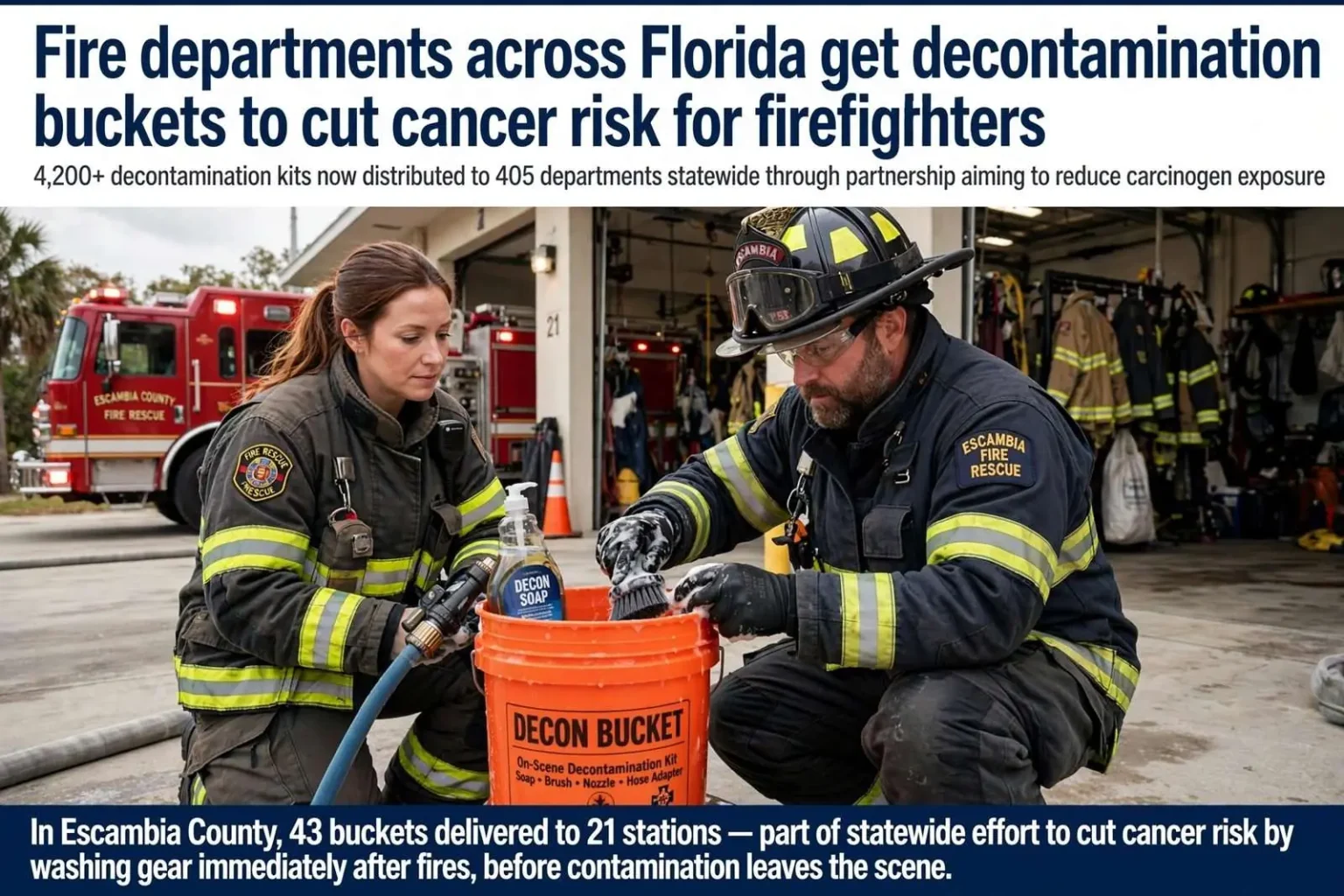
A collaborative effort has delivered more than 4,200 decontamination buckets to fire departments across Florida in a push to lower the cancer risk firefighters face on the job. Studies show firefighters are about 9 percent more likely than the general public to develop cancer, and the gear they wear into a burning building carries much of the danger home with them. The free kits went out to 405 fire departments through a partnership among Ten-8, the University of Miami Sylvester Comprehensive Cancer Center, the Florida Firefighters Safety and Health Collaborative, and the Firefighter Cancer Support Network.
The buckets are deliberately simple. Each one holds dish soap, a nozzle, a scrub brush and an adapter that lets crews hook a hose from the fire truck and wash their gear on scene, turning a hydrant line and a brush into the first line of defense against contamination. The idea is to make decontamination immediate and routine, so that soot and residue never leave the fireground on turnout gear in the first place. In Escambia County, Fire Rescue Captain Craig Ammons said the county received 43 buckets, enough for all 21 of its stations.
Ammons did not mince words about why the effort matters. “There’s well over 20 or 30 known carcinogens in the smoke that’s produced at these fires,” he said, pointing to the synthetic materials common in modern homes. Furniture, carpeting, electronics and building products made from plastics and treated fabrics burn hotter and dirtier than the natural materials of earlier generations, and the smoke they produce clings to helmets, hoods, coats and gloves long after the flames are out.
The cultural shift may be as important as the equipment. For generations, soot-covered gear was worn as a badge of honor in the fire service, visual proof of the fires a firefighter had fought. That attitude is changing across Florida and the Gulf Coast. Crews now scrub down after every fire rather than celebrating the grime, and departments are treating decontamination the way they treat seatbelts and self-contained breathing apparatus, as non-negotiable safety practice rather than optional caution.
Why the risk is so high
Firefighters face a combination of exposures that few other professions encounter. They absorb carcinogens through inhalation, through skin contact with contaminated gear, and through off-gassing from equipment stored inside cabs between calls. Studies of fire service populations have linked the occupation to elevated rates of several cancers, and researchers have repeatedly pointed to turnout gear as a reservoir of contamination when it is not cleaned properly. Firehouse exhaust diesel particulates and repeated emergency responses add to the cumulative load over a career.
The exposure problem has grown along with modern construction. Half a century ago, household contents were dominated by wood, cotton and other natural fibers that burned at comparatively lower toxic loads. Today’s homes are filled with polyurethane foam, synthetic textiles, composite materials and flame retardants that produce dense, chemical-laden smoke when they burn. A single room-and-contents fire can coat a crew’s gear with residues that include known carcinogens, and without on-scene decontamination those residues ride back to the station and, eventually, into the living quarters where firefighters eat and sleep between calls.
That is why the bucket program focuses on the fireground itself. Washing gear at the scene, before it is packed back onto the engine, removes the majority of loose contamination at the point of exposure. The soap, brush and truck-mounted hose supply make the task possible within minutes of the last overhaul, and the routine of doing it after every fire builds the habit into department culture. The buckets cost little, require no special training to use, and work in the rural and volunteer settings where elaborate decontamination equipment is least likely to be budgeted.
The partners behind the effort each bring a different piece of the puzzle. Ten-8, a fire equipment supplier with deep roots in Florida’s fire service, helped coordinate distribution at scale. The University of Miami’s Sylvester Comprehensive Cancer Center contributes the clinical and research perspective on cancer prevention. The Florida Firefighters Safety and Health Collaborative organizes departments around statewide health and safety initiatives, and the Firefighter Cancer Support Network provides education and direct support to firefighters and families already facing a diagnosis.
The concern reaches across the Gulf Coast
The effort echoes concern across the Gulf Coast, where fire departments in Alabama, Mississippi and the Florida Panhandle have been confronting the same statistics. Earlier in the year, Mobile Fire Chief Mark Sealy spoke publicly about his own cancer diagnosis, which was caught early during a free screening at a fire chiefs’ summit. His decision to discuss the diagnosis openly put a familiar face on the data and encouraged departments in the region to keep pressing for screenings, clean gear and earlier detection.
Screening events aimed at firefighters have grown in number across the region for precisely that reason. Professional fire organizations in Florida and Alabama have pushed for annual physicals, early-detection screenings and benefits coverage for occupational cancers, arguing that prevention and early diagnosis are far cheaper, for departments and families alike, than late-stage treatment. Sealy’s experience, in which a routine screening caught the disease early enough to act, has become the kind of story chiefs cite when they ask crews to show up for exams they might otherwise skip.
The counties along the Gulf, from Escambia eastward and across the state line into Baldwin and Mobile counties, share the same mixture of risks: fast-growing suburban development, busy interstate corridors, industrial facilities and a hurricane season that multiplies structural fires after landfall. Firefighters there respond to a steady volume of working fires, which means repeated exposure cycles year after year. Programs that reduce even a fraction of that exposure, delivered free to every station, have an outsized effect on a career’s worth of cumulative risk.
For the departments receiving buckets, the distribution also serves as an educational touchpoint. Each delivery is an opportunity to rebrief crews on contamination discipline: bagging gear after a fire, showering as soon as possible, keeping dirty equipment out of living quarters, and swapping hoods and gloves between calls. Fire service researchers have emphasized that no single measure eliminates the risk, but layered precautions, of which on-scene washing is one of the most practical, measurably cut the contamination a firefighter carries.
The program’s scale is notable. Reaching 405 departments with more than 4,200 buckets means covering everything from large metro battalions to two-engine volunteer stations scattered across Florida’s rural counties, and it happened through coordination rather than legislation. Organizers have framed the campaign as an ongoing commitment rather than a one-time giveaway, with the goal of making decontamination buckets as standard a sight on Florida fire apparatus as the hose and the ladder.
What it means for local residents
For residents of the Gulf Coast, the program is mostly invisible until the day a fire engine arrives, but it has a direct bearing on the people who answer the call. Communities depend on experienced firefighters, and keeping veterans healthy through long careers protects both the workforce and the institutional knowledge that makes a department effective. Every crew that washes its gear at the curb is reducing the odds that a responder will face a cancer diagnosis in the middle of a serving career.
The broader lesson from the campaign is that firefighter cancer is not an inevitable occupational toll. It is a risk that can be reduced with habits, equipment and attention, and the fire service nationally has spent the past decade rewriting its training standards to reflect that. Decontamination after every fire, clean spare hoods and gloves, diesel exhaust capture in apparatus bays and routine medical screening now appear together in department policies that would have looked unusual a generation ago.
Ammons’ advice to his own crews captures the shift in plain terms: the smoke from a modern fire is a chemical event, and the gear that protected them from the flames now needs protection of its own. The buckets arriving across Florida, and the conversations they spark in stations from Pensacola to Mobile, are part of a regional recognition that the badge of honor is no longer the soot, but the years of healthy service that come after the fire is out.
The science behind the 9 percent figure has accumulated over years of occupational health research. Studies comparing fire service populations with the general public have consistently found elevated cancer rates among firefighters, even after accounting for smoking and other lifestyle factors, and national fire service organizations have treated the finding as a mandate for change. Researchers caution that the percentage represents an average across a varied workforce, with exposure differing by the number of fires fought, the type of responses and the protective practices each department follows, which is exactly why programs that reach every department matter.
Alabama’s fire service has followed the same arc. Departments in Mobile and Baldwin counties have adopted gear-banking practices, second hoods and structured decontamination protocols, and regional training events now routinely include cancer-prevention sessions alongside hose drills and ventilation tactics. The free screenings offered at fire chiefs’ summits, the kind of event where Chief Sealy’s cancer was detected, have become a fixture of the regional calendar, drawing officers who might otherwise postpone medical attention until symptoms appear.
Voters and local governments have played a role as well. Occupational cancer presumption laws, which make it easier for firefighters diagnosed with certain cancers to qualify for benefits, have been debated in statehouses across the South, and the cost of those benefits gives municipalities a direct financial stake in prevention. Every bucket that keeps contamination off a firefighter’s skin is also, in a quiet way, a savings to the taxpayers who fund the department’s pensions and disability costs.
There is also a family dimension that advocates emphasize. Firefighters take their work home on their gear, and contamination that rides in a personal vehicle can expose spouses and children who never stood near a fire. On-scene washing interrupts that chain before it starts, protecting households as well as crews. It is one of the reasons the Firefighter Cancer Support Network has made education about take-home exposure a standing part of its messaging to departments nationwide.


