Fire Displaces Family in Mobile’s Crichton Neighborhood
A house fire displaced a family Wednesday night in Mobile's Crichton neighborhood after flames broke out in the kitchen of a home on Union Avenue.
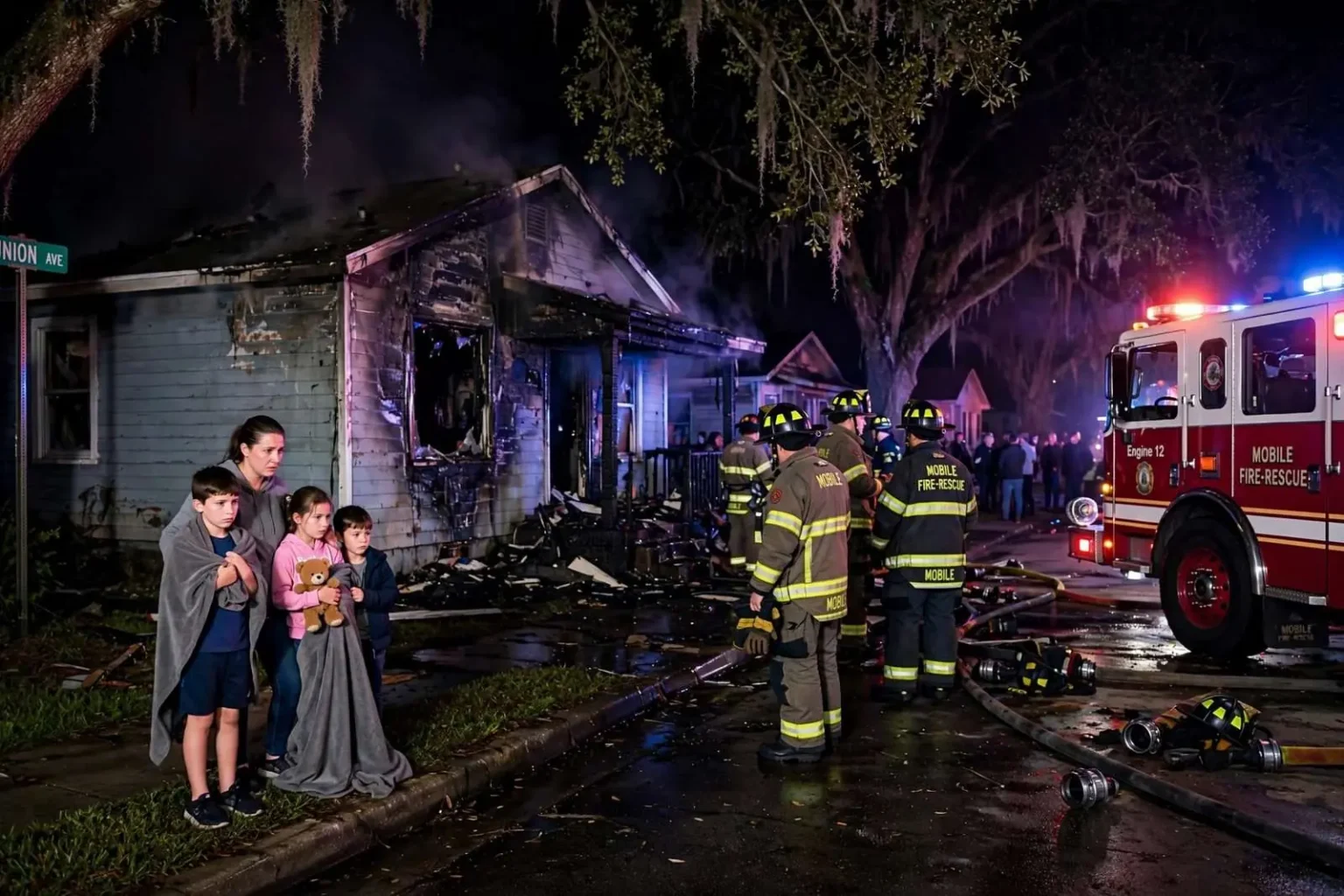
MOBILE, Ala. — A family was displaced Wednesday night after a fire broke out at a home in Mobile’s Crichton community, on the city’s north side, sending crews from Mobile Fire-Rescue to a residential block where neighbors acted quickly when smoke began to rise.
Mobile Fire-Rescue crews were called to the 9 p.m. blaze on Union Avenue, a residential street tucked between Spring Hill and Old Shell Road. The hour mattered: nighttime fires are among the most dangerous residential emergencies, catching families asleep and delaying the early calls that give firefighters their best window to contain a blaze before it spreads.
Neighbors said they noticed smoke rising from the home and quickly alerted others nearby before firefighters arrived. That kind of early warning is often decisive in residential fires — the difference between a household evacuated in minutes and one that needs a search by firefighters in zero visibility.
Several children were seen standing outside the house as crews worked to knock down the flames. The image captured the stakes that fire crews train for and the reason residential responses are treated with urgency regardless of the hour.
No injuries were reported among the residents or the firefighters who responded, though the family is now without a place to call home while the damage is assessed. Displacement is the aftermath most house fires leave behind, even small ones: smoke and water damage can render a home unlivable long after the flames are out, forcing families into the care of relatives or short-term shelter while repairs are arranged.
Fire Investigators Trace the Origin
Investigators believe the fire originated in the kitchen, though the exact cause remains under review. Kitchen fires are the most common residential fire scenario firefighters respond to, typically beginning on or near the stovetop and spreading quickly through smoke, cabinets and ventilation before anyone can react.
Fire investigators with Mobile Fire-Rescue handle the task of determining cause once flames are knocked down, examining burn patterns, appliance condition and witness accounts. Their findings matter beyond the family involved — they determine whether an incident is accidental, whether a product or utility issue is implicated, and what safety lessons the department can pass to the public.
Crews on scene said thick smoke complicated efforts to reach the source of the flames, slowing the response as firefighters worked room to room to keep the fire from spreading further through the structure. Smoke is the element that makes interior firefighting dangerous: it reduces visibility to inches, carries toxic gases from burning materials, and can drive temperatures in a hallway to levels that threaten firefighters even without visible fire present.
Working room to room — advancing hose lines while checking for occupants — is the methodical response structure departments drill on. It is slower than an exterior attack, but it protects lives inside and limits the fire’s spread to the rest of the structure, which is why crews accept the difficulty when the situation allows it.
Crichton’s Close-Knit Response
The Crichton neighborhood is one of several close-knit communities on Mobile’s north side, and residents there have a history of rallying around neighbors following house fires and other emergencies. The area’s identity is rooted in generations of families who have lived on the same blocks, in churches and community groups that activate quickly when a household is in need.
That network matters most in the days after a fire, when the immediate danger has passed but the practical crisis begins. Families displaced by fires typically need clothing, food, temporary lodging and help navigating insurance or assistance programs, and in neighborhoods like Crichton those needs are often met first by neighbors before outside agencies complete their own response.
Fire officials continue to encourage homeowners across Mobile County to test smoke alarms regularly and keep a close eye on stovetops and other kitchen appliances, since cooking-related incidents remain among the most common causes of residential fires. The advice is simple and repeatedly proven: a working smoke alarm doubles the odds of surviving a house fire, and most fatal cooking fires begin with unattended stoves.
Safety officials recommend a three-part routine for kitchen fire prevention: never leave cooking unattended, keep flammable items — towels, curtains, packaging — away from burners, and keep a lid nearby to smother a pan fire rather than dousing it with water, which can spread burning grease instantly. They also advise homeowners to keep a functioning fire extinguisher accessible but away from the stove itself.
What Displaced Families Face Next
For the family on Union Avenue, the days ahead will involve the unglamorous logistics of displacement. Disasters of this kind typically trigger assistance from disaster relief organizations that provide emergency lodging, clothing and food, followed by longer-term questions about rebuilding, insurance claims and salvaging belongings from smoke and water damage.
Fire damage compounds in ways that are not immediately visible. Water from hoses soaks insulation and subfloors, smoke penetrates walls and fabrics, and utilities must be inspected before a home can be reoccupied — reasons that even contained fires often leave families out of their homes for weeks.
The response on Union Avenue also illustrated the standard structure of a Mobile Fire-Rescue residential call: first-arriving units assessing the scene and attack, additional engines ensuring water supply, and a ladder company handling ventilation and searches. The department operates fire stations across the city positioned so that a crew can reach most Mobile addresses within minutes, and the north side’s stations covered this one quickly enough that the fire was stopped before injuries occurred.
No further details on the extent of the damage or the family’s immediate needs were available as of Wednesday night. Officials did not release the number of residents in the home or an estimate of the damage, pending the completion of the investigation and a fuller assessment of the structure.
This story may be updated as more information becomes available. Residents in the area who noticed anything relevant to the investigation are encouraged to contact Mobile Fire-Rescue, and homeowners across the county are reminded to test their smoke alarms this week — the step fire officials cite most often as the difference between a close call and a tragedy.
The Crichton fire also fit a seasonal and structural pattern that fire departments track closely. Older housing stock — much of Mobile’s north side dates to the early and mid-20th century — tends to carry higher fire risk than newer construction, because of aging wiring, older appliances and floor plans that predate modern fire codes. Combined with the prevalence of cooking as an ignition source, those factors make residential fires in established neighborhoods a recurring call for crews.
The Department Behind the Response
Mobile Fire-Rescue, the city’s fire and emergency medical service, is one of the largest departments in Alabama, operating from stations spread across Mobile’s districts and responding to far more medical calls than fires on any given day. Its investigators are trained to trace fire origins through the physics of a burn: where the deepest charring lies, what melted first, which direction smoke traveled.
The department’s public education arm delivers the kitchen-safety and smoke-alarm messages officials repeat after incidents like Wednesday’s, working with schools, churches and community groups across the city. Those programs exist because the data is consistent — smoke alarms, cooking vigilance and escape plans prevent far more deaths than any firefighting technology.
For neighbors on Union Avenue, the night ended with relief that everyone got out and a familiar next chapter: collecting what the family needs, watching the house board up, and waiting for the investigators’ word on what happened. In communities like Crichton, that chapter tends to be written by the block itself.
House fires also carry a cost that spreads beyond one family. A burned home affects property values, insurance rates and the rhythm of a street, and each incident renews the case officials make for prevention — the alarms, the extinguishers, the attention to the stove that costs nothing and averts the worst.
Assistance for the displaced family will also draw on the county’s broader safety net. Disaster relief organizations maintain volunteer teams across the Gulf Coast that respond to house fires — statistically the most frequent disaster they answer — providing emergency funds for lodging and essentials within hours of a call. Local churches and community organizations in Crichton typically supplement that support with furniture, clothing and the quieter forms of help a family needs to reestablish itself.
Fire officials’ advice after Wednesday’s fire was the same they give after every one: test your smoke alarms tonight, plan two ways out of every room, and never walk away from a burning stovetop. The family on Union Avenue, like thousands across the county each year, is living the reason why.