Fire Reported at Oaktree Apartments on Old Pascagoula Road in Mobile
A fire broke out at Oaktree Apartments on Old Pascagoula Road in Mobile, producing heavy smoke. Mobile Fire-Rescue responded to the scene.
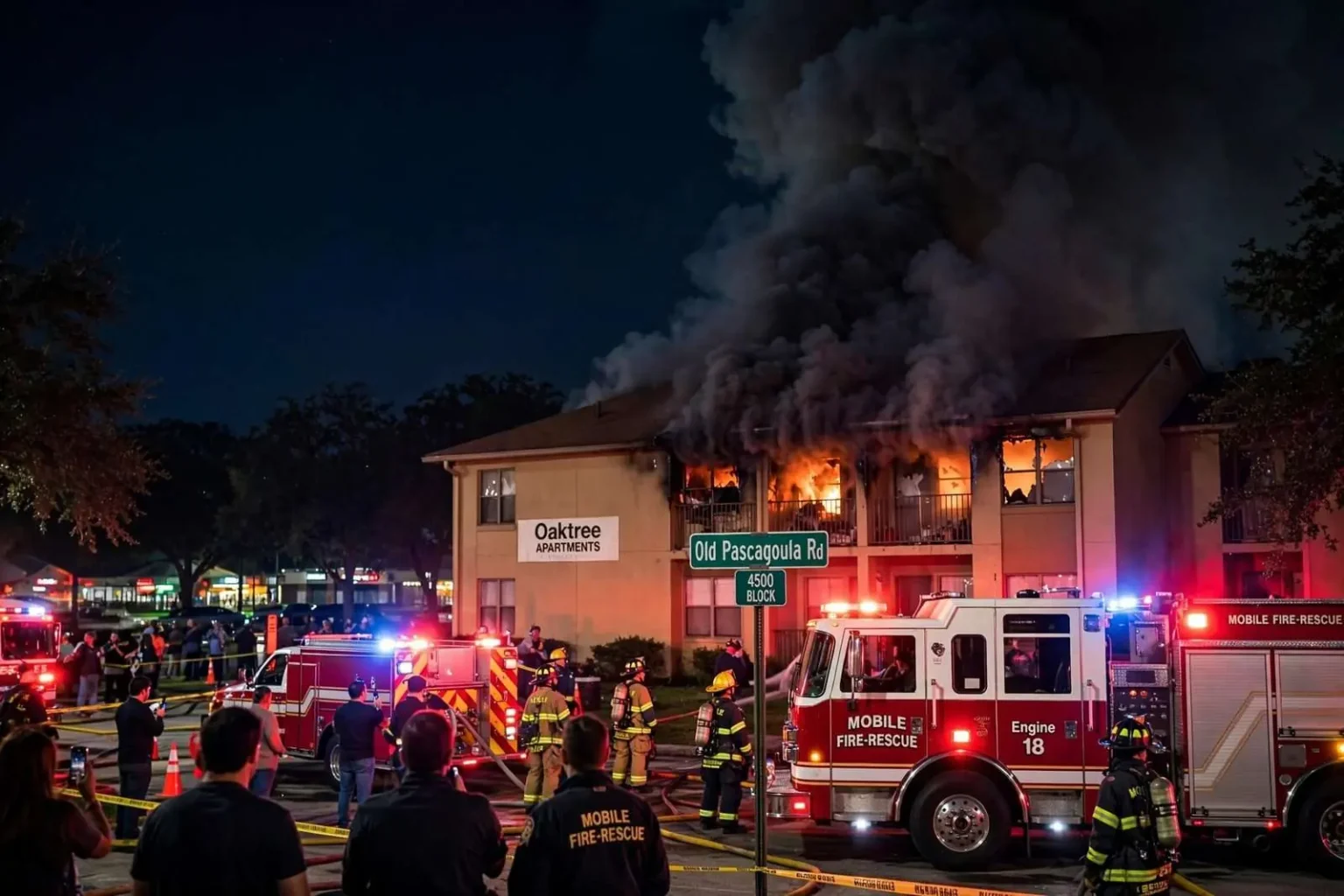
A fire broke out at the Oaktree Apartments on Old Pascagoula Road in Mobile on Tuesday night, November 3, sending heavy smoke into the air. Mobile Fire-Rescue responded to the scene after the fire was reported. Witnesses in the area captured photos showing heavy smoke emanating from the building. Mobile Fire-Rescue was contacted for additional details about the fire, including its cause and whether any residents were displaced or injured. Authorities had not released further information at the time of the initial report.
The sight of heavy smoke rising over the area drew attention from residents and passersby well before official details became available. People in nearby neighborhoods photographed the smoke column from a distance, and those images circulated locally as fire crews worked the scene. At apartment complexes, an evening fire carries particular urgency: units share walls, attics, and breezeways, which means a fire that starts in one building can threaten several families’ homes within minutes.
Apartment fires also set off a familiar chain of response beyond the hose lines. Fire crews handle extinguishment and search each unit for occupants, while the property’s management is typically left to arrange temporary lodging for displaced residents and Red Cross volunteers may be called in when families have nowhere to spend the night. In Mobile, that after-hours coordination is common during cooler months, when heating equipment and indoor cooking put extra demand on electrical systems in older buildings.
Old Pascagoula Road is a major corridor in southern Mobile County, running through residential and commercial areas between Mobile and the community of Theodore. The road carries steady daily traffic between west Mobile neighborhoods and the industrial and retail centers closer to the coast, and it is lined with apartment complexes, churches, schools, and small businesses that have grown up along it over several decades. An incident that closes or constrains the road, even briefly, is felt quickly by commuters in the area.
How Mobile Fire-Rescue responds
Mobile Fire-Rescue is the fire and emergency medical service for the city of Mobile, operating fire stations spread across the city so that crews can reach structure fires within minutes from multiple directions. A reported apartment fire typically brings an upgraded response: multiple engines and ladder trucks, a battalion chief to command the scene, and medic units standing by in case of injuries. Crews arriving first make a rapid decision on whether to fight the fire offensively from inside or defend surrounding exposures from outside, depending on conditions inside the building.
Nighttime fires add difficulty that daytime incidents do not. Visibility is limited, occupants may be asleep and slower to report the fire or evacuate, and investigators cannot photograph and document the scene in natural light. Crews also have to account for residents who are not home when the fire breaks out, checking vehicles in the parking lot and coordinating with property managers on who may be unaccounted for.
Smoke itself is the leading killer in residential fires, not flame. Modern furnishings and building materials produce thick, fast-moving smoke when they burn, and breathing even a few breaths of it can incapacitate a person. That is one reason fire departments across the Gulf Coast repeat the same guidance after every apartment fire: get out quickly, stay out, and never go back inside for belongings. Once outside, residents should stay clear of fire lanes so apparatus can position and so crews can move hose lines without obstruction.
For neighbors who photographed the smoke, fire officials generally ask that images be shared with investigators rather than posted in ways that could hamper the scene — and that anyone who saw flames, heard an explosion, or noticed anything unusual before the fire contact the fire marshal’s office. Bystander photos and doorbell camera footage have become valuable evidence in fire investigations, sometimes establishing the exact minute a fire started or showing a vehicle or person near the building beforehand.
What happens after the flames are out
Determining a fire’s cause is the job of fire investigators, who examine burn patterns, look at electrical panels and appliances, and interview residents and witnesses before classifying the fire as accidental, natural, or incendiary. Cooking equipment, heating devices, electrical malfunctions, and discarded smoking materials are the most common causes of apartment fires nationally, but investigators do not speculate publicly until their examination supports a conclusion. That process can take days or longer when a building is heavily damaged or structurally unsafe to enter.
In the days that follow, displaced residents typically work with the property’s management and, when needed, disaster-relief volunteers to replace housing, clothing, and documents lost in the fire. Renters insurance plays a major role in that recovery; fire officials across the region encourage renters to carry it, since a landlord’s policy covers the building but not a tenant’s personal property. Families who lose everything in an apartment fire also face the practical challenge of replacing prescriptions, identification, and school supplies, and local churches and civic groups along Old Pascagoula Road have historically stepped in to help in cases like this one.
Because officials had not released the fire’s cause, the extent of damage, or whether any residents were hurt or displaced at the time of the initial report, this story was developing, and updates would depend on information from Mobile Fire-Rescue. Residents of the Oaktree Apartments and nearby neighborhoods were left to wait for word on when the affected building might be safe to re-enter and what, if anything, they needed to do in the meantime.
Fire safety in apartment communities
Fire departments use incidents like this one to remind renters of a few basics that apply in any apartment community. Smoke alarms should be tested monthly, and any alarm that chirps or fails a test should be reported to management immediately rather than disabled. Residents should know two ways out of their building and agree on a meeting spot outside, and hallways and breezeways should stay free of furniture and boxes that could block an escape route or feed a fire.
Heating season adds its own cautions. Space heaters should sit on a hard, level surface well away from curtains and bedding and should be plugged directly into a wall outlet, not a power strip. Cooking fires, the most common kind, are prevented by staying in the kitchen while anything is on the stove. None of these steps takes much effort, but together they address the handful of causes behind most apartment fires, and they matter most in multi-family buildings where one unit’s fire becomes everyone’s emergency.
The response to an evening apartment fire also draws on mutual aid arrangements that fire departments across Mobile County maintain with one another. When a fire requires more resources than one department can field, neighboring volunteer and municipal departments send apparatus under automatic aid or mutual aid agreements, ensuring that water supply, ladder coverage, and manpower arrive quickly enough to make a difference. In a corridor like Old Pascagoula Road, where city limits and unincorporated pockets sit close together, that cooperation is routine rather than exceptional.
Water supply is one of the first logistical problems crews solve on any structure fire. Engines carry several hundred gallons, enough for a few minutes of attack, so connectors to hydrants are laid early in the incident. At an apartment complex, firefighters also have to be mindful of parking patterns and narrow drives, which can force longer hose lays and slow the placement of ladder trucks — a factor that influences how quickly an upper-floor fire can be reached.
Weather in early November along the central Gulf Coast is typically mild, but seasonal transitions still shape fire behavior and fire response. Cooler nights mean residents are running heaters and using ovens more, and fallen leaves and dry landscaping can give a fire additional fuel around the exterior of a building. Wind off Mobile Bay and its tributaries can push smoke across neighborhoods and carry the smell of a blaze for miles, which is often how people first learn that something is burning nearby.
For the wider community along Old Pascagoula Road, the images of heavy smoke over the Oaktree Apartments served as an unplanned reminder of how quickly an ordinary evening can change. Apartment residents who had never checked their smoke alarms did so that night; property managers reviewed exterior lighting and alarm coverage; and neighbors checked on one another. Fire officials say that heightened attention usually fades within weeks, which is why they keep repeating the same safety messages after every fire, regardless of its cause.
The investigation into the Oaktree Apartments fire remained open at the time of the initial report, with Mobile Fire-Rescue expected to release additional details on the cause, injuries, and displacement once investigators had completed their initial work at the scene. Until then, the facts on record were those of the first hours: a Tuesday-night fire reported at the complex on Old Pascagoula Road, a heavy smoke condition visible across the area, a full response by Mobile Fire-Rescue, and witnesses capturing the scene as crews worked into the night.