
First African American Blue Angels pilot reflects on making history 35 years later
Donnie Cochran, the first African American Blue Angels pilot, reflects 35 years later on his time with the Navy flight demonstration squadron.
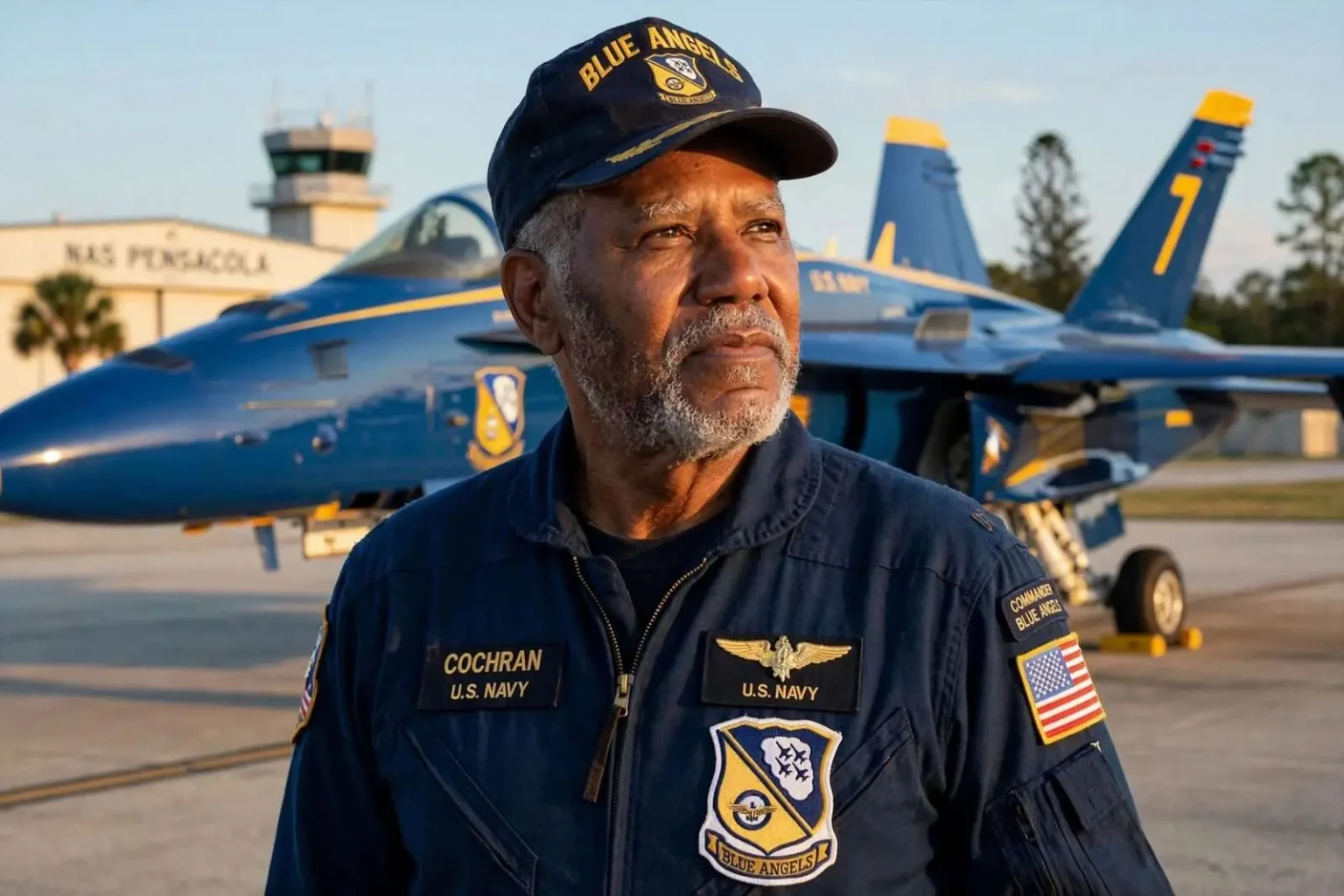
Thirty-five years after becoming the first African American pilot in the Blue Angels, Donnie Cochran is looking back on what he calls one of the greatest stretches of his life. The naval aviator’s journey from a farm in southwest Georgia to the cockpit of the Navy’s most visible aircraft is a story he has told to audiences across the country — one that still resonates, he says, with young people deciding what they believe is possible for them.
The dream started on his family’s southwest Georgia farm, where as a child he watched planes pass overhead and wondered whether he would rather be flying them or working the fields below. That early fascination eventually carried him into Navy flight training and, ultimately, to a seat on the flight demonstration squadron that performs for millions of spectators each year.
Cochran flew with the Blue Angels for three seasons in the late 1980s and returned in 1994 as the team’s commander and flight leader. The return, he has said, made the experience rare in a different way — a demonstration pilot invited back to lead the entire team rather than simply complete a tour.
“Having the opportunity to fly for three years then come back as flight leader was like lightning striking twice in the same location,” Cochran said.
Breaking the Color Barrier at 300 Knots
When Cochran joined the team, he became the first African American pilot in the Blue Angels’ history — a milestone that arrived more than four decades after the squadron was formed in 1946 and decades after the Navy itself was integrated. The Blue Angels, based at Naval Air Station Pensacola, fly across the sound from the Alabama line, and their diamond formation is a fixture of Gulf Coast summers. For generations of spectators along the coast, the squadron has been the public face of naval aviation.
The selection also placed Cochran in a spotlight that went well beyond flying. Some fellow aviators questioned his selection, but the Navy denied that race played any role. He has spoken openly about the pressure of being the first African American to join the team — the sense that his performance would be read not just as his own, but as a verdict on everyone who might follow him.
That pressure became a defining part of his story. He later stepped down as flight leader, citing what he described as personal training difficulties, a decision he has since discussed candidly as part of a larger conversation about the weight carried by pioneers in any field. The Navy’s flight demonstration program demands precision measured in feet and seconds, and its leaders are evaluated relentlessly — a reality that applied to Cochran as it applied to every commander before and since.
For Cochran, the experience produced a leadership philosophy he has carried into his post-Navy life.
“You cannot lead or you should not follow anyone who will dishonor you,” Cochran said.
The lesson, he has explained in speeches and interviews, is about standards — the idea that leadership and character are inseparable, and that a leader’s integrity is the one asset that cannot be delegated or rebuilt once spent. It is a message he has delivered to corporate groups, students and military audiences as a motivational speaker, one of the roles that now fills his calendar alongside appearances tied to the squadron’s history.
From Georgia Farm to Navy Cockpit
Cochran’s path to the cockpit began in a rural corner of southwest Georgia, far from any naval air station. The distance between the family farm and Navy flight training is part of what makes his story useful to him as a speaker: it argues that the pipeline to aviation careers can begin anywhere a child looks up. Military aviation offers one of the few merit tracks in American life where a farm kid’s talent can carry him to the most visible platform in his profession.
The Blue Angels themselves occupy a distinctive place in American culture. Formed at the end of World War II to keep public interest in naval aviation alive, the squadron has performed for hundreds of millions of spectators and remains one of the military’s most effective recruiting tools. Its pilots are drawn from fleet squadrons, serve two- or three-year tours, and return to operational units afterward — which makes Cochran’s three seasons plus a command tour an unusually deep investment by the Navy in a single demonstration aviator.
Gulf Coast audiences have a particular connection to the team. The squadron’s home at Pensacola puts its practice sessions within an easy drive of Mobile and Baldwin County, and seasonal shows across the region routinely draw crowds measured in the hundreds of thousands. When the Blues fly over, spectators along the northern Gulf Coast are watching an institution Cochran helped integrate — and one whose history he now carries into rooms where the story of being first still needs telling.
Thirty-five years on, Cochran’s reflections carry the perspective of someone who has made peace with the full shape of his own story — the triumph of selection and command, and the difficulty of the departure. Both parts, he says, taught him something worth passing on.
His continuing work as a motivational speaker has put him in front of audiences that range from school assemblies to aviation industry conferences, and the through-line is consistent: the farm, the planes overhead, and the choice he made between the fields and the sky. Cochran splits his time between his home in central Florida and the farm where he first decided the sky was the limit — a return that closes the circle his story began.
Veterans of the demonstration team describe the duty as unlike any other in naval aviation. Formation flying with the Blue Angels happens at distances and speeds that leave no margin for hesitation, and the team’s reputation rests on a culture in which every member is accountable for every maneuver. Cochran’s tenure as flight leader placed him at the top of that culture, responsible not only for his own flying but for the standards of the entire squadron.
That responsibility is what makes his leadership lesson credible to the audiences who hear it. “You cannot lead or you should not follow anyone who will dishonor you” is not an abstract maxim from a book; it came from a man who led the Navy’s most scrutinized aviation unit and who felt, personally, what happens when standards slip or trust erodes. Speakers who talk about leadership from experience rather than theory tend to leave different marks on their listeners.
Why the First-Still-Matters
Three and a half decades later, the number of African American pilots who have flown with the Blue Angels remains small, and Cochran’s place as the first is still cited whenever the team’s history is discussed. Military aviation has worked for decades to widen its pilot pipeline, and role models like Cochran — visible, accomplished, willing to talk about both success and setback — are part of that effort. His story gives flight programs and ROTC units a concrete answer to the question of whether someone who looks like their students can reach the top of the profession.
It also gives the Gulf Coast’s large military community a local connection to a national story. Naval Air Station Pensacola trains thousands of naval aviators each year, many of whom will someday watch or even join the demonstration squadron. When Cochran speaks about the pressure of being first and the discipline required to stay excellent, he is speaking to an audience that includes the people who will write the next chapters of that history.
Cochran has never disowned the hard parts of his tenure. His decision to step down, the questions raised about his selection and the Navy’s response are all part of the record, and his willingness to discuss them is precisely what gives his speeches their credibility. Young audiences, he has found, respond less to the perfection of a career than to its honesty — to the admission that even history-making pilots face doubt, pressure and failure.
Thirty-five years of hindsight have also clarified what his achievement meant beyond the squadron. When Cochran strapped into a Blue Angels jet for the first time, he did more than earn a spot on a demonstration team; he expanded what a generation of young African Americans believed the Navy could ask of them and what they could ask of themselves. Every milestone that has followed in military aviation diversity stands, in some measure, on that first flight.
The squadron he led remains one of the most watched aviation acts in the world, and its appearances over the Gulf Coast still stop traffic along the beaches and shorelines of two states. Spectators watching the diamond pass overhead are, whether they know it or not, watching the institution Cochran changed — one whose history now includes a farm kid from southwest Georgia who wondered, from the ground, whether he would rather fly the planes or work the fields.
His answer to that childhood question carried him through three demonstration seasons, a command tour and a career’s worth of firsts. The question he asks audiences now is the one he has spent his second career pressing on them: what are you willing to be first at, and can you carry the honor that comes with it?
For the Blue Angels, Cochran’s legacy is embedded in the team’s own story — the proof, preserved in the squadron’s record, that its cockpits belong to the best pilots the fleet produces, whatever they look like and wherever they started. For the audiences who hear him tell it, the legacy is simpler and closer to home: a reminder that the sky above an ordinary field is not a boundary but an invitation.
Cochran, now splitting his time between central Florida and the family farm, continues to speak, mentor and reflect on the years he calls among the greatest of his life. Thirty-five years after his first Blue Angels flight, the lightning that struck twice for him keeps finding new audiences — one speech, one classroom, one airfield at a time.


