First responders survey possible tornado damage in Escatawpa, Mississippi
First responders surveyed possible tornado damage in Escatawpa, Mississippi, after a suspected twister damaged 13 homes. No injuries were reported.
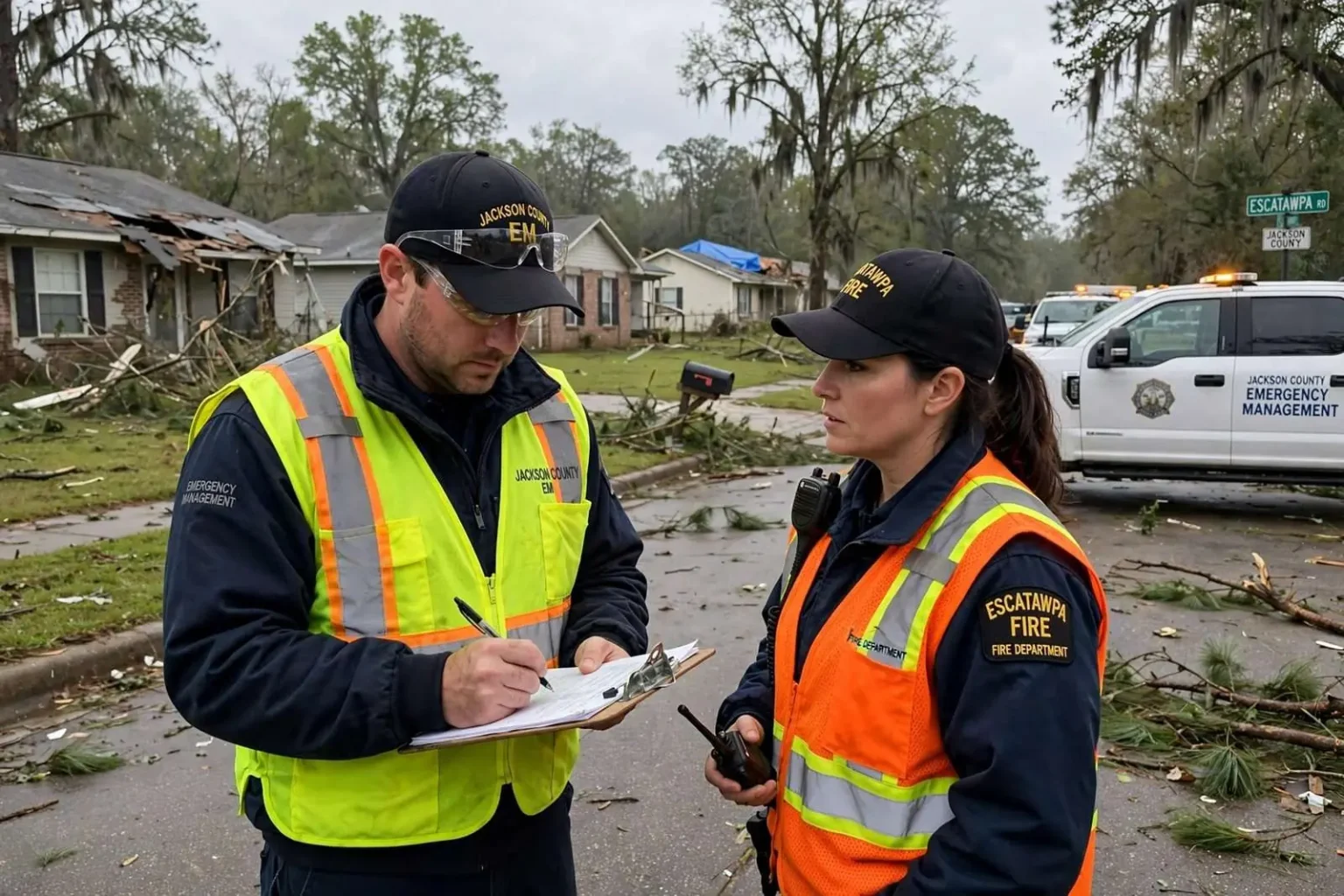
ESCATAWPA, Miss. — First responders are surveying damage in Escatawpa after what is believed to be a tornado moved through the area early Sunday morning, leaving a trail of damaged homes along the Gulf Coast of Mississippi. Preliminary reports put the number of damaged homes at 13, according to officials, who said most of the damage appears to be minor.
No injuries have been reported, a fact that officials credit to a combination of timing and warning. The storm came through in the early morning hours, when most residents were home and sheltered, and crews arriving after daybreak found damage to structures rather than to people. Emergency personnel spent Sunday assessing the path of the storm and checking on residents one by one as daylight revealed the extent of the impact in the Jackson County community.
Escatawpa is an unincorporated community in Jackson County, Mississippi, situated in the coastal plain near Pascagoula and Moss Point. The area’s neighborhoods are a mix of older homes and newer construction, and the region has a long and well-documented history of severe weather. Spring and fall storm systems regularly track across south Mississippi, and tropical systems approaching the Gulf Coast add to the region’s exposure, making tornado damage surveys a familiar routine for emergency managers in Jackson County.
First responders began their work as soon as conditions allowed, moving through affected streets to account for residents and to catalog the damage. The preliminary count of 13 damaged homes is expected to be refined as the assessment continues, and officials emphasized that most of the damage observed so far has been minor — the kind that affects roofs, siding, porches, and trees rather than destroying structures outright.
How tornado damage surveys work
When a suspected tornado strikes the Gulf Coast, determining what actually happened falls to a coordinated assessment effort. Emergency management agencies walk the damage path on the ground, while the National Weather Service office responsible for the region conducts its own survey to determine whether a tornado occurred and, if so, how strong it was. The weather service assigns a rating on the Enhanced Fujita scale based on damage indicators — the way trees, signs, roofs, and walls failed — because direct wind measurements at a tornado’s location are rarely available.
Those survey results matter for residents in practical ways. An official tornado rating helps county and state agencies document the event for potential assistance, informs insurance claims for homeowners, and feeds back into the weather service’s long-term understanding of how storms behave along the Gulf Coast. For a community like Escatawpa, the difference between minor straight-line wind damage and even a weak tornado can affect how repairs are documented and how the event is recorded.
In the immediate aftermath, the priority for first responders is simpler: make sure every resident is accounted for and safe. Crews checking on residents look for structural hazards, downed power lines, gas leaks, and blocked roadways, and they connect families with any assistance they need. Jackson County’s emergency management structure, which coordinates fire, law enforcement, and public works responses across the county’s unincorporated communities, is built around exactly this kind of post-storm assessment.
The storm that struck Escatawpa early Sunday was part of a broader weather system affecting the Gulf Coast region, where severe thunderstorms can spin up brief tornadoes with little distinction between one community and the next. Residents in the affected area were urged to report damage to county authorities so that assessments could be as complete as possible, and to be cautious around damaged structures until utilities and officials had cleared them.
For residents of south Mississippi, the early Sunday storm was a reminder of how quickly severe weather can develop along the Gulf Coast, particularly during the overnight hours when warnings are harder to receive. Emergency officials across the region consistently urge residents to have multiple ways to get warnings — a NOAA weather radio, phone alerts, and local media — because nighttime tornadoes are among the deadliest, striking while families are asleep and less likely to hear a siren or see an alert.
The fact that no injuries were reported in Escatawpa despite 13 damaged homes reflects both that preparedness and an element of fortune. Minor damage suggests the community was on the edge of the storm’s path or that the suspected tornado was relatively weak, and officials noted that most of the affected homes will need repairs rather than replacement. Even so, the response treated the event with full seriousness, as post-storm surveys always do — the difference between minor and major damage is often a matter of a few blocks or a few minutes.
Damage assessment in unincorporated communities like Escatawpa relies on coordination among several agencies. Fire departments that serve the area handle initial welfare checks, county road crews clear debris from streets, utility workers restore any service interruptions, and emergency management compiles the totals that feed state and federal reporting. In Jackson County, that structure has been refined through years of hurricanes, floods, and tornadoes, and the county’s emergency operations plan assigns each of those roles in advance so that a Sunday morning storm triggers a familiar sequence.
The region’s severe weather history
The Mississippi Gulf Coast sits in a region where tornado risk is elevated year-round. Unlike the plains, where tornado season concentrates in spring, the Gulf Coast sees two peaks — one in late winter and early spring, and another in the fall — driven by storm systems that ride along the coast and by the remnants of tropical systems. Jackson County and its neighbors along the state line with Alabama have experienced destructive tornadoes over the years, and local emergency managers treat every warning as though the next damaging storm could come at any time.
That history shapes how residents respond. Many homes along the coast are built or retrofitted with severe weather in mind, and community awareness of warning signs is generally high. Still, the suspected tornado that moved through Escatawpa early Sunday illustrates the practical limits: storms arriving after midnight leave little time for preparation, and the first many residents knew of the damage was when they stepped outside after daybreak to find downed limbs and damaged roofs in their neighborhoods.
Officials said the path assessment was continuing, with crews following the damage track to determine the storm’s full extent. Residents whose homes were damaged were encouraged to document the effects with photographs and to contact their insurance carriers once the immediate safety checks were complete. County authorities also asked residents to avoid approaching downed power lines or entering structures with visible structural damage until inspectors had evaluated them.
As Sunday wore on, the picture in Escatawpa settled into a recovery routine familiar across the Gulf Coast: crews clearing debris, neighbors helping with tarps and tree removal, and emergency managers finalizing the damage count that will define the event in the official record. Thirteen damaged homes, most of them with minor damage, and no injuries — for a community that knows how much worse severe weather can be, the outcome was one emergency officials described as the best result possible under the circumstances.
The suspected tornado in Escatawpa also prompted reminders from officials about the steps residents can take before the next storm arrives. Emergency managers recommend that every household in the coastal region maintain a basic plan: know where in the home to shelter — a small interior room on the lowest floor, away from windows — keep shoes, helmets, and flashlights accessible, and store important documents where they can be grabbed quickly. Those preparations cost little and are credited time and again with reducing injuries when storms strike with little notice.
Homeowners in the affected area will now turn to the repair process, and officials offered practical guidance for that stage as well. Residents should be wary of contractors who appear unannounced after storms offering quick repairs for upfront payment, a recurring problem in Gulf Coast communities after damaging weather. Verifying licenses, getting written estimates, and paying only as work is completed are the standard protections. Photographs taken before cleanup begins also help ensure that insurance claims accurately reflect the damage the storm caused.
County crews and utility workers, meanwhile, continue working through the storm’s path. Tree and limb removal is typically the most visible part of the recovery, and in neighborhoods with mature oaks and pines — common across Jackson County — fallen trees account for much of the damage even in minor tornado events. Power interruptions are usually restored within hours of a minor event, but downed lines must always be treated as live until workers confirm they are de-energized.
The early morning storm that swept through Escatawpa will be remembered locally for its damage count and its timing, but the outcome officials emphasized most was the absence of injuries. Thirteen homes damaged, most of them minor, and everyone accounted for — a result that reflects the warning systems, the preparedness of residents, and the rapid response of the first responders who walked the community’s streets as daylight revealed what the storm had left behind.