Ingalls Shipbuilding Plans to Hire About 3,000 Shipbuilders on the Mississippi Gulf Coast
Ingalls Shipbuilding in Pascagoula planned roughly 3,000 new shipbuilder jobs in 2021, with a hiring event, skilled-trades openings and full benefits.
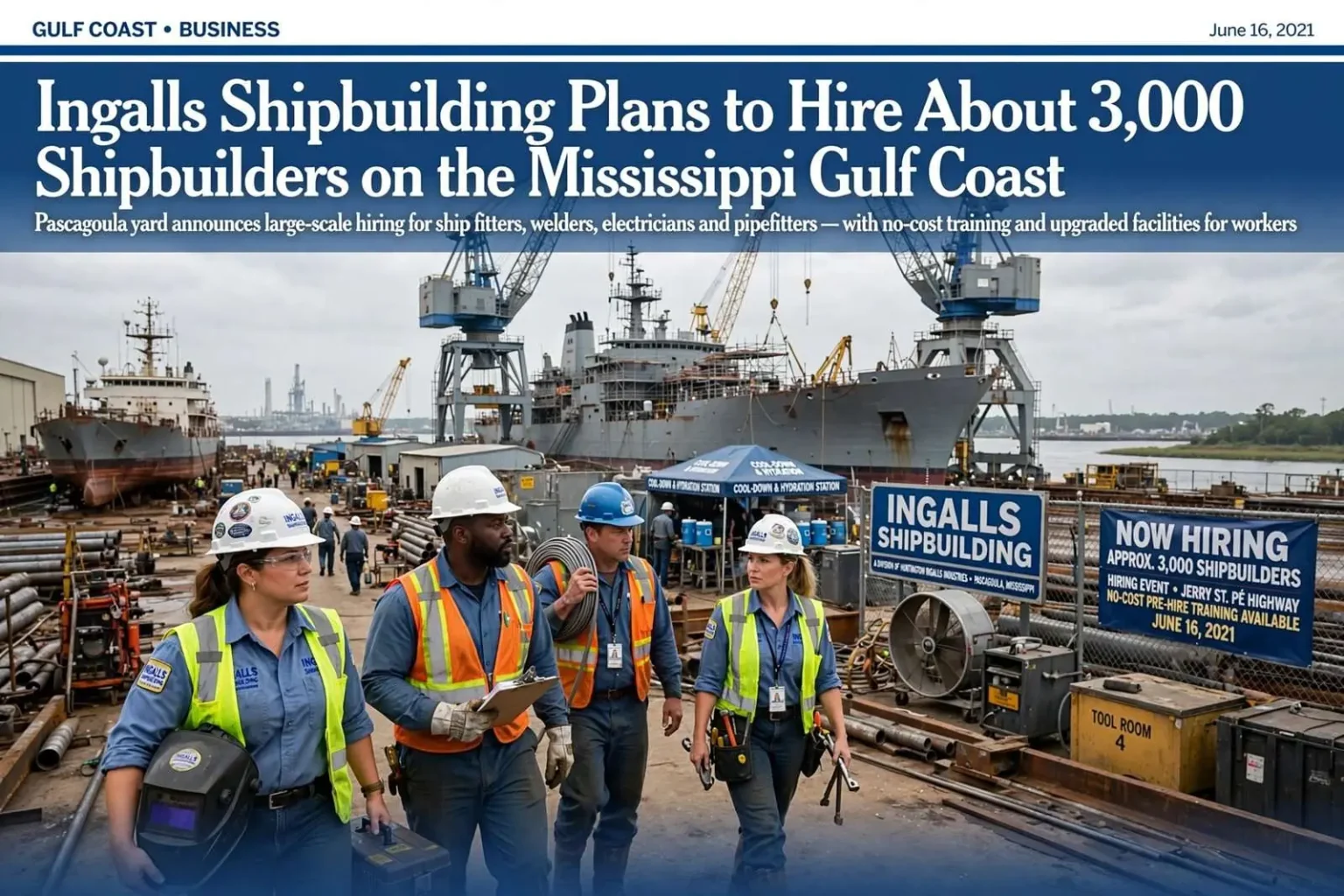
Ingalls Shipbuilding announced in June 2021 that it planned to add approximately 3,000 full-time shipbuilders at its Pascagoula yard as part of a long-term growth plan, and it invited job seekers to a hiring event the following day at the company’s new human resources building on Jerry St. Pé Highway. The announcement was one of the largest single hiring pushes in recent memory on the central Gulf Coast, and it put thousands of skilled-trades positions within reach of workers across south Mississippi and south Alabama.
The Huntington Ingalls Industries division said its recruiting team had been working across Mississippi, Alabama and Louisiana, with openings for ship fitters, electricians, pipefitters, pipe welders and structural welders. Applicants with mechanical, hot work or carpentry experience were especially sought, and no-cost pre-hire training was available to those who lacked the required skills.
The training offer lowered one of the traditional barriers to entry into the shipyard’s trade careers. Workers who had experience in construction, industrial maintenance or fabrication could translate those skills into shipbuilding roles, while candidates with aptitude but no formal background could acquire the basics through the company’s training programs before ever starting on the floor.
Competitive Pay and Expanded Facilities
Company president Kari Wilkinson described shipbuilding as “challenging, extremely rewarding and potentially life-changing” and pointed to stable, full-benefit positions. Benefits included competitive pay, health insurance, 12 paid holidays a year and an on-site health care clinic for shipbuilders and their families.
The yard had also recently finished facility upgrades aimed at improving the daily experience of the people who build ships there: more than a million square feet of covered work area, better access to worksites and tool rooms, cool-down and hydration stations, and a second dining area that included a Chick-fil-A. The investments signaled how seriously the company was courting workers in a competitive labor market, where shipyards, construction firms and industrial plants across the Gulf Coast were all chasing the same skilled tradespeople.
Covered work areas matter in a climate like the central Gulf Coast, where summer heat and afternoon thunderstorms can slow outdoor work. Hydration stations and cool-down areas similarly reflect lessons learned about safety and productivity in the region’s punishing humidity, and they address the kind of quality-of-life details that workers weigh when choosing between employers.
The hiring event itself took place at the new human resources building on Jerry St. Pé Highway, a thoroughfare named for the longtime Ingalls leader whose career spanned the yard’s growth into one of the region’s dominant employers. Hosting hiring events in a dedicated facility rather than scattered offices allowed the company to process large numbers of applicants efficiently.
Building the Talent Pipeline
Vice president of operations George S. Jones emphasized longstanding partnerships with local schools and community groups to keep training opportunities within reach for people considering a shipbuilding career. Those partnerships extend the company’s recruiting reach well beyond its own hiring hall, feeding the yard with graduates who arrive already familiar with the trades the work demands.
Edmond Hughes, vice president of human resources and administration, called Ingalls Mississippi’s largest industrial employer and said continuing investment in the employee experience was essential to attracting the workers needed to build the Navy’s ships. In his framing, the battle for skilled labor is won in the details — pay, benefits, facilities and career paths — long before a résumé ever crosses a desk.
The scale of the operation makes those details matter. The Pascagoula yard is the largest employer in the region and one of the biggest industrial sites on the Gulf Coast, assembling complex warships that represent years of work from thousands of hands. Every class of ship the yard builds depends on a steady flow of new workers to replace retirees and support expanding schedules.
For educators on both sides of the state line, announcements like this one shape curriculum decisions as well. Community colleges and technical programs across south Mississippi and south Alabama train welders, electricians and pipefitters specifically because employers like Ingalls can absorb graduates at scale, often with hiring pipelines that move students from classroom to dockyard.
What It Means for South Alabama
For South Alabama readers, the announcement mattered well beyond the state line: Pascagoula sits just across Mobile Bay, and Gulf Coast shipyard jobs have long drawn commuters and relocating workers from Mobile and Baldwin counties. Thousands of area residents cross the water on Interstate 10 each day to work at the yard, making the shipbuilding industry a direct part of the Mobile-area economy as well as Mississippi’s.
The commute is a familiar feature of Gulf Coast life. The drive from Mobile to Pascagoula runs along the bay and through the tunnel and bridge crossings of the I-10 corridor, and workers from as far away as Gulf Shores and the eastern shore routinely make the trip for the steady pay and benefits the yard offers.
A hiring wave of that size also ripples through the wider economy. New shipbuilders buy houses, rent apartments, eat at local restaurants and pay taxes in communities from Pascagoula to Mobile, and the yard’s growth supports subcontractors and suppliers throughout the two-state region.
The Work Behind the Warships
The trades Ingalls was hiring for represent the backbone of ship construction. Ship fitters fit and align the steel components that form a hull, electricians run the miles of cabling that power modern warships, and pipefitters and welders build the systems that carry fuel, water and steam through a vessel. Structural welders, in particular, perform some of the most consequential work on any ship, since the integrity of every hull depends on their joints.
These are careers, not just jobs. The yard’s model has long been to hire entry-level workers, train them through apprenticeship-style programs and advance them into certified specialties, leadership roles and higher pay grades over time. A worker who starts as a helper in their twenties can retire decades later with a pension-level skill set and a resume of work on ships that serve the nation’s fleet.
The stability of that path is a large part of the yard’s appeal in a region where employment has historically swung between tourism, fishing, seafood processing and construction. Shipbuilding work is tied to Navy and Coast Guard contracts that span years, giving workers a predictability few other Gulf Coast industries can match.
A Regional Anchor Industry
The June 2021 hiring push also reflected the yard’s position in the national defense industrial base. Ingalls is the sole builder of several classes of Navy surface combatants and amphibious ships, and the pace of national shipbuilding plans depends directly on the yard’s ability to staff up. Every thousand workers hired translates into hulls delivered on schedule.
For job seekers, the practical takeaway was straightforward: show up prepared. Hiring events for trade positions typically move quickly, with applicants able to interview, test and, in some cases, receive conditional offers on the spot. Candidates who brought documentation of their experience — certifications, prior work history, military service records — moved fastest through the process.
Veterans have long been a core part of the shipyard’s workforce, and the skills learned in military service translate naturally into shipbuilding. The yard’s recruiting across Mississippi, Alabama and Louisiana targeted exactly that overlap, reaching into communities with strong traditions of both military service and industrial work.
The announcement’s promise of no-cost pre-hire training underscored the same point from the other direction: the company was willing to invest in workers who had the aptitude and work ethic but not yet the credentials, an approach that widens the pipeline beyond those who can already afford trade school.
The Pascagoula Yard’s Place in Gulf Coast History
The shipyard’s roots on the Pascagoula riverfront go back more than eight decades, and generations of Gulf Coast families have built careers — and lives — around its rhythms. Parents and children have worked the same ways, whole neighborhoods have risen around the shifts and schedules of the yard, and the company’s paychecks have underwritten households across two states.
That history gives the 2021 hiring push a significance beyond the raw number of jobs. Each wave of new hires represents a renewal of that tradition, bringing in workers who will learn the trade from the veterans already on the floor and carry it into the next decade of naval construction.
The yard’s presence also shapes the identity of the communities around it. In Pascagoula and neighboring towns, the sight of ships under construction on the waterfront is part of everyday life, and the yard’s fortunes are followed the way other regions follow sports teams. When the company grows, the region feels it; when schedules tighten, the same is true.
Advice for Interested Applicants
For South Alabama residents considering one of the 3,000 openings, the path typically starts with the company’s careers portal or a hiring event, where recruiters match an applicant’s background to an open trade. Those with no prior experience can ask specifically about pre-hire training, which covers the foundational skills needed to succeed in the shipyard’s entry-level programs.
Applicants should be prepared for the physical realities of the work. Shipbuilding takes place outdoors and in covered but open-air facilities, involves heavy materials and demanding schedules, and rewards the same traits as any serious trade: reliability, attention to detail and the willingness to learn from seasoned craftsmen.
In exchange, successful hires get what Wilkinson described — a stable, full-benefits position with real room to advance, building ships that their families and their region can point to for decades. For workers across Mobile and Baldwin counties willing to make the commute across the bay, the 3,000-job expansion stood as one of the largest career opportunities the Gulf Coast had seen in years.