Crime Jackson County Mississippi
Two Jackson County Meth Manufacturers Sentenced to Decades in Federal Prison
Two Jackson County, Miss. meth manufacturers were sentenced to 20 and 14 years in federal prison after a Gulf Coast task force investigation.
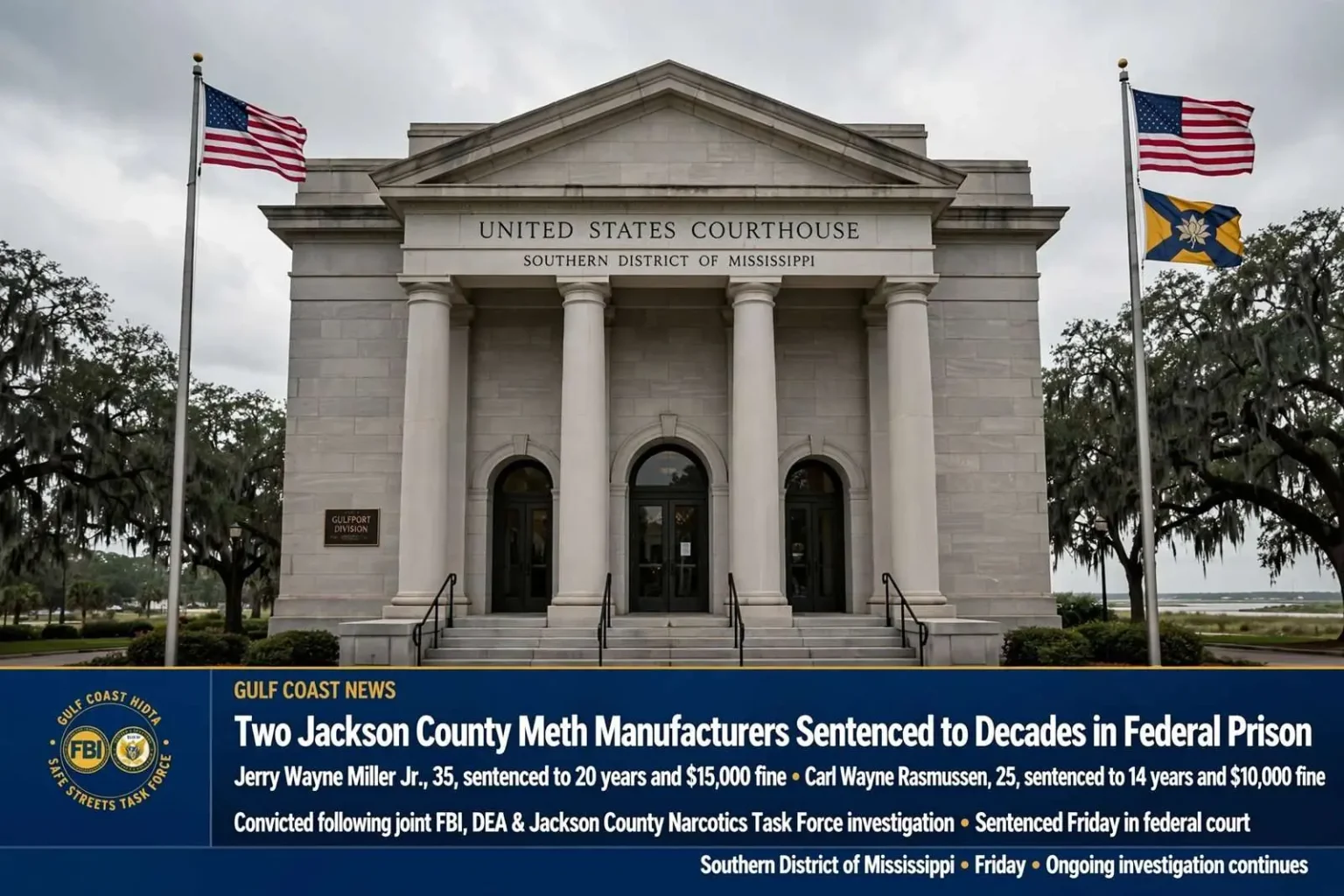
Two men who produced and distributed methamphetamine in the Jackson County, Mississippi area have been sentenced to lengthy federal prison terms.
Jerry Wayne Miller Jr., 35, received 20 years in prison and a $15,000 fine, while Carl Wayne Rasmussen, 25, drew 14 years and a $10,000 fine at Friday’s sentencing in federal court.
The sentences grew out of an investigation into illegal drug activity on the Mississippi Gulf Coast that was worked jointly by the FBI, the Drug Enforcement Administration and the Narcotics Task Force of Jackson County.
The FBI Safe Streets Task Force that targeted the pair is part of the Gulf Coast High Intensity Drug Trafficking Area initiative funded by the Office of National Drug Control Policy. Its roster includes FBI special agents working alongside officers from the Pascagoula, Moss Point, Gautier and Ocean Springs police departments, the Jackson County Sheriff’s Office and the Mississippi Bureau of Narcotics.
Federal Sentencing Rules and the Task Force’s History
Federal prosecutors said the multi-agency investigation remains active as authorities continue to pursue meth production and distribution networks along the Coast.
The terms imposed — twenty years for Miller and fourteen for Rasmussen, with no mention of parole — reflect the arithmetic of federal drug sentencing, which differs sharply from state practice. Federal sentences are served at a minimum of 85 percent of their imposed length under truth-in-sentencing provisions, meaning Miller’s term amounts to at least seventeen years in actual custody, and neither man will face the parole board process that governs most state sentences. Federal prosecutors typically seek these cases when the evidence — quantities, prior records, conspiracy involvement — supports the longer exposure, and when a multi-year investigation has documented activity across jurisdictions, as the Gulf Coast task force structure is built to do.
The investigation that produced the sentences was itself a case study in the layered enforcement structure that has developed along the Mississippi Gulf Coast over the past two decades. The FBI’s Safe Streets Task Force program, launched nationally in the early 1990s, exists precisely to fuse federal investigative authority — wiretaps, grand jury subpoenas, federal charges with their longer sentences — with the street-level knowledge of local officers who know the neighborhoods and the players. On the Mississippi Coast, that fusion runs through the Gulf Coast HIDTA (High Intensity Drug Trafficking Area), one of the regional designations the Office of National Drug Control Policy uses to concentrate federal resources on corridors where trafficking is heaviest. HIDTA status brings shared intelligence systems, funding for task force officers, and coordination structures that tie the Coast’s agencies to counterparts across the Southeast.
Local Agencies and the Region’s Meth Problem
The local roster matters to how cases like this one develop. Officers from Pascagoula, Moss Point, Gautier, and Ocean Springs — the four municipalities that anchor Jackson County’s population — work the task force in rotation, bringing cases from their own jurisdictions into the federal pipeline. The Jackson County Sheriff’s Office adds coverage of the county’s rural expanses, and the Mississippi Bureau of Narcotics contributes statewide reach and its own case files. When an investigation like this one matures, it typically reflects months of coordinated work: controlled buys, surveillance, confidential informants, and the slow accumulation of the documented transactions that federal conspiracy charges require. The DEA’s role adds the specialized expertise in methamphetamine investigations that the drug’s supply chain demands.
Methamphetamine’s grip on the Gulf South shaped the enforcement posture behind these sentences. Mississippi, like much of the rural South, saw meth production and use surge through the 2000s and 2010s as the drug migrated from West Coast supply chains to local production and, later, to Mexican-sourced meth and its precursors. State lawmakers responded with some of the country’s strictest controls on pseudoephedrine sales, and enforcement shifted toward the trafficking networks that moved the drug in quantity. The Gulf Coast’s interstate corridors, port infrastructure, and highway connections to Atlanta, New Orleans, and Texas have made the region a persistent HIDTA concern, and meth remains among the most common drugs in federal prosecutions along the Coast.
The “remains active” language in prosecutors’ statement is more than boilerplate. Federal drug cases in the HIDTA system are typically developed as part of ongoing investigations rather than isolated arrests, and a sentencing like Friday’s often marks a waypoint — cooperation agreements, continued surveillance of the network’s remaining members, and the possibility of further indictments that the completed cases help support. Prosecutors leverage sentenced defendants in this structure: the certainty of long federal terms creates incentives for cooperation that can reach further up the supply chain than any single arrest. For the community, the practical effect is that a case with two named defendants often represents only the visible portion of a broader enforcement effort.
The Human Cost of Decades-Long Sentences
The ages of the two men — 35 and 25 — fit the demographic profile that drug court judges and treatment providers across Mississippi work with daily: men whose involvement in the trade began young and whose sentences will remove them from their families and communities for the decades that define a working life. Federal sentences of this length carry consequences that ripple beyond the defendants: for their children, whose parents will return in middle age; for the local labor market in industries that lose workers to incarceration; and for the taxpayers who fund the decades of custody that federal drug sentences impose. These costs are the backdrop against which the enforcement community weighs each prosecution — and the reason federal sentencing in drug cases remains a subject of national debate even as the cases continue to be brought.
For Jackson County residents, the case reflects the continuing presence of meth in their communities — and the enforcement machinery that responds to it. The task force structure means that a tip to a Pascagoula police officer, a Moss Point neighborhood complaint, or a highway stop by a sheriff’s deputy can all feed the same pipeline, and the sentences announced Friday are the visible end of that pipeline’s work. Authorities across the Coast have consistently urged residents to report suspected drug activity, framing community information as the raw material on which the task force structure depends. The investigation’s active status, prosecutors said, means that work continues — with the two sentences handed down Friday standing as the latest measure of its reach.
The federal courthouse where Friday’s sentences were imposed sits within the Southern District of Mississippi, the jurisdiction that handles federal prosecutions from the Coast’s six southernmost counties. Cases of this kind move through the district on a timeline measured in months from indictment to sentencing: defendants are arrested on criminal complaints or indictments, appear before magistrate judges for detention hearings, and — in the overwhelming majority of federal drug cases — resolve their charges by guilty plea rather than trial. The sentencing hearing itself, where a judge weighs the advisory guidelines range, the prosecution’s recommendation, and the defense’s arguments before imposing the final term, is the point at which the months of investigation become the years of custody that follow. Fines like those imposed on Miller and Rasmussen are a standard component, though collection on defendants facing decades of incarceration is often limited by their circumstances.
Mississippi’s Legal Response to the Meth Trade
The Safe Streets model’s emphasis on violent crime and gang activity connects drug enforcement to the broader public-safety concerns of the Coast’s communities. The task force structure was designed on the theory that drug trafficking, violent crime, and neighborhood decay feed one another — that the open-air markets and distribution networks which narcotics investigators target are the same phenomena residents experience as shootings, robberies, and fear. That theory drives the program’s structure: federal authority applied to the cases that local agencies identify as most damaging, with the longer sentences available in federal court serving as both punishment and deterrent. Cities the size of Pascagoula and Moss Point, whose own departments could not sustain multi-year investigations alone, gain through the task force the investigative capacity of a federal agency focused on their most persistent problems.
Methamphetamine enforcement in Mississippi carries a distinctive legal landscape shaped by the state’s own legislative history. Mississippi’s pseudoephedrine prescription law — enacted in 2010, requiring a doctor’s prescription for the cold medicines used in meth production — was among the first of its kind in the nation and was credited with a sharp drop in local clan-lab seizures. The enforcement focus that followed shifted toward finished meth imported through trafficking networks, which federal agencies investigate under the conspiracy and distribution statutes that produced Friday’s sentences. The shift matters to how residents understand the trade: the meth on the Coast today arrives largely through organized distribution rather than neighborhood labs, which places enforcement emphasis on the networks, quantities, and multi-agency coordination that cases like this one display.
For the neighborhoods where the trade operated, the sentences mark the removal of specific individuals whose activity residents experienced directly — traffic, strangers, the hazards that accompany drug production and distribution. Community organizations along the Coast pair the enforcement message with prevention and treatment resources: the drug courts that Mississippi pioneered among the nation’s, the treatment programs that the state’s corrections and health systems fund, and the faith-based recovery community that serves many of the region’s families. The balance between enforcement of the kind reflected in Friday’s sentences and the treatment infrastructure that addresses meth’s grip on users is the standing debate of drug policy in the region — one that plays out case by case, sentence by sentence, in courtrooms like the one where Miller and Rasmussen learned their futures.
The case closes with the defendants beginning long terms in the federal Bureau of Prisons system — assignments that can place them in facilities anywhere in the country, far from the Gulf Coast families they leave behind. The $15,000 and $10,000 fines join the restitution and forfeiture components that drug judgments carry, and the supervised release terms that follow custody will return both men to federal oversight in middle age. For the task force that built the case, the sentences are the outcome that justifies the months of coordinated work; for the investigation’s still-active status, they are a marker of progress in an effort that authorities describe as ongoing — the latest chapter in the Gulf Coast’s long-running effort to push methamphetamine and the violence that travels with it out of its communities.