Vancleave Man Accused of Selling State Road Equipment at Pawn Shops
A Jackson County road employee from Vancleave was charged with felony embezzlement for allegedly selling state road equipment at pawn shops; more arrests.
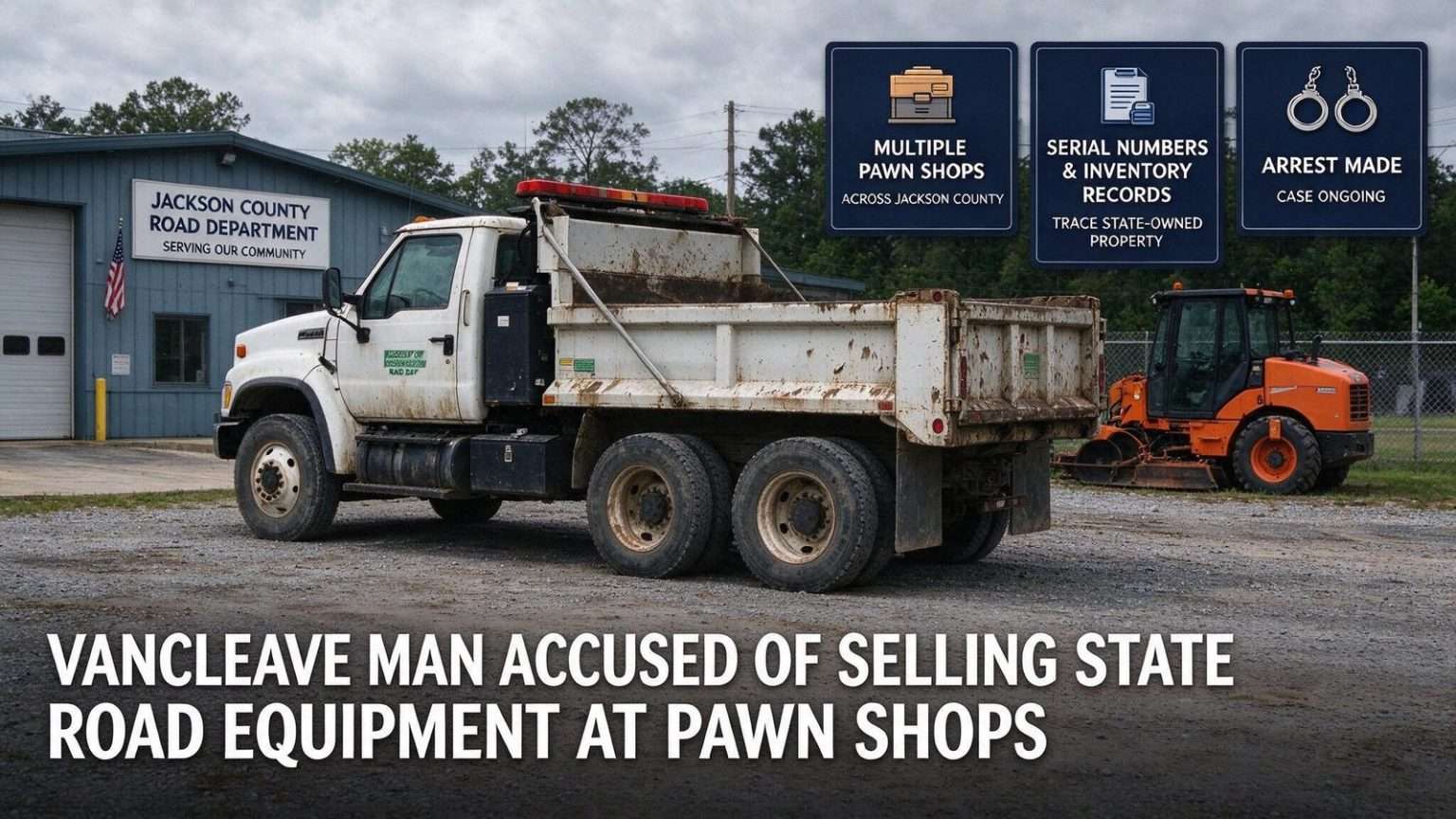
A Jackson County road department employee has been arrested on allegations that he sold state-owned equipment at multiple pawn shops across the county, according to the Jackson County Sheriff’s Office. Jonathan Wayne Smith of Vancleave was taken into custody this week after investigators tied a series of pawn transactions to property that belonged to the state.
According to investigators, the equipment involved has since been recovered through the Mississippi state auditor’s office, the agency charged with tracking and reclaiming public property when it goes missing. The recovery means the items can be returned to public service, but the criminal case against Smith is moving forward independently.
The arrest grew out of a cooperative investigation between the sheriff’s office and state authorities, who were able to trace the serial numbers and inventory records from the road department’s holdings to the shops where the equipment turned up. Pawn shop records, which Mississippi requires businesses to keep and make available to law enforcement, proved central to building the case.
The charges
Smith faces a felony embezzlement charge and was released from the Jackson County jail after posting a $10,000 bond. Embezzlement under Mississippi law covers the fraudulent conversion of property that has been entrusted to a person because of their position — a definition that fits a public employee accused of diverting government equipment for personal gain.
A felony conviction in Mississippi can carry prison time, fines and restitution, and public employees convicted of crimes against their agencies can face additional civil consequences, including demands for repayment through the state auditor’s office. Prosecutors have not said whether additional charges are being considered as the case moves toward an initial court appearance.
Sheriff Ezell noted that additional arrests are possible as the investigation continues, an indication that investigators are still reviewing transactions and interviewing potential witnesses in the case.
Vancleave and the road department
Vancleave is a growing unincorporated community in western Jackson County, along the Pascagoula River basin between the population centers of Pascagoula-Moss Point to the southeast and the Biloxi area to the southwest. The community is served by county departments rather than a municipal government, and the Jackson County road department maintains hundreds of miles of county roads across its districts, from grading rural lanes to repairing routes that carry heavy commuter traffic.
Road department equipment — tools, generators, small machines and shop gear — is inventoried by the county and, in many cases, tied to state or federal grant funding that paid for it. That funding trail is what brings the state auditor’s office into cases like this one, since property purchased with state money remains public property no matter where it physically ends up.
The state auditor’s role
The Mississippi Office of the State Auditor occupies an unusual and powerful position in state government. Beyond conducting routine audits of county and municipal books, the office is empowered to investigate the misuse of public property and funds, to demand restitution from those who misuse public assets, and to refer criminal matters to district attorneys for prosecution.
When public property surfaces outside government hands — in pawn shops, online marketplaces or private garages — the auditor’s office can seize and recover it, then issue demands for reimbursement against individuals found responsible. The office publishes regular reports of its recoveries and demands across the state, and cases involving county road departments and equipment are among its most common.
In this case, the recovery of the equipment through the auditor’s office suggests the property was still identifiable when investigators moved, allowing the items to be photographed, matched to inventory records and taken back into public custody as evidence and then as returned property.
Mississippi’s pawn shop paper trail
Mississippi law requires pawn shops to maintain detailed records of the items they take in, including descriptions, serial numbers when present, and identification from the person conducting the transaction. Those records must be available to law enforcement, and police and sheriff’s investigators across the state routinely check pawn logs when stolen or missing property reports come in.
The system is designed to make pawned stolen goods traceable, and repeated sales of similar items at multiple shops — as alleged here — stand out quickly once investigators begin pulling records. State law also places limits on who can legally conduct certain transactions and requires shops to hold items for a period before selling them, giving investigators a window to act.
Investigators in Jackson County have not said how many transactions are involved, the total value of the equipment, or over what period the sales allegedly took place. Those details are likely to emerge as the case proceeds through the court system.
Public corruption cases in Mississippi
Cases involving public employees accused of stealing from their agencies are prosecuted seriously in Mississippi, and the state auditor’s office has made such prosecutions a signature priority. The office has repeatedly argued that public trust depends on accountability when government workers convert public property to personal use, and legislators have strengthened the office’s authority to demand repayment in recent years.
For a county road department, the loss of equipment is more than a financial line item. Missing tools and machines slow road maintenance across a large rural county, and replacing them means either an insurance claim or an appropriation from county funds — money that ultimately comes from taxpayers. County administrators typically respond to such cases by tightening inventory checks, adding sign-out procedures and increasing audits of shop property.
What happens next in the case
Smith’s case will move through the Jackson County court system, beginning with an initial appearance and, if the case proceeds, a preliminary hearing or grand jury review. In Mississippi, felony charges can be brought by indictment after a grand jury reviews the evidence gathered by investigators and the state auditor’s office.
The $10,000 bond reflects a standard scale for non-violent felony allegations in the county, and conditions of release typically require the defendant to remain in the area and avoid contact with witnesses. Court dates have not been announced, and the case file will grow as investigators complete their review of the pawn records and inventory documents.
The sheriff’s office has not released the full incident report, and officials caution that the allegations are accusations at this stage. Smith is presumed innocent unless and until convicted in court, and the felony charge will be tested against the evidence as the case proceeds.
A reminder for other counties
Sheriff’s investigators and auditors across south Mississippi use cases like this to renew calls for aggressive inventory management in county government. Modern asset-tracking systems, periodic physical counts and serial number databases all make it harder for equipment to disappear quietly, and easier to prove a case when it does.
Residents who suspect misuse of public property can report concerns directly to the Jackson County Sheriff’s Office or to the state auditor’s office, which accepts tips about missing or misused government property. The investigation in this case continues, and authorities say more information will be released as it becomes available.
Jackson County’s size and reach
Jackson County, anchored by Pascagoula and stretching along the Mississippi Gulf Coast from the Alabama line west toward Biloxi, is one of the state’s larger counties by population. Its unincorporated communities — Vancleave, Hurley, Wade, Big Point and others — depend on county services for road maintenance, sheriff’s patrols and utility coordination, which makes the performance of departments like the road operation directly visible to thousands of residents.
The county’s road network faces constant wear from coastal weather, heavy truck traffic serving the shipbuilding and chemical industries along the Pascagoula River, and the steady growth of subdivisions in the Vancleave area. Keeping crews equipped is a year-round job, and equipment losses ripple quickly into delayed grading, patching and drainage work across the districts.
How embezzlement cases typically unfold
Investigators in cases of this kind usually start with a discrepancy — an inventory count that comes up short, a tip from a co-worker, or a chance discovery of government-marked property outside government hands. From there, the work is documentary: pulling purchase records, matching serial numbers, and building a timeline of when property left the shop and where it turned up.
Pawn transaction records give investigators dates, amounts and identification details, which can be cross-checked against work schedules and sign-out logs. When the pattern points to one employee, the case is presented to prosecutors, and the state auditor’s office may issue a demand for repayment covering the full value of the property involved, separate from any criminal sentence.
Sentencing in Mississippi embezzlement cases varies widely with the value of the property and the defendant’s record, but restitution is nearly always ordered, and public employees can lose retirement credits and eligibility for future public employment as a collateral consequence of a conviction.
The message from investigators
Sheriff Ezell’s note that additional arrests are possible signals that the investigation has not closed. Investigators may be reviewing whether others participated in or benefited from the transactions, or whether the property trail leads to additional shops or buyers. In similar cases around the state, the initial arrest has sometimes been followed months later by further charges as the audit of missing property widened.
For now, the equipment has been recovered, one arrest has been made, and the case is headed through the courts. The Jackson County Sheriff’s Office has not said when additional information will be released.