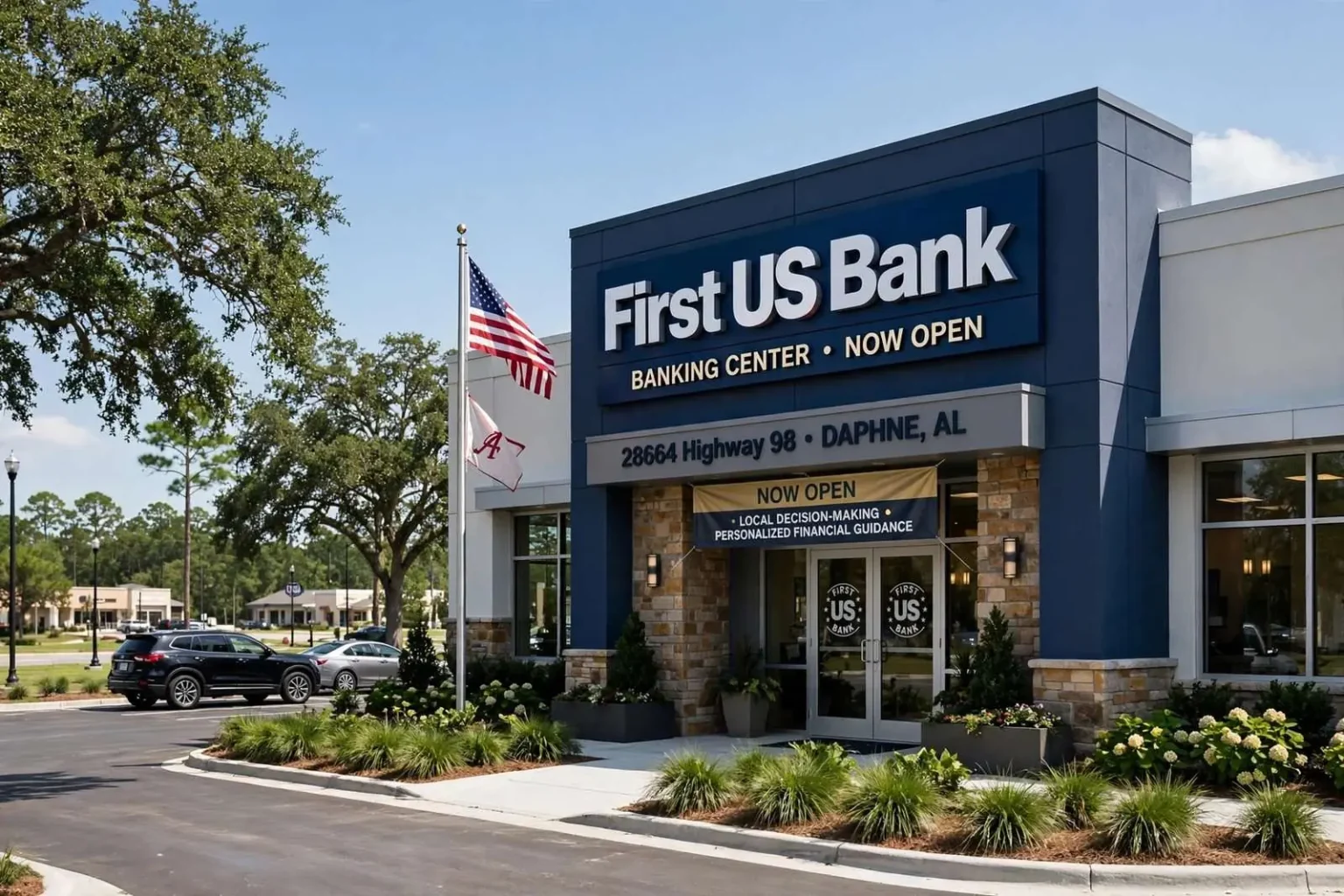
DAPHNE, Ala. — First US Bank has opened a new banking center at 28664 Highway 98 in Daphne, expanding the institution’s presence on the Eastern Shore. The bank describes the location as offering local decision-making alongside personalized financial guidance and service — a positioning that community banks have leaned on as regional and national institutions have consolidated branch networks across Baldwin County.
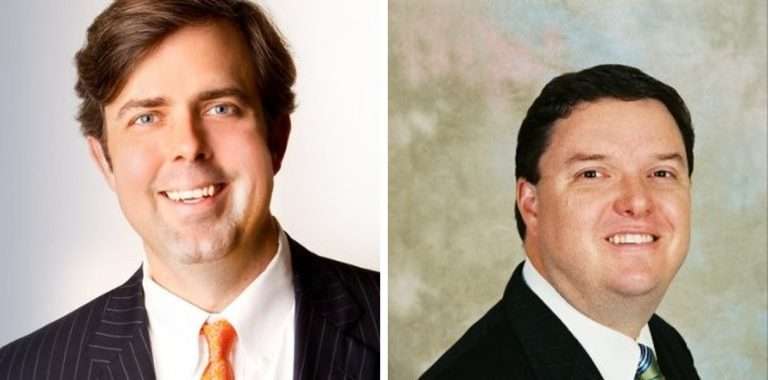
Leadership at the new location includes Banking Center Manager Liz Shearer and Senior Vice President and Market Executive Rob Downing. The pairing of a banking center manager with a market executive reflects the structure many community banks use to split day-to-day branch operations from broader commercial and lending relationships across a market.
For customers, the distinction between a branch and a banking center often comes down to services and staff. Locations of this kind typically handle everything a traditional branch does — deposits, accounts, consumer lending — while adding dedicated space and personnel for business banking, mortgages and wealth conversations, making them a working base for commercial customers as well as individuals.
What local decision-making means in practice
The emphasis on local decision-making carries practical weight for small business owners and prospective homebuyers. When lending decisions are made in the market rather than at a distant regional office, the underwriting conversation tends to account for context that does not appear on a credit application — a builder’s track record in the area, the seasonality of a coastal business, the specifics of a particular property.
That flexibility matters in a market like Baldwin County, where the economy blends tourism, construction, healthcare, retail and agriculture, and where a borrower’s circumstances rarely fit a template. A restaurant along the Eastern Shore freeway corridor has different cash flow patterns than a machine shop or a medical practice, and lenders who know the local market can structure credit around those realities instead of turning applicants away because they do not match a model.
Community banks have also argued that local decision-making shortens timelines. Without a remote credit committee in the loop, a loan decision can move from application to answer in days rather than weeks — a difference that can determine whether a small business catches a real estate opportunity or watches it pass.
Growth on the Eastern Shore
Daphne sits in one of the fastest-growing corridors in Alabama. Baldwin County has added residents at a pace that consistently outstrips state averages, and the Highway 98 corridor through Daphne has become a central commercial artery serving that growth. The route ties Daphne to Fairhope and Spanish Fort and funnels residents toward Mobile Bay commuter traffic, which has made the corridor a magnet for retail, medical offices, restaurants and now financial services.
New branch openings run counter to the broader industry trend, which has favored consolidation and digital channels. Banks that continue to invest in physical locations generally do so where population growth and small business formation justify the expense — conditions that describe the Eastern Shore fairly well.
The calculation is straightforward. A branch represents a long-term commitment of capital and staff, and institutions are willing to make it where household formation, business licenses and deposit growth support one. The stretch of Highway 98 around the new banking center has seen steady commercial development in recent years, with new roofs going up on everything from professional offices to quick-service restaurants, and each of those businesses becomes a potential banking customer.
Growth also changes what residents need from a bank. Newcomers arriving from other states open checking accounts and shop for mortgages; established residents refinance, expand or start businesses of their own. A banking center positioned in the middle of that activity can serve the whole lifecycle.
Banking access and the local economy
The banking center at 28664 Highway 98 is now open for business. Small business openings contribute to the economic diversity and resilience of local communities, and financial institutions play a supporting role in that process — a new business needs a depository relationship before it can accept its first payment, and most need credit long before they are profitable enough to self-fund growth.
New banking centers expand access to financial services and support local economic activity in less visible ways as well. Branch staff volunteer with community organizations, local lenders sit on nonprofit boards, and banking relationships often serve as the first professional network a young business owner builds. In markets dominated by out-of-town institutions, that civic footprint tends to thin; community-oriented banks make it a selling point.
These developments reflect confidence in the region’s growth prospects. An institution does not open a location in a market it expects to shrink, and the decision to invest along the Highway 98 corridor amounts to a forecast that Daphne’s population and commercial base will keep expanding.
That forecast has support in the county’s fundamentals. Baldwin County’s growth has been sustained for years by a combination of coastal quality of life, lower costs than neighboring Florida markets, and the pull of the Mobile metro area’s jobs, and the Eastern Shore cities have captured much of the residential and commercial development that follows. Schools, infrastructure and public safety demands have grown alongside the population, and each round of public investment brings more private construction in its wake.
A competitive banking market
Daphne’s banking market is crowded, with national, regional and community institutions operating within a short drive of one another. That competition tends to benefit consumers through rate and fee competition, and it raises the stakes on differentiation — which is where the local decision-making pitch comes in. Institutions that cannot compete on scale argue instead on service, speed and familiarity, and the new banking center’s positioning leans on all three.
For First US, the Daphne location deepens a presence in a submarket where relationship banking carries particular weight. The Eastern Shore’s small business community includes contractors, medical and dental practices, marine trades and professional services, many of them owner-operated and all of them dependent on a bank that understands the local rhythm of payrolls, permits and seasonal swings.
The events described in this report connect to broader patterns of growth and investment along Alabama’s Gulf Coast, where population gains have drawn financial institutions, retailers and service providers into markets that were rural a generation ago. For residents of Daphne and the surrounding communities, the opening adds a banking option close to home; for the corridor, it adds another signal that the Eastern Shore’s growth is expected to continue.
What it means for homebuyers
For homebuyers, the arrival of another full-service lender in Daphne lands in one of Alabama’s most active residential markets. The Eastern Shore’s housing stock has been in heavy demand for years, with buyers drawn by the school systems, the waterfront and the commute across Mobile Bay, and that demand has kept prices moving upward and inventory tight. In a market that moves quickly, buyers working with a local mortgage lender can move from pre-approval to offer without waiting on an out-of-market underwriting queue.
Local lenders also know the appraisers, insurance agents and title companies that make a closing happen, and that network familiarity can smooth transactions that would stall elsewhere. First-time buyers, meanwhile, often benefit from sitting across the table from a loan officer who can walk them through down payment assistance options and the realities of insurance costs in a coastal county — conversations that are harder to have through a website.
Supporting small business formation
Small business formation has been a quiet strength of the Baldwin County economy, with new enterprises launched in everything from marine services to specialty food. Each of those ventures needs a banking partner early: an account to receive revenue, a card processor, eventually a line of credit to bridge the gap between invoices and expenses. Community banks have historically supplied much of that early credit, precisely because their loan officers can sit down with a founder and understand the plan rather than score it.
The commercial relationships that result tend to deepen over time. A contractor who opens a first account at a local banking center often returns for equipment financing, then for a construction loan, then for the accounts that support a second crew. Multiplied across a growing county, those relationships explain why institutions keep building locations in markets where the population curve keeps rising.
Banking in a digital era
The physical expansion comes even as everyday banking moves to phones. Most deposits at any institution now arrive digitally, and branches have evolved from transaction centers into places where customers come for the conversations that matter — a mortgage, a business loan, an estate question. Banking centers are designed around that shift, with offices for private conversations rather than rows of teller windows, and staff who are measured on relationships rather than lines at the counter.
For older customers and small business owners, though, the physical location remains essential. Cash-intensive businesses still need a place to make deposits, and many residents prefer a banker they can meet in person when the stakes are high. A banking center on the corridor they drive every day keeps those services within reach.
The new location is staffed and accepting customers, with Shearer leading the banking center team and Downing overseeing the market. Residents and business owners along the Highway 98 corridor now have one more option within a few minutes’ drive — and another sign that the institutions watching Baldwin County’s growth curves expect them to keep climbing.