Fishing Rodeo on Dauphin Island to Proceed Despite Gulf Storm Threat
The 89th Alabama Deep Sea Fishing Rodeo will proceed as scheduled July 15-17 despite a tropical disturbance in the Gulf of Mexico.
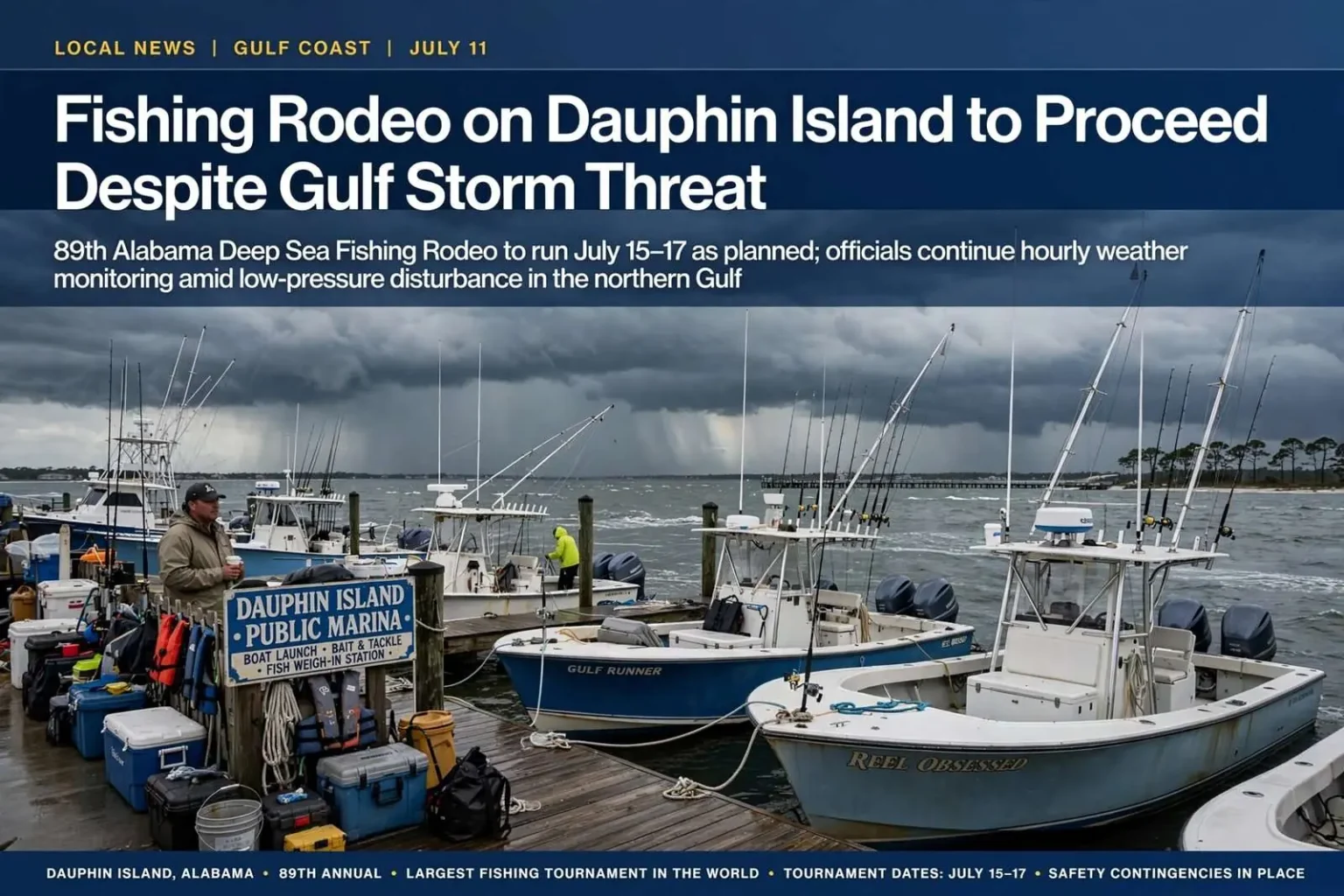
Organizers of the 89th Alabama Deep Sea Fishing Rodeo confirmed the tournament will go on as planned, even as forecasters watched an area of disturbed weather in the Gulf of Mexico ahead of the event. The announcement, made Monday, July 11, settled the question that had been building among anglers across the Gulf Coast as the tournament’s July 15-17 dates approached: the rodeo runs, and the weather gets watched.
Rodeo officials said that a tropical disturbance sitting in the northern Gulf had only a low chance of strengthening into a tropical depression or storm. Still, heavy rain and strong thunderstorms were expected along the Gulf Coast during the week leading into the tournament, and officials were taking nothing for granted. “We are closely keeping an eye on the weather building this week leading up to the 89th Alabama Deep Sea Fishing Rodeo and will continue to do so hourly,” officials said in a statement, adding that contingencies were in place for all events surrounding what organizers call the largest fishing tournament in the world.
A Storm Watch in Storm Season
Mid-July sits deep in the Atlantic hurricane season, and the northern Gulf of Mexico is a familiar birthplace for the season’s quick-forming systems. Disturbances that drift north from the Caribbean or develop over the warm Gulf waters can organize into tropical depressions with little warning, which is why coastal event organizers treat every blip on the satellite imagery with respect. The disturbance being monitored ahead of the rodeo carried only a low chance of development — but “low chance” is not “no chance,” and the difference between a rainy weekend and an organized storm can emerge over a day or two.
The forecast environment ahead of the tournament called for exactly the kind of conditions that complicate offshore fishing even without a named storm: heavy rain and strong thunderstorms expected along the Gulf Coast during the week leading into the event. Lightning is the immediate hazard for a fleet of small boats, and squall lines moving across the Gulf’s open water can develop faster than a boat running 20-plus knots can outrun them. Hourly monitoring, as the rodeo’s statement promised, is the standard approach for events that must balance a long-planned schedule against a sky that can change.
The Tournament and Its Traditions
The Alabama Deep Sea Fishing Rodeo, now in its 89th year, is a Dauphin Island institution — a fixture of the island’s summer that draws thousands of anglers and spectators across its three-day run. Organizers call it the largest fishing tournament in the world, a claim built on the sheer scale of the event: dozens of fish categories and weight classes, a judge’s stand where every catch is weighed and displayed, and a footprint that takes over much of the island for the weekend. Generations of Gulf Coast anglers measure their summers by the event.
The rodeo’s traditional opening comes even before the fishing does: the Liars’ Contest kicks off coverage on Thursday, July 14, the night before the tournament’s first lines go in the water. The contest — a Dauphin Island tradition in which fishermen tell increasingly improbable tales of the one that got away — sets the tone for the weekend, blending competition with the self-deprecating humor the fishing community is known for.
Safety as the Top Concern
Angler and patron safety, organizers said, remained the top concern — the principle that governs every weather decision a tournament of this size makes. A fishing rodeo cannot be rescheduled the way a stadium event can: its participants are spread across the open Gulf, from small bay boats to larger offshore vessels, each making its own judgment about sea conditions hours before the weighmaster ever sees them. The rodeo’s structure, with its judge’s stand on shore and its fleet at sea, means that weather safety starts with the anglers themselves and the forecast information they carry.
The contingencies officials referenced cover all of the events surrounding the tournament — the shoreside operations, the weigh-ins, the awards and the ancillary festivities that fill the island across the weekend. Contingency planning for Gulf weather is a well-practiced discipline on Dauphin Island, a community that has weathered hurricanes and tropical storms across its history and that plans every major public event with the season’s realities in mind.
One neighboring event did bend to the forecast: the Blue Marlin Grand Championship, originally slated to begin July 14, was pushed back to Thursday, July 21. The decision by the Blue Marlin’s organizers — a separate event based at Orange Beach — reflected the same calculus on a different scale. Blue marlin tournaments depend on boats running far offshore to the deep water beyond the continental shelf, often a hundred miles or more round trip, and a forecast full of thunderstorms makes those runs dangerous in ways a nearshore rodeo does not face. A one-week postponement preserved the event while keeping its fleet out of the weather window that had organizers on Dauphin Island watching hourly.
The contrast between the two decisions illustrates how differently weather shapes Gulf fishing events depending on where their boats go. The rodeo’s categories include inshore and nearshore species as well as offshore ones, and much of its fleet fishes within sight of Dauphin Island’s beaches; the Blue Marlin Grand Championship is, by design, a long-range offshore expedition. When a disturbance sits over the northern Gulf, the far-offshore event moves first.
What the Rodeo Means to Dauphin Island
For Dauphin Island, the rodeo’s July weekend is one of the year’s defining stretches. The island’s permanent population swells as anglers, families and spectators arrive for the weigh-ins, and the businesses that serve the island — restaurants, bait shops, marinas and rental houses — plan their summer around the tournament’s crowds. An 89-year run means the event has survived the Depression, wars, hurricanes and every other disruption the Gulf Coast has produced; its persistence is part of its identity, and organizers’ decision to proceed with the 89th edition despite the forecast fits that institutional character.
The rodeo’s economic reach extends beyond the island as well. Anglers book charters out of Mobile Bay and the waterfront marinas along the coast, fill fuel docks and grocery stores across south Mobile County, and carry the tournament’s reputation with them across the region. The claim of “largest fishing tournament in the world” is a marketing asset precisely because the event has, for nearly a century, actually delivered the crowds to back it up.
Reading the Forecast
The tournament’s opening days coincided with a forecast picture familiar to Gulf Coast residents: a disturbance with low development chances, but enough moisture and instability to produce heavy rain and strong thunderstorms along the coast. For anglers, such forecasts demand attention to timing — the difference between fishing through morning showers and running offshore beneath an afternoon squall line can be the difference between a successful trip and a dangerous one. Modern forecast tools, from marine weather radio to radar apps, put hourly updates in every captain’s hand, and the rodeo’s hourly monitoring statement matched the practice its participants follow.
The weather that ultimately greeted the fleet would be decided by the disturbance itself, but the rodeo’s planning had already accounted for the range of possibilities. Contingencies in place for all events, officials said — the phrase that reassures anglers who had spent the week watching the same satellite loops the organizers were.
The Weekend Ahead
The 89th Alabama Deep Sea Fishing Rodeo was set to run July 15-17 on Dauphin Island, with the Liars’ Contest opening the festivities Thursday, July 14. The tournament would proceed as planned, organizers confirmed, with hourly weather checks, shore and offshore contingencies, and a judge’s stand ready for the fleets that arrive every July. Down the coast, the Blue Marlin Grand Championship would wait a week, resuming Thursday, July 21, once the disturbed weather cleared its offshore grounds.
For the anglers, the families and the island that hosts them, the week’s message was the one Gulf Coast communities have learned across generations of storm seasons: respect the weather, plan for its worst, and — when the forecast allows — fish. The rodeo’s 89th year would go on as nearly a century of rodeos had before it, under a Gulf sky that organizers would be watching hour by hour until the last fish was weighed.
The rodeo’s timing within the summer calendar shapes both its weather exposure and its turnout. Mid-July is peak season for Gulf fishing: red snapper seasons in federal and state waters have historically run through the summer months, adding offshore pressure to the tournament’s usual inshore traffic, and the school calendar still leaves families free to make the trip to the island. The 89th edition’s July 15-17 dates put it squarely in that window.
That concentration of boats and people is why weather monitoring takes on such urgency in the tournament’s final week. A disturbance with low development chances still matters to an event that must coordinate thousands of participants, dozens of volunteers and the logistics of a judge’s stand weighing fish by the minute across three days. Organizers’ hourly checks, and the contingencies they described for all events surrounding the tournament, are the operational expression of the safety-first principle the statement emphasized.
How the Fleet Prepares
The anglers themselves make the first weather calls. Captains planning offshore runs study marine forecasts, check radar before dawn and decide morning by morning whether the grounds are reachable; inshore fishermen work the bays and beaches where thunderstorms are easier to outrun. The rodeo’s structure accommodates that variation — its categories span from speckled trout and flounder caught in Mobile Bay’s shallows to the blue marlin and other big-game species brought in from far offshore — so a weekend of marginal weather shifts effort toward the nearshore rather than canceling it outright.
The judge’s stand, where every fish is weighed in public, is the tournament’s heartbeat and its most weather-vulnerable piece of infrastructure. A three-day parade of anglers, families and spectators gathers there, which makes lightning and heavy rain as much a shoreside concern as an offshore one. Contingency planning for the stand and its surrounding events is part of the reason organizers could promise that contingencies were in place for all of the tournament’s surrounding events.
Storms and the Rodeo’s Long History
Nearly a century of operation means the rodeo has navigated severe weather before. Dauphin Island sits at the mercy of the Gulf’s hurricane seasons, and the island’s institutions have rebuilt after storms that reshaped its shoreline; the fishing tournament’s persistence through that history is part of what gives its “goes on as planned” announcements their credibility. Coastal event organizers across the region have learned from decades of hurricane seasons that early, frequent communication — like the Monday, July 11 statement — prevents the speculation that otherwise fills an ambiguous forecast week.
The same week’s decision by the Blue Marlin Grand Championship to move from July 14 to July 21 offered a real-time contrast in how two Gulf fishing events read the same weather. Both monitored the disturbance; each reached the decision its geography demanded. The rodeo stayed, its fleet mostly nearshore; the Blue Marlin’s long-range fleet stayed ashore for a week. Gulf Coast fishing, like Gulf Coast living, has always been a negotiation with the weather — and the week of July 11 gave the region a public demonstration of how that negotiation works.
Looking at the Week Ahead
With the tournament confirmed, the practical advice for anglers followed the forecast: watch the sky, respect the lightning, and file flight plans — float plans, in fishing terms — with someone ashore. Heavy rain and strong thunderstorms through the week meant launching decisions would be made daily, and the rodeo’s hourly monitoring promised that organizers’ own calls would come as early as the weather allowed.
The 89th Alabama Deep Sea Fishing Rodeo would run July 15-17 on Dauphin Island, the Liars’ Contest would open the week on Thursday, July 14, and the weighmaster’s stand would do what it has done for generations: weigh the fish, announce the leaders and draw the island’s summer crowds. The disturbance in the northern Gulf would be watched hourly — and the largest fishing tournament in the world, its organizers promised, would go on.