Flock Safety Cameras Face Reckoning in Alabama After Winners From Governor to Sheriff Campaigned on Limits
Newly elected Alabama officials, including Gov.-elect Tommy Tuberville, Lt. Gov.-elect John Wahl and Saraland's Rep. John Knapp, campaigned on rules or bans for Flock Safety license plate cameras, setting up a debate in the 2027 legislative session.
License plate cameras were not on the ballot in Alabama’s Nov. 3 general election, but they may have been on many voters’ minds. Across the state, candidates who won their races, from the governor’s office to county sheriff’s departments, spoke out during their campaigns about Flock Safety’s camera network, and their comments suggest that rules governing the system could become a major topic when the Alabama Legislature convenes for its 2027 session.
Concerns about the artificial intelligence-powered network center on potential misuse by law enforcement, the tracking of individuals and the sharing of collected data. Some law enforcement agencies have adopted their own policies, but several newly elected officials campaigned on stricter statewide mandates, and a few vowed to end their jurisdictions’ use of the cameras altogether.
One of the most outspoken critics summed up the political argument by urging that America be put first and its values protected.
Where Alabama’s incoming statewide officials stand
Gov.-elect Tommy Tuberville. The Republican U.S. senator from Auburn, who won the governor’s race on Tuesday, supports law enforcement but said on the campaign trail that he wants to ensure rules are in place to protect Alabamians.
Lt. Gov.-elect John Wahl. Wahl questioned the constitutionality of Flock Safety’s collection of data from private citizens and said citizens should be allowed to vote on the matter.
Attorney General-elect Katherine Robertson. Robertson said the state should have a uniform set of rules governing how the system is managed, rather than a patchwork of local policies.
Taken together, the positions of the state’s three top incoming officials suggest broad agreement that some kind of state-level framework is needed, even if they differ on how far it should go.
Yarbrough: “Does this uphold our vow?”
Another big winner in Tuesday’s general election was State Rep. Ernie Yarbrough, R-Trinity, perhaps the Legislature’s most vocal critic of Flock. Yarbrough has vowed to fight to protect Alabamians’ rights and said he believes the camera system’s tracking abuses the Fourth Amendment to the U.S. Constitution and the Alabama Constitution.
Yarbrough said legislators swear to uphold and defend the U.S. and Alabama constitutions, so the key question about Flock cameras is not whether they are useful for law enforcement but whether they uphold that vow.
Yarbrough said he believes Flock Safety was a significant factor in the midterm election.
He said that voters in Republican-leaning areas especially want to see whether officials will protect constitutional leverage and freedoms, emphasizing putting America first and protecting its values. He added that the conservative base is motivated when candidates act on conservative values, such as defending the Fourth Amendment.
A bipartisan issue in a Huntsville Senate race
The debate crossed party lines. In north Alabama, former State Sen. Sam Givhan, R-Huntsville, was unseated by newly elected State Sen. Jared Sluss, D-Huntsville.
Givhan said he did not believe the camera system violated the Constitution, but he said he planned to bring legislation to hold law enforcement accountable for misuse of the system. Sluss, meanwhile, campaigned in support of ending government contracts with Flock unless the state passed transparency reform requiring agencies to be open about the data they collect.
Saraland’s John Knapp: “Your movements are your business”
Closer to home, some candidates with law enforcement backgrounds who won their races also criticized the system. State Rep. John Knapp, R-Saraland, who won the House District 65 seat in Tuesday’s election, said abuse of the Flock camera system should be reined in.
Knapp’s campaign website stated that license plate cameras quietly track law-abiding citizens’ movements, storing and sharing data with little oversight, calling it an unacceptable mass surveillance system. The campaign pledged to push for clear limits on data collection, retention, and access, asserting that people’s movements are their own business.
Knapp’s position gives Mobile County a voice among the incoming lawmakers who want limits on data collection, retention and access when the issue reaches the State House.
Sheriffs-elect plan to end or review contracts
The issue also surfaced in county sheriff’s races.
Lee County Sheriff-elect Cam Hunt said Flock cameras can be used for legitimate law enforcement purposes, but said their use should be balanced against constitutional rights and individual liberties. He vowed to terminate the county’s contract with Flock Safety.
Madison County Sheriff-elect Brett Jones also said he would look into his county’s contract with Flock Safety and said he does not plan to renew it when it expires.
The national picture
Alabama was not alone. On the national stage, U.S. Sen.-elect James Talarico, D-Texas, said Flock Safety has no place in Texas, and Pennsylvania Gov.-elect Josh Shapiro said he would support a statewide ban.
The fact that critics include both conservative Republicans focused on the Fourth Amendment and Democrats focused on transparency and civil liberties is part of what makes the issue unusual, and part of why it could move quickly in legislatures that are otherwise sharply divided.
How the cameras work and how they spread
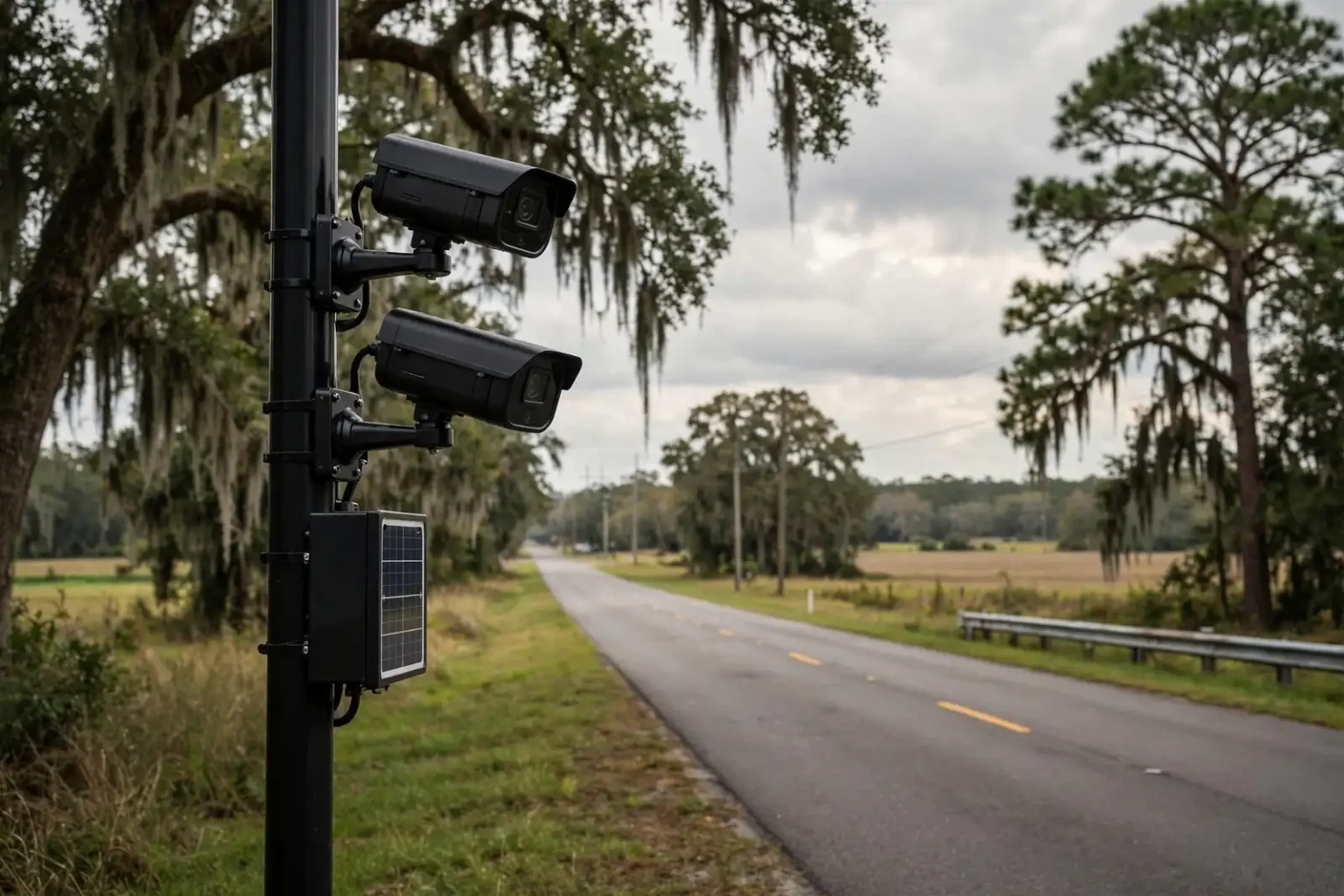
Flock Safety’s automated license plate readers are typically mounted on poles along roadways. The cameras capture images of passing vehicles, read their tags and log details that can be searched by law enforcement agencies, which use the system to look for stolen vehicles, wanted individuals and vehicles connected to crimes.
Cities across Alabama began deploying Flock cameras in 2019, often with approval from city councils rather than through state legislation. That local, contract-by-contract approach is one reason incoming officials such as Robertson are calling for uniform statewide rules.
The cameras have already been debated in south Alabama. In Baldwin County, Daphne Police Chief Brian Gulsby recently defended the city’s Flock cameras before the City Council and asked the city to add four more after some were damaged by vandalism and by Hurricane Isaias.
Flock Safety’s response
Flock Safety advertises success stories from agencies using its system and says communities should not have to choose between public safety and privacy.
The company has responded to criticism by reducing its default data retention period from 30 days to seven days, giving customers more control over data sharing, expanding audit requirements and establishing a multi-factor authentication process for users. Cities and counties are also reconsidering their own use of the system and the policies that govern it.
What to watch in the 2027 session
With a new governor, lieutenant governor and attorney general taking office, and with a number of newly elected legislators who campaigned on the issue, Flock Safety and license plate reader technology appear headed for a serious debate in Montgomery next year.
Based on positions taken during the campaign, proposals could include:
- Statewide rules on how long license plate data may be kept and who may access it;
- Transparency requirements that would force agencies to disclose what data they collect and how it is shared;
- Accountability measures for officers or agencies that misuse the system;
- Limits on new government contracts, or a requirement that voters approve them.
Law enforcement agencies that rely on the cameras are likely to argue that the technology helps solve crimes, while critics will press for guardrails, or an outright ban. How lawmakers balance those interests could determine whether the cameras that now line roads in cities across Alabama, including along the Gulf Coast, stay in place.
South Alabama News will follow the issue as the 2027 legislative session approaches.