Follow-Up Scan After Back Surgery Leads to Early Lung Cancer Diagnosis for Monroeville Woman
A follow-up CT scan after back surgery revealed early lung cancer in a Monroeville woman who never smoked, and surgery at a Pensacola hospital removed it before it spread.
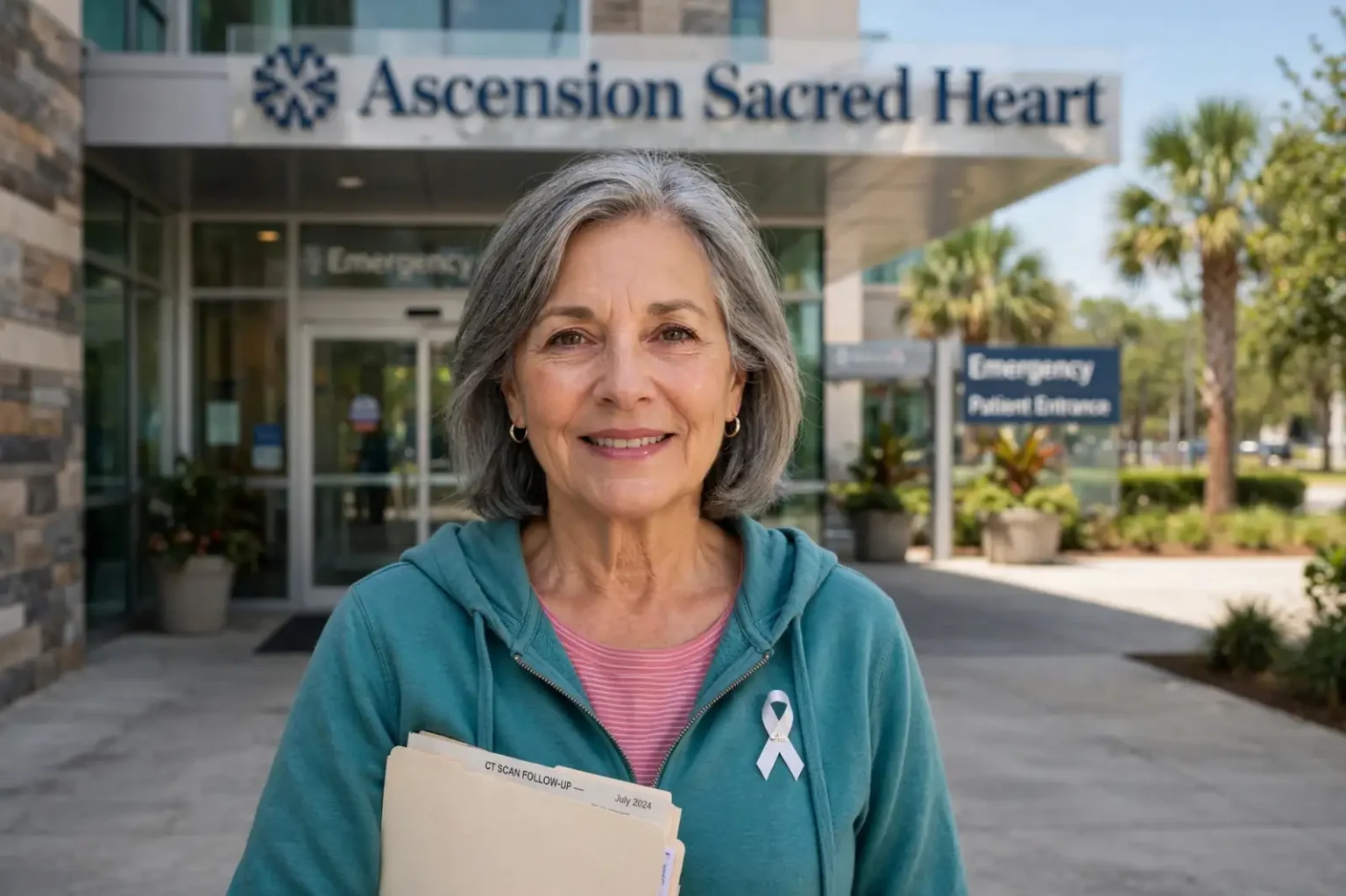
PENSACOLA, Fla. — A Monroeville woman who never smoked is cancer-free today because a CT scan ordered for an entirely different reason revealed a small spot on her lung. Her case, treated at Ascension Sacred Heart in Pensacola, is drawing attention during Lung Cancer Awareness Month to the value of finding early lung cancer before symptoms ever appear.
The woman had been recovering from her fifth back surgery. In July, she made the drive from her home in Monroeville, in Monroe County, to Pensacola for a routine follow-up CT scan connected to that recovery. The images showed something no one had been looking for: a nodule in one of her lungs.
A Surprise Finding on a Routine Follow-Up Scan
The woman said the news left her stunned and unsure what to do next. Because she had never smoked, she had assumed lung cancer was not something she needed to worry about, believing smoking was its only cause.
Medical teams at Ascension Sacred Heart ordered additional testing after the nodule was spotted. The hospital has a nurse navigator dedicated to incidental pulmonary nodules, meaning spots on the lung that are discovered by chance on scans done for other purposes. The navigator explained that whenever a radiologist reading any scan flags a nodule, the case is routed to her for follow-up.
A biopsy confirmed the nodule was cancer, a type of lung cancer not linked to smoking. The navigator noted that there is no way to know how long the tumor had been growing or what might have happened had it gone unaddressed.
Surgery, and No Need for Chemotherapy or Radiation
A few weeks after the diagnosis, the woman returned to the operating room, this time for her lungs. A thoracic surgeon removed roughly one-third of her right lung.
Because the cancer was found early, it had not spread. She did not need chemotherapy or radiation after surgery. Today she is walking, talking and breathing normally, and she recently reunited with the hospital staff who first told her she might have cancer.
She said she never felt afraid during the ordeal because of her faith, and she now describes her cancer simply as gone, adding that she is doing very well.
Why Early Lung Cancer Is Easy to Miss
The surgeon said many lung cancer patients are nonsmokers, and that the disease typically produces no symptoms in its early stages. He described it as a silent illness and said that is why doctors need to be more aggressive about finding it early, when it may still be curable. He added that the risk is even greater for people with a history of smoking.
Lung cancer is the deadliest cancer in the country. According to the American Cancer Society, more people die each year from lung cancer than from colon, breast and prostate cancers combined.
Smoking remains the leading risk factor, but it is not the only one. People who have never smoked can also develop the disease, with exposure to radon gas, secondhand smoke and air pollution among the recognized risk factors, along with certain genetic changes found in some lung tumors.
Who Should Get Lung Cancer Screening
The surgeon said the recommended age to begin lung cancer screening is 50. National guidelines tie that starting age to smoking history:
- The U.S. Preventive Services Task Force recommends a yearly low-dose CT scan for adults ages 50 to 80 who have a smoking history of at least 20 pack-years and who either still smoke or quit within the past 15 years.
- The American Cancer Society recommends yearly low-dose CT screening for people ages 50 to 80 who smoke or used to smoke and have at least a 20 pack-year history, regardless of how long ago they quit.
A pack-year is a way of measuring how much a person has smoked: one pack a day for one year equals one pack-year, so a pack a day for 20 years, or two packs a day for 10 years, would each equal 20 pack-years.
Because those guidelines are built around smoking history, someone like the Monroeville patient, who never smoked, would not typically qualify for routine screening. That is one reason hospital programs that track incidental nodules found on other scans can be so important. Anyone with questions about screening eligibility or a nodule found on a scan should talk with a doctor.
What Happens When a Lung Nodule Is Found
Lung nodules are common, and most turn out to be harmless. The surgeon said that when small nodules are found, patients will likely be advised to return for follow-up scans so doctors can watch for any changes over time. Larger or more suspicious nodules may call for additional imaging or a biopsy, as in this case.
Early Lung Cancer and Lung Cancer Awareness Month
November is Lung Cancer Awareness Month, a time when health organizations encourage people to learn their risk, ask about screening and take symptoms seriously. Warning signs that can appear as lung cancer advances include a cough that does not go away, coughing up blood, chest pain, shortness of breath and unexplained weight loss, but as this case shows, early lung cancer often causes no symptoms at all.
For residents of Monroe County and other rural parts of South Alabama, care often means traveling to larger medical centers along the Gulf Coast. In this case, a follow-up appointment for a back problem turned into a lifesaving catch.
For more health news from across the region, visit our Health and Wellness section or our Monroeville news page.