South Alabama Radiologic Sciences Program Celebrates Technology Week Through Student, Faculty and Graduate Stories
For National Radiologic Technology Week, the University of South Alabama is highlighting a student leader, a clinical coordinator and a graduate to show how its radiologic sciences program prepares imaging professionals.
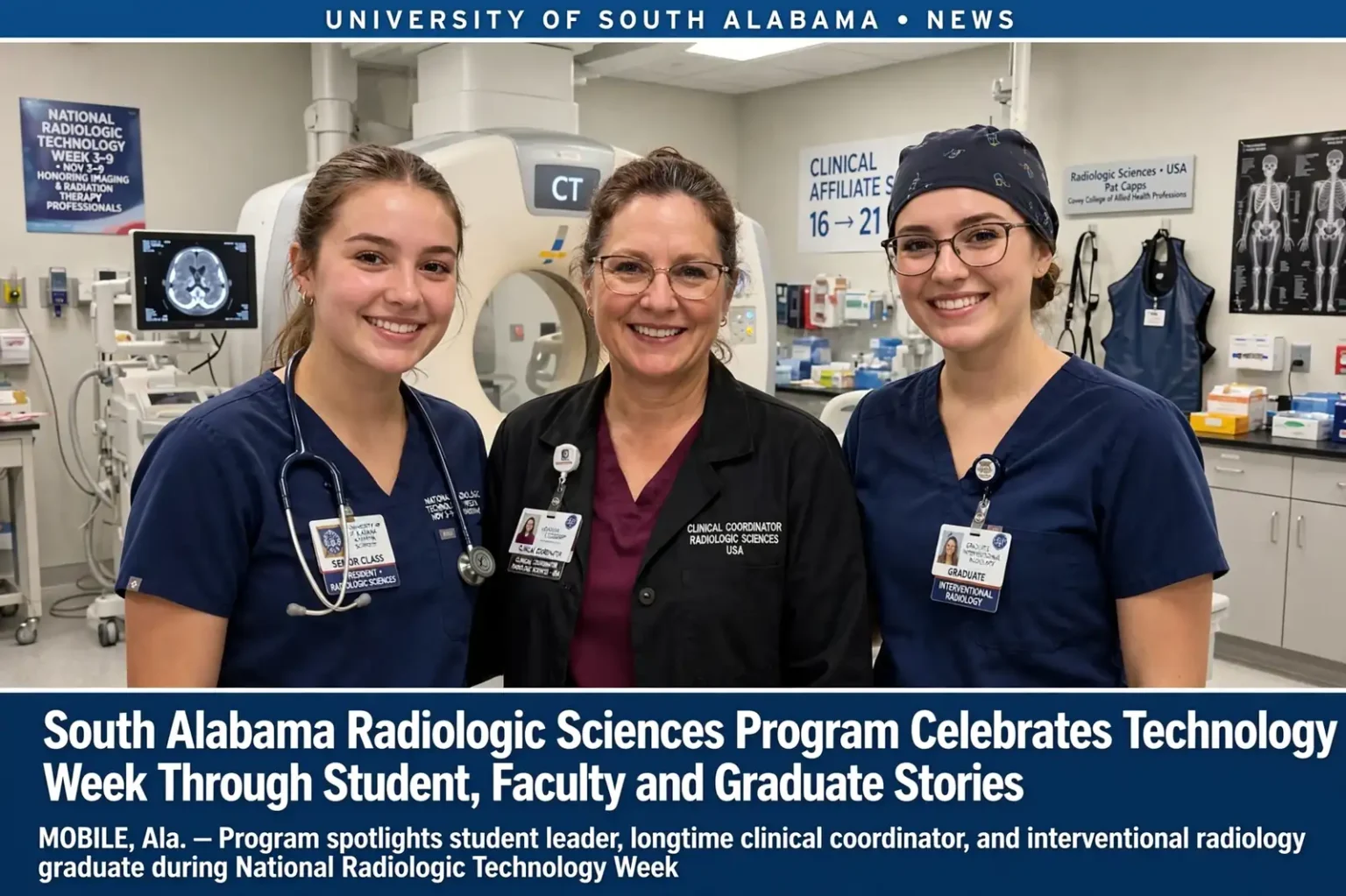
MOBILE, Ala. — Behind every X-ray, CT scan and radiation treatment is a technologist trained to get the image right while keeping the patient at ease. During National Radiologic Technology Week, the University of South Alabama is spotlighting the people who make up its radiologic sciences program, from a student leader preparing to graduate to a longtime instructor and a recent alum now working in one of the most demanding corners of hospital imaging.
The recognition comes from the university’s Pat Capps Covey College of Allied Health Professions, home of the Department of Radiologic Sciences. The college is using the week to show how classroom teaching, clinical training and mentoring combine to prepare graduates for careers in diagnostic imaging, computed tomography, interventional procedures and radiation therapy.
What National Radiologic Technology Week Recognizes
National Radiologic Technology Week is held each November during the week that includes Nov. 8, the anniversary of physicist Wilhelm Conrad Roentgen’s discovery of the X-ray in 1895. The observance, promoted nationally by the American Society of Radiologic Technologists, honors the medical imaging and radiation therapy professionals who work alongside physicians and nurses in hospitals, clinics and cancer centers.
Radiologic technologists position patients, operate imaging equipment and help produce the images doctors rely on to diagnose injuries and illness. Radiation therapists deliver the carefully planned radiation doses used to treat cancer. Both roles call for a mix of technical precision and steady, compassionate patient care, a balance the South Alabama program emphasizes throughout its curriculum.
Clinical Training Sites Have Grown From 16 to 21
One of the clearest signs of change in the department is the size of its clinical network. Under departmental leadership, the number of clinical affiliate sites where students train has grown from 16 to 21. That expansion gives students exposure to a wider range of healthcare settings, equipment and patient populations before they graduate.
The growth has paralleled a larger transformation in the field itself. A senior instructor who serves as the department’s clinical coordinator learned radiography in the era of traditional film and has since guided students through the profession’s full shift to digital imaging. She said the pace of technological change means education has to evolve just as quickly, and she credited department leadership with backing efforts to grow and adapt rather than stand still.
Radiologic Sciences Through a Student Leader’s Eyes
For the senior class president, the appeal of radiologic sciences was the chance to pair hands-on patient interaction with technical accuracy. She said the field lets her play a meaningful part in a patient’s care journey, and that South Alabama stood out to her as a place that would challenge her to grow for the sake of the patients she will one day serve.
In her leadership role, she has concentrated on supporting classmates and acting as a go-between for underclassmen and prospective students. She said having a trusted peer to turn to for advice can relieve a great deal of stress for newer students, and that serving in student leadership has taught her the value of teamwork and of being dependable for others.
Her clinical rotations in radiation therapy, where she sees the same patients day after day during their treatment courses, have deepened her appreciation for the personal side of care. Those daily encounters helped her sharpen her listening skills and learn to adapt, with guidance from faculty. She described the radiation therapy program director as a mentor who sets high expectations because patients deserve excellence, while also working to help students meet that bar.
Her message to incoming students is to set firm goals and hold themselves to them. She acknowledged that the program is rigorous and at times exhausting, but encouraged students to remember how far they have come and not let that progress slip away.
A Clinical Coordinator Who Followed Her Passion Into Teaching
The clinical coordinator originally entered imaging with plans to specialize in ultrasound. Instead, she found herself drawn to the quick pace and problem-solving demands of CT, and that enthusiasm eventually carried her into the classroom.
She said what keeps her motivated as an educator is knowing she has a hand, however small, in shaping the profession’s future. She described the reward of watching students who start out uncertain grow into confident, skilled technologists who go on to improve patient care.
When students head into clinical rotations or their first jobs, she encourages them to speak up for themselves, stay humble and stay engaged. A piece of advice she often shares is to be the kind of technologist they would want as a coworker and to remember what it was like to be a student. She also urges students not to wait for learning opportunities to be handed to them, to stay flexible and to step forward, noting that confidence builds with experience but growth begins with a willingness to take that first step.
A Graduate’s Path to Interventional Radiology
Not every student arrives knowing they want a career in imaging. One graduate of the program first applied to South Alabama planning to study nursing. After exploring other healthcare fields, she discovered radiologic sciences and changed her major before her freshman year began.
She said the chance to earn a bachelor’s degree while sampling different areas of radiology was a major draw. Her varied clinical rotations introduced her to interventional radiology, a fast-moving specialty she had never considered. Interventional radiology uses live imaging to guide minimally invasive procedures, and today she works full time in that field at a Mobile hospital, assisting with stroke and neurological procedures.
She credits faculty mentoring with preparing her for complex procedural work, describing an instructor who challenged her, pushed her to grow and helped her see she was more capable than she believed. She said much of the confidence she carries as a professional traces back to that guidance.
Her advice to current students is to make the most of every clinical opportunity, to say yes even when an assignment feels unfamiliar and to ask questions freely.
What the Program Prepares Graduates to Do
Taken together, the three perspectives illustrate the range of paths open to radiologic sciences graduates, from radiation therapy to CT to interventional work in hospital procedure suites. The college says the combination of classroom leadership, committed clinical instruction and attention to patient care is how the program prepares graduates to deliver precise and compassionate care.
Prospective students can learn more about allied health programs through the University of South Alabama. For more news from the campus, visit our University of South Alabama section or browse our Health and Wellness coverage.