University of South Alabama Mobile
USA Health Physician Takes Pediatric Critical Care Sedation Workshop to World Congress in Melbourne
A USA Health pediatric critical care physician helped lead a workshop on sedation, delirium and withdrawal in critically ill children at the WFPICCS world conference in Melbourne, Australia.
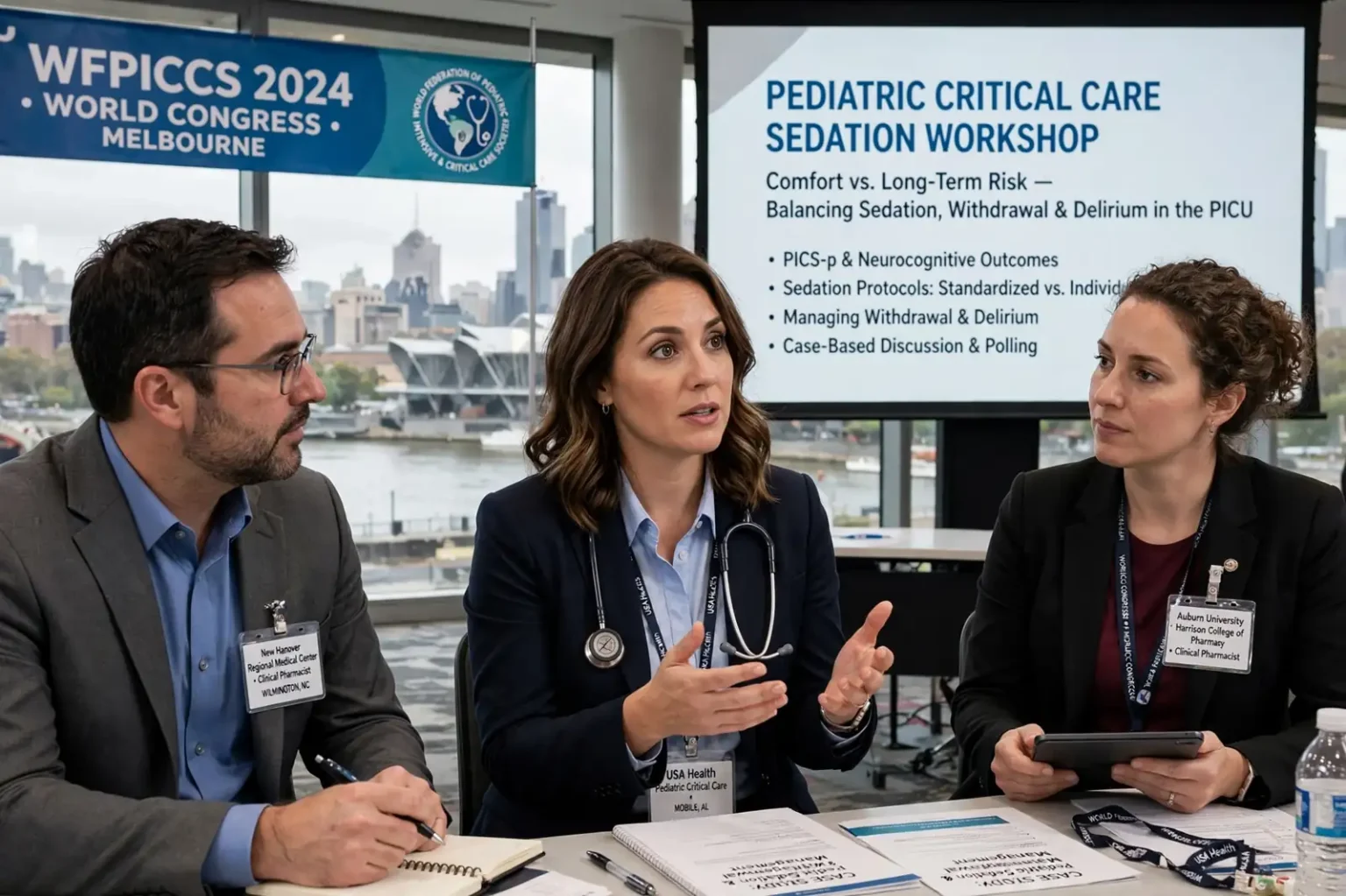
MOBILE, Ala. — How do doctors keep a critically ill child comfortable without creating new problems that linger long after the child leaves the hospital? That question was at the heart of a workshop a USA Health pediatric critical care physician helped lead at an international meeting in Melbourne, Australia, where specialists from around the globe gathered to compare notes on caring for the sickest children.
The physician co-organized and presented the interactive session at the conference of the World Federation of Pediatric Intensive and Critical Care Societies, known as WFPICCS. She was joined by two clinical pharmacist colleagues, one from New Hanover Regional Medical Center in Wilmington, N.C., and one from the Harrison College of Pharmacy at Auburn University.
The Pediatric Critical Care Challenge: Comfort Versus Long-Term Risk
The workshop tackled a problem familiar to every pediatric intensive care unit, or PICU. Children who are on breathing machines, recovering from major surgery or fighting severe infections often need pain medication and sedation to stay safe and comfortable. Those same medications, however, can carry risks of their own.
The session focused on how to deliver effective pain control and sedation while reducing the chances of delirium, drug withdrawal and possible long-term complications. In her remarks, the physician said clinicians have to weigh comfort and safety during a child’s critical illness against the need to prevent withdrawal, to be able to check how the brain is functioning and to plan for the child’s recovery over the long run.
Withdrawal is a particular concern because children who receive sedatives and opioid pain medicines for an extended period can develop physical dependence, so those drugs often must be tapered carefully. Delirium, a sudden state of confusion, is also recognized in critically ill children and can be difficult to detect when a patient is heavily sedated.
Topics Covered: PICS-p, Brain Outcomes and Sedation Strategies
The presenters walked participants through several related areas of pediatric critical care, including:
- Pediatric post-intensive care syndrome, known as PICS-p, which describes the physical, cognitive, emotional and social difficulties that can follow a child’s stay in intensive care
- Neurocognitive outcomes, or how a critical illness and its treatment may affect a child’s thinking, memory and development
- Approaches to managing sedation and withdrawal
- The advantages and drawbacks of following a standardized sedation protocol compared with tailoring sedation to each individual child
A central message was that pediatric sedation is complex and that treatment works best when it is matched to the needs of each patient.
An Interactive Format Built Around Real Cases
Rather than relying solely on lectures, the team built the workshop around real-world PICU cases. Audience members answered live polling questions and broke into roundtable discussions, giving clinicians from different countries a chance to compare how their own hospitals handle sedation and to share what has and has not worked for them.
That kind of exchange is one of the main purposes of WFPICCS, an international federation that brings together pediatric intensive care organizations and professionals to share knowledge and improve care for critically ill children worldwide. Its congresses draw physicians, nurses, pharmacists and other members of the pediatric critical care team.
Two Research Abstracts Accepted
Beyond the workshop, two research abstracts involving the USA Health physician were accepted for presentation at the conference:
- “Combined N-Acetylcysteine and Fomepizole Therapy in Severe Acetaminophen Overdose,” on which she served as first author
- “Incidence and Characteristics of Neonatal Patients with Bacteremia Following Probiotic Administration,” on which she was a contributing author
The first abstract concerns the treatment of serious acetaminophen poisoning. N-acetylcysteine is the long-established antidote for acetaminophen overdose, while fomepizole is a medication best known as an antidote for certain toxic alcohol poisonings that has drawn interest as a possible add-on therapy in severe acetaminophen cases.
The second abstract examines bloodstream infections, known as bacteremia, in newborns who received probiotics. Probiotics are sometimes given to fragile infants, and researchers continue to study the rare cases in which the live organisms in those products are later found in a baby’s blood.
Where the Pediatric Critical Care Physician Practices in Mobile
The physician cares for patients in the PICU at USA Health Children’s & Women’s Hospital in Mobile, the region’s dedicated hospital for children and women. She also helps lead the hospital’s neonatal and pediatric critical care transport work, which brings seriously ill newborns and children from other facilities, and she teaches as a faculty member at the Frederick P. Whiddon College of Medicine at the University of South Alabama.
Bringing back lessons from a gathering of international experts can benefit families along the Gulf Coast, where Children’s & Women’s Hospital serves young patients from across South Alabama and neighboring areas who need intensive care.
To learn more about pediatric services, visit USA Health. For more local health stories, see our Health and Wellness section and our University of South Alabama coverage.