Flora-Bama Sues MTV and Producers Over ‘Floribama Shore’ Name
The Flora-Bama at Perdido Key filed a trademark infringement lawsuit against MTV, Viacom and 495 Productions over the title of 'Floribama Shore.'
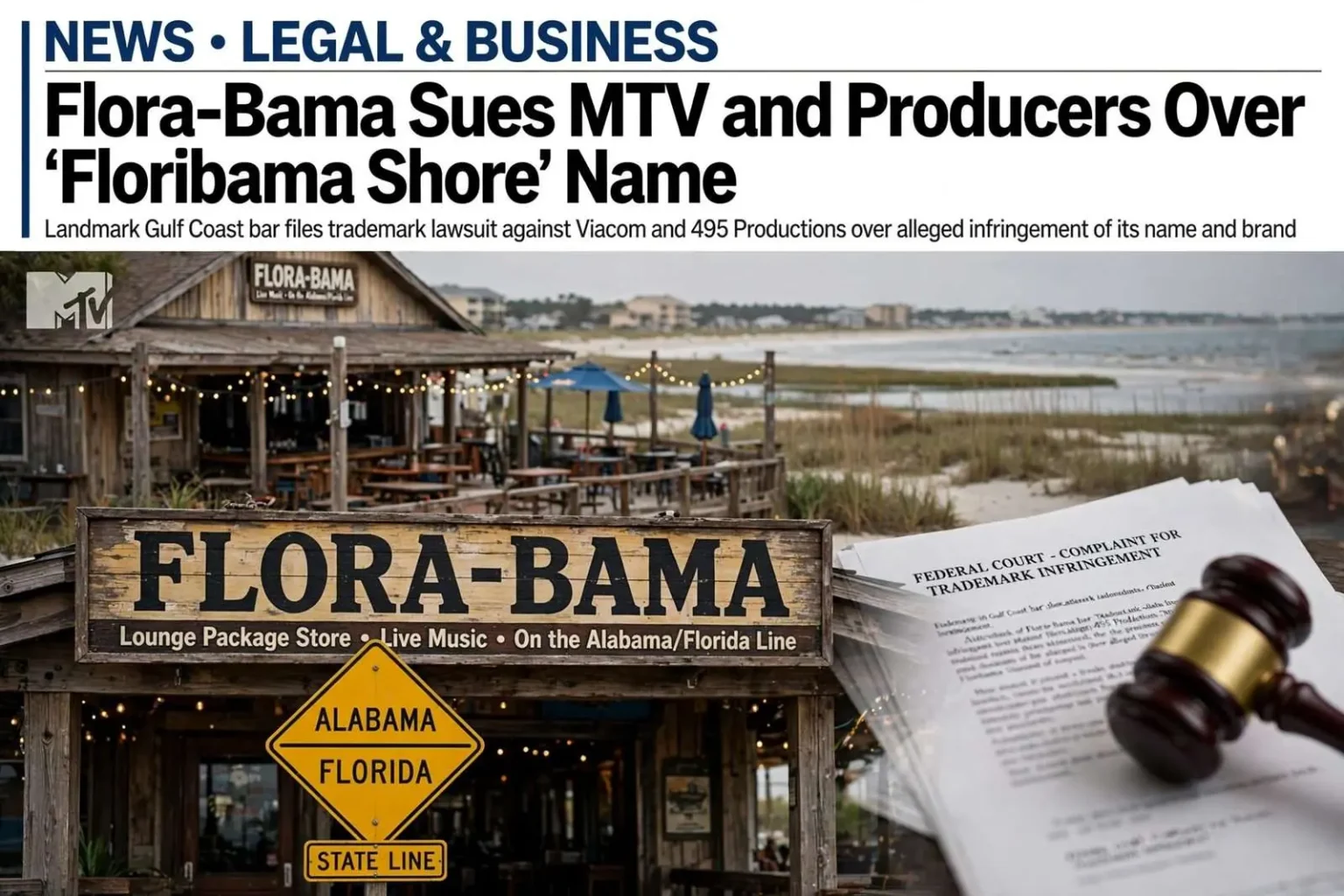
The Flora-Bama, the well-known bar straddling the Alabama-Florida state line at Perdido Key, has filed a trademark infringement lawsuit against MTV and the producers behind the reality series “Floribama Shore.” The suit names the network’s parent company, Viacom, along with 495 Productions. Attorneys for the bar allege the show’s title trades on the Flora-Bama’s long-established name and trademark rights.
For a business that has spent decades as one of the most recognizable landmarks on the Gulf Coast, the decision to take a television network to court marks a significant escalation in a dispute the bar says has been building since the series went on the air. The Flora-Bama is not asking for a renaming quietly or through back channels; it is pressing its claim in federal court, where the question will be whether “Floribama Shore” is close enough to the bar’s famous name to cause real confusion among consumers.
Attorneys Frame It as a Local Business Fight
“This is a case about a large corporation infringing on the trademark rights of a local business,” said Joshua Harris of the Pensacola law firm Levin Papantonio Thomas Mitchell Rafferty & Proctor, which announced the filing.
Harris argued that changing a single letter does not put the show’s title outside the reach of trademark protection, calling the substitution of an “i” for an “a” an action that must be taken seriously.
That argument sits at the heart of the case. Trademark law does not require an alleged infringer to copy a name exactly — only closely enough that ordinary consumers are likely to be confused about the source or sponsorship of the product. Attorneys for the bar contend that swapping one letter in a name that has been plastered on signs, T-shirts and postcards along the coast for generations is precisely the kind of alteration the law is meant to police.
The lawsuit pits a Pensacola-area institution against two of the biggest names in American entertainment. Viacom, MTV’s parent company, is a global media conglomerate with vast legal resources, while 495 Productions is the prolific reality television production company behind the series. The imbalance in size is exactly what the bar’s attorneys say makes the case worth fighting: a local business defending the name it built against programming marketed to a national audience.
A Landmark Built on the State Line
The Flora-Bama takes its name from its unusual geography. The building sits directly on the line that divides Alabama from Florida at Perdido Key, so that patrons can literally stand in one state and order a drink delivered in the other. That novelty, combined with decades of live music and a famously unpolished atmosphere, has made the bar a destination for travelers from across the Southeast and beyond.
Over the years the venue has become far more than a roadside honky-tonk. Its annual Interstate Mullet Toss, in which competitors hurl dead fish across the state line, draws thousands of visitors each spring and regularly generates coverage well beyond the Gulf Coast. The bar has also endured its share of hardship, including damage from hurricanes that repeatedly battered the Perdido Key shoreline, and each reopening after a storm was treated by locals as a community milestone.
That long history is central to the legal claim. Trademark rights in the United States generally attach through use in commerce, and the longer a name has been used and promoted, the stronger the protection it commands — particularly for marks that have become famous. The Flora-Bama’s attorneys argue that the bar’s name is not merely a sign over a door but a brand with decades of goodwill behind it, goodwill that a national television program can exploit simply by borrowing a recognizable variation of it.
The name itself has become shorthand for a stretch of coastline and a certain Gulf Coast lifestyle. For residents of the Perdido Key area and the surrounding communities on both sides of the line, the bar is a fixture of local identity as much as a commercial enterprise, which is part of why the dispute over the show’s title has resonated so strongly in the region.
The Show Behind the Dispute
“Floribama Shore” followed the familiar formula of the network’s long-running reality franchise, assembling a cast of young adults to live and work together along the Gulf Coast, with the drama of their shared household forming the core of each episode. The series drew on the beaches, bars and waterfront towns of the Panhandle and south Alabama for its settings, borrowing heavily from the culture of the very stretch of coastline where the Flora-Bama operates.
From the bar’s perspective, that borrowing came without permission. According to the suit, the producers built a program around a title that echoes the bar’s name while presenting an image of the region to a national audience. The bar says it has no affiliation with the series and never agreed to be associated with it, yet the similar name has left many viewers with the opposite impression.
Reality television has long traded on real places, and programs set on the Gulf Coast have used recognizable local landmarks to establish authenticity. But the line between setting a show in a region and implying an endorsement by its best-known business is precisely what this lawsuit asks a court to draw. The Flora-Bama’s position is that the title was chosen not for accuracy — the show is not centered on the bar itself — but for the instant recognition the name carries with millions of people who have visited the venue or heard of it.
Bar Says Viewers Have Been Confused
The Flora-Bama has repeatedly said it has no affiliation with the series. According to the bar, use of the similar name has led people to believe the two are connected in the time since the show launched.
That claimed confusion matters legally as well as commercially. A trademark holder that stands by while others use a similar name risks weakening its rights, and businesses in the Flora-Bama’s position typically document instances of mistaken association — visitors assuming the show is a bar production, viewers crediting the venue for content it had nothing to do with, and merchandise or promotions understood to be connected when they are not.
There is also the question of control. A bar famous for a particular image of Gulf Coast nightlife has a strong interest in how that image is presented to the country. A program bearing a near-identical name can shape public perception of what the “real” Floribama coast experience is, without the bar having any say in the portrayal. The lawsuit frames the issue not simply as lost revenue but as the unauthorized use of a name the bar spent half a century building.
For the defendants, the likely response is that the title describes a region rather than a business, and that viewers understand the difference between a television program and the establishment whose name it resembles. Media companies have successfully defended titles against trademark claims before, arguing that expressive works receive heightened protection when their names are artistically relevant rather than purely a source identifier. How a court weighs that doctrine against the bar’s evidence of actual confusion will go a long way toward deciding the case.
What Happens Next
The allegations in the complaint had not been tested in court, and the defendants had not responded publicly to the filing.
Litigation of this kind typically unfolds over many months. Viacom and 495 Productions would be expected to answer the complaint or move to dismiss it, and either party could seek judgment on the pleadings before anything resembling a trial. In the meantime, the series remains associated with the region and the dispute remains a talking point in the beach towns it depicts.
For the Flora-Bama, the filing is a statement as much as a legal move. The bar’s owners have positioned the case as a defense of local enterprise against national programming, a message that has struck a chord with residents who see the venue as part of the cultural fabric of the coast. Whether the courts agree that one changed letter is enough to constitute infringement will determine whether that message becomes legal precedent or simply another chapter in the bar’s long, storied history.
The case now moves into the early stages of federal litigation, where the bar’s legal team will seek discovery into how the title was chosen and how much the network earned from the series. Any damages would likely be measured against profits attributed to the alleged infringement, along with the possibility of an injunction requiring changes to the show’s branding.
What is not in dispute is the staying power of the name at the center of it. From the Mullet Toss to hurricane rebuildings to generations of Gulf Coast vacations, the Flora-Bama has spent decades turning a spot on the state line into a brand known far beyond Perdido Key. The lawsuit now asks the legal system to decide how much that brand is worth — and who gets to use it.