Florida Agriculture Officer Credited With Saving Choking Toddler’s Life at Century Gas Station
OALE Officer William Register is credited with saving a choking 1-year-old at a Century gas station after the child's family sought help along Highway 4.
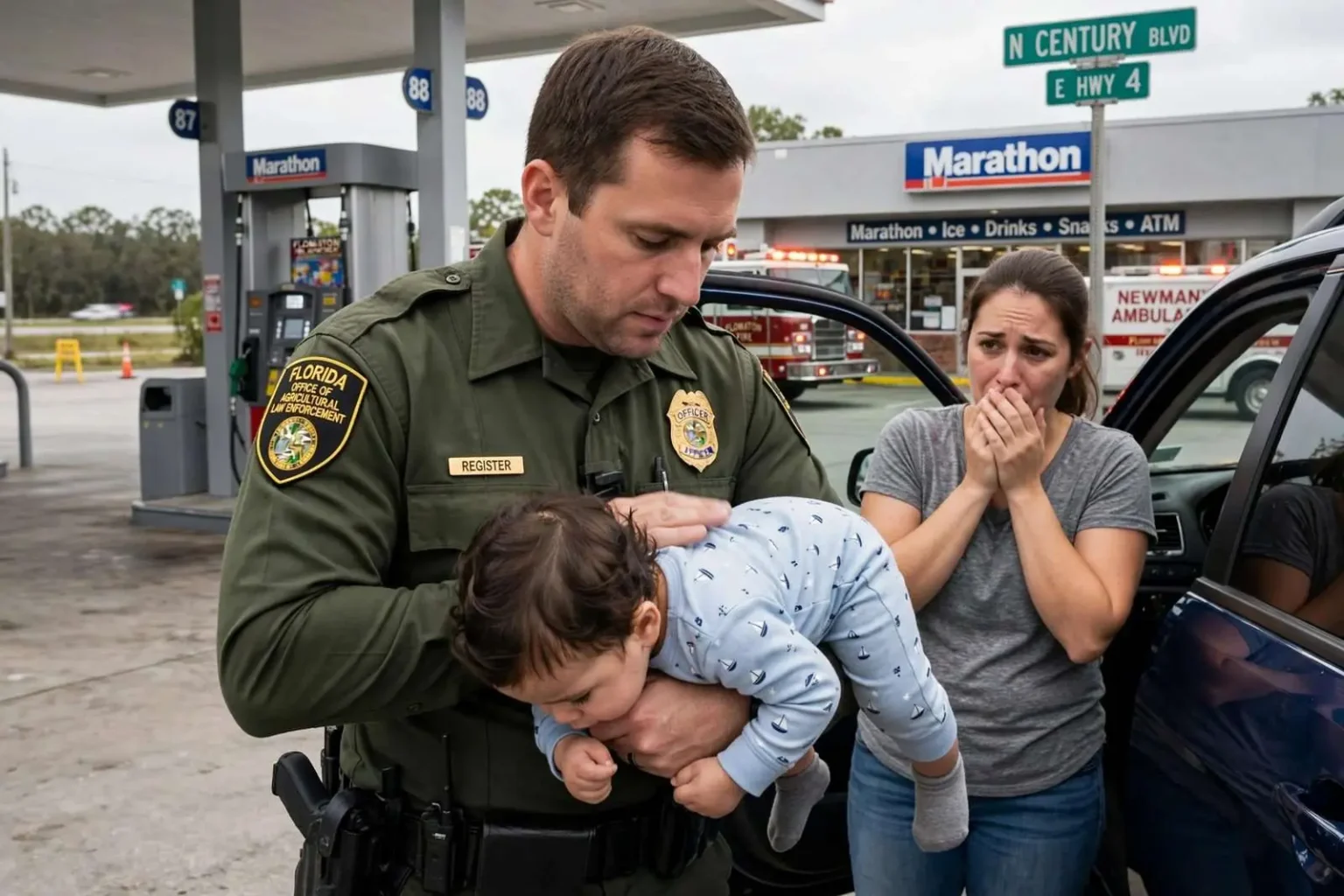
A Florida Office of Agricultural Law Enforcement officer is being credited with saving the life of a 1-year-old child at a Century gas station earlier this week. According to OALE, the incident began in Flomaton, where a couple called for help after their child started choking — a call that set off a chain of emergency responses across two counties and a state line.
The call prompted a response from the Flomaton Fire Department and Newman’s Ambulance. Flomaton, just across the Alabama border in Escambia County, Alabama — while Century sits immediately south in Florida’s Escambia County — means emergencies in this corridor routinely draw resources from both states, and the agencies involved have long-standing mutual habits of crossing the line when seconds count.
As the couple continued driving south toward Century seeking faster help, they pulled into the Marathon station at North Century Boulevard and East Highway 4 — and flagged down OALE Officer William Register, who happened to be working a detail nearby. The chance convergence of a desperate family, a trained officer and a well-lit intersection turned a roadside emergency into a rescue.
“Register immediately took action, performing back blows that helped clear the child’s airway and improve breathing before EMS arrived,” the agency said. The child was then transported to a local hospital for treatment. Back blows — sharp strikes between the shoulder blades with the casualty angled forward — are a standard first-line response for choking victims, using the impact to create pressure that expels the blocking object from the airway.
The geography of a rescue
The Century-Flomaton corridor is a case study in small-town emergency response. State Line Road literally marks the boundary between Alabama and Florida, and the communities share schools’ worth of family connections, commerce and emergency resources. When a family’s child began choking in Flomaton, the nearest help came from the hometown fire department and its ambulance provider — and when driving toward faster help meant crossing into Florida, the family did not hesitate.
That decision — moving toward help rather than waiting in place — is the kind of choice emergency dispatchers encounter constantly, and it carries risks. Emergency medicine guidance generally favors staying put when EMS has been summoned, since responders are en route with equipment and, in this case, already dispatched. But the outcome here illustrates the other side: a moving family met an off-duty-beat officer with exactly the training the moment required.
Because Flomaton Fire and Newman’s Ambulance had already been dispatched, Escambia County Fire Rescue’s Century station also responded to the scene. The layered response meant that when the ambulance arrived, the child’s airway was already cleared and crews could focus on assessment and transport rather than airway management under pressure.
The officer and his agency
William Register serves with the Florida Office of Agricultural Law Enforcement, one of the state’s smaller and less-visible law enforcement agencies. OALE officers enforce agricultural, food safety and consumer protection laws, inspect produce shipments and protect the state’s farming economy — work that puts them on highways and at commercial sites across Florida, including the panhandle’s produce corridor.
Like all Florida sworn officers, OALE personnel maintain first aid, CPR and related emergency training, and officers regularly find themselves first on scene at traffic crashes and medical emergencies simply because their duties scatter them along rural highways. Register was working a detail near the Marathon station — a common arrangement in which agencies provide traffic or security presence for businesses and events — when the family’s vehicle pulled in.
The agency’s account emphasized how quickly the intervention unfolded. Choking is one of the leading causes of unintentional death in infants and toddlers, and the window for successful intervention is measured in minutes. An airway blocked long enough causes brain injury within four to six minutes; a trained responder’s hands, applied correctly and immediately, are the difference between that outcome and a child breathing again.
Praise from the fire chief
Flomaton Fire Chief Steve Stanton praised Register’s response, saying that in more than 40 years as a firefighter, he had never seen a law enforcement officer handle a medical emergency with such care and professionalism. Coming from a chief whose career spans four decades of EMS and fire response on both sides of the state line, the assessment carried particular weight.
“We are incredibly proud of Officer Register’s quick thinking, calm composure, and genuine compassion in a moment that truly mattered,” OALE said. The agency’s statement highlighted not just the technique but the composure — the ability to act calmly on a screaming, panicking scene is what training is meant to build, and it is what separates effective intervention from well-intentioned chaos.
Scenes involving a choking infant are among the most chaotic a responder can face. Parents in terror, a child unable to breathe or cry, and the pressure of time combine into an environment where the correct technique — appropriately scaled to a 1-year-old’s body — must be applied without hesitation. Register’s actions, as described by the agency, cleared the airway before EMS arrived, ending the emergency’s most dangerous phase.
What every caregiver should know about choking
The incident is a stark illustration of why pediatric choking first aid is widely taught. For infants under one year, recommended response differs from older children and adults: alternating five back blows with five chest thrusts, using the rescuer’s forearm and thigh to support the baby face-down at an angle. Abdominal thrusts — the Heimlich maneuver — are not used on infants because of injury risk.
For children over one year and adults, the sequence shifts to abdominal thrusts with back blows as a companion technique. The American Heart Association and the Red Cross teach these skills in courses that take only a few hours, and both organizations urge every parent and caregiver — including grandparents and babysitters — to learn them before an emergency forces the lesson.
Prevention matters as much as response. The foods that most often choke toddlers — whole grapes, hot dogs, nuts, hard candy, popcorn, chunks of raw carrot — share a shape and firmness that lodges in small airways, and pediatric guidance recommends cutting foods into small pieces and supervising all meals for children under four. Small objects, from button batteries to toy parts, pose the same risk off the high chair.
Two counties, one response
The response roster tells the story of the border corridor: a Flomaton couple, the Flomaton Fire Department and Newman’s Ambulance from Alabama, and Escambia County Fire Rescue’s Century station and OALE from Florida — all engaged around a single 1-year-old at a gas station pump island. Agencies along the line train together informally by necessity, and their mutual familiarity shows up in outcomes like this one.
Escambia County Fire Rescue’s Century station, positioned close to the Marathon station’s crossroads, provides the community’s first-due fire and medical response. Newman’s Ambulance, a private provider serving the Flomaton area, was already rolling south when the child’s airway was cleared, and its crew’s arrival converted the rescue into a standard medical transport with a hospital destination and a much better prognosis.
The child was transported to a local hospital for treatment and evaluation. Choking victims who regain an airway still require medical assessment, since forceful interventions and retained fragments can leave complications that are not immediately visible. Physicians examine for airway damage and confirm the airway is fully clear before discharge.
The wider lesson for the Gulf Coast
Rescues like this one circulate quickly in small communities, and they serve a purpose beyond celebrating the rescuer. Each account of a life saved by back blows or CPR is a public prompt for the training that made it possible — a reminder that the skills involved are learnable in an afternoon and that the next emergency will not schedule itself around the nearest paramedic.
The Gulf Coast region has seen its share of such stories in recent years, from officers performing CPR at crash scenes to bystanders deploying AEDs in churches and schools. Emergency medical professionals note that bystander intervention is the critical link in the chain of survival for both choking and cardiac emergencies; by the time EMS arrives, the outcome has usually already been determined by what those first on scene did or did not do.
Locally available training makes those skills accessible. County health departments, hospital community education programs, fire departments and Red Cross chapters across the region offer CPR and first aid classes on rotating schedules, and many fire and EMS agencies will arrange group instruction for churches, daycares and workplaces on request.
Recognition for a quiet agency
The Florida Office of Agricultural Law Enforcement occupies a niche most Floridians never think about until one of its officers appears in a story like this. Part of the Florida Department of Agriculture and Consumer Services, the agency’s sworn law enforcement officers patrol the state’s agricultural interests: produce inspections at packinghouses and border stations, food safety investigations, consumer fraud matters and the protection of the farms and nurseries that anchor Florida’s agricultural economy.
Because their beats run along rural highways and commercial corridors, OALE officers are frequently positioned to be first responders by accident. The agency’s public statement of pride in Register reflected that dual identity — an investigator of produce fraud by trade who, at the Marathon station on North Century Boulevard, became the reason a 1-year-old was still breathing when the ambulance arrived.
Chief Stanton’s four decades of perspective framed the compliment in its fullest context: fire and EMS professionals measure emergency response against the standards of their own profession, and an officer’s medical intervention drawing that level of praise is rare by his own account. The moment’s poise — flag downed family served, airway cleared, hospital transport arranged, scene handed smoothly to arriving crews — read, in his telling, like a professional EMS response.
A family’s ordinary afternoon, restored
For the couple at the center of the story, the sequence began with every caregiver’s worst moment: a child suddenly unable to breathe. Their drive toward help, their flagging down of the officer at the gas station, and the rapid actions that followed ended with a child transported for treatment — a rescue assembled in minutes out of two counties’ worth of responders and one officer’s training.
The child was reported to have been improving after treatment at a local hospital, and the agencies involved closed their public accounts with the gratitude their statements expressed. Officer Register’s name — and the image of a produce-inspection officer clearing a toddler’s airway at a border-town gas station — will stay with the community that watched it unfold.
For everyone else, the takeaways are the ones emergency agencies repeat after every such story: learn pediatric choking first aid, keep small foods and objects away from toddlers, know that help in the Century-Flomaton corridor crosses state lines without hesitation, and never underestimate the difference one trained person at one gas station can make.