Florida Man Charged With Voter Intimidation After Yelling at, Recording Voters in Milton
A 40-year-old man was arrested and charged with voter intimidation after deputies say he yelled at and recorded voters at the Santa Rosa County Auditorium in Milton during Tuesday's primary election.
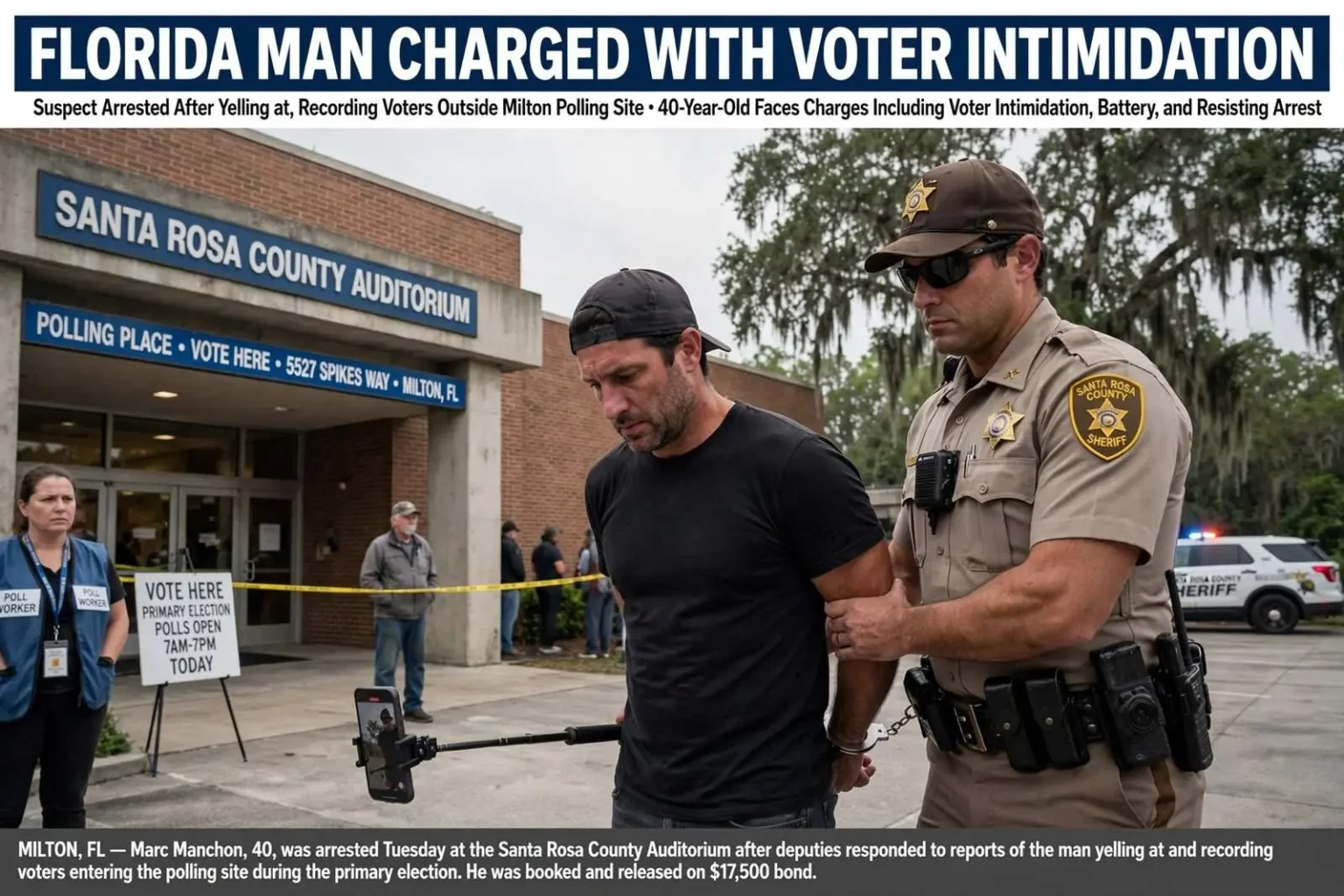
A 40-year-old man was arrested and charged with voter intimidation after deputies say he yelled at and recorded citizens as they tried to vote at a Santa Rosa County polling site during Tuesday’s primary election, according to an arrest report. Marc Manchon faces multiple charges stemming from the incident, including three counts of disturbing the peace, two counts of voter intimidation or suppression, battery, and resisting arrest.
The case unfolded at one of the busiest moments of Florida’s election calendar, when primaries decide which candidates advance to the general election and turnout is concentrated into a single day. Santa Rosa County, west of Pensacola in the Florida Panhandle, uses a network of precincts across the county for in-person voting, and the county auditorium in Milton — the county seat — serves as one of the more heavily trafficked sites. Incidents at polling places are rare but closely watched, because election officials in Florida and every other state operate under statutes that treat access to the ballot as something the government must actively protect.
Deputies Called to Polling Site
The confrontation happened around 10:30 a.m. at the Santa Rosa County Auditorium on Spikes Way in Milton. Deputies were dispatched after reports of a man recording video and yelling at civilians as they entered an active polling station. When deputies arrived, they found Manchon “yelling and cussing at civilians who were entering and exiting the polling location,” according to the arrest report. He was holding a cell phone mounted on a camera stick and appeared to be recording.
A polling clerk at the site told deputies Manchon had also been inside the building recording and yelling at civilians who were trying to enter, the report states. That detail matters under Florida law, which draws the lines of permissible conduct carefully around polling rooms. Campaigning and electioneering are barred within a statutorily defined distance of a polling place entrance, and inside the voting room, conduct that disrupts voting or harasses voters is prohibited outright. Recording inside a polling station raises its own concerns, since voters casting ballots have an expectation of privacy in the booth that state law is designed to protect.
Voters Say They Were Intimidated
Two citizens told deputies that Manchon’s behavior scared and intimidated them as they attempted to cast their ballots, according to the report. The report also states that Manchon pushed a man who was trying to help poll workers get him to leave the building. When deputies attempted to investigate, Manchon reportedly refused to identify himself and then resisted arrest.
The witness statements form the core of the intimidation counts. Voter intimidation laws do not require that a victim actually abandon the attempt to vote; the offense lies in conduct intended to frighten or pressure voters away from the polls, and the testimony of voters who felt scared and intimidated while attempting to cast ballots is precisely the evidence prosecutors rely on. The alleged push adds a battery charge, and the refusal to identify himself and the resistance to arrest round out the criminal exposure from what began as a disturbance call.
Deputies noted that the Santa Rosa County Auditorium was not Manchon’s assigned polling location. They also noted that Manchon has prior convictions for obstructing government operations and disorderly conduct out of Hillsborough, New Hampshire. In Florida, a voter may only vote in the precinct to which he or she is assigned, so a person’s presence at a precinct where he cannot legally cast a ballot — combined with the alleged conduct — is a detail investigators weigh when assessing intent. The out-of-state record gives prosecutors background on prior confrontations with government proceedings, though each charge stands on the events of Tuesday alone.
The response at the auditorium also illustrates how polling-place security is supposed to work in practice. Deputy sheriffs in Florida are routinely assigned to or staged near polling sites on election days, not as a show of force but because the polls are among the few public buildings where crowds, emotions and high stakes reliably intersect. A deputy’s first task at a disturbance call is separation: getting the disruptive person away from the entrance and out of the voting room so that voters can pass without pressure. Only after that does the investigation — interviews with voters, poll workers and witnesses — begin.
Poll workers themselves are the first line of defense. Clerks and inspectors at each precinct are trained to manage conduct near the entrance, to distinguish protected speech from prohibited electioneering or intimidation, and to call law enforcement when a situation exceeds what they are authorized to handle. The fact that a polling clerk at the auditorium reported Manchon’s conduct inside the building, according to the arrest report, follows that sequence: the civil authority at the precinct documented what happened and handed the matter to the sheriff’s deputies.
Released on Bond
Manchon was booked into the Santa Rosa County Jail and released Wednesday after posting $17,500 bond. Florida law prohibits voter intimidation, harassment, or interference with a voter’s right to cast a ballot, and polling places are required to remain free of disruptive conduct so voters can access the polls without fear of harassment. Local election officials rely on deputies stationed near polling sites to respond quickly to reports of disruptive behavior during active voting hours.
Bond releases a defendant from custody pending trial while the charges proceed through the courts, and the $17,500 figure reflects the combined schedule of the multiple counts he faces. The case will now move through the normal sequence: arraignment, discovery, and — if no plea agreement is reached — trial. The charges range from second-degree misdemeanors to more serious offenses, and the voter intimidation counts in particular carry consequences beyond jail time, since they touch the state’s core interest in protecting elections.
Election officials across the Panhandle treated the incident as contained. Voting at the auditorium continued after the arrest, and there was no indication that other precincts in Santa Rosa County experienced similar disruptions during the primary. That is the ordinary pattern in these cases: a single individual, a single precinct, and a system built to absorb the disruption and keep the line moving.
The broader context is a period of heightened attention to conduct at polling places nationwide. In the last several election cycles, states including Florida have updated and emphasized their election-crimes statutes, and law enforcement agencies have trained deputies on what electioneering, intimidation and interference look like at a precinct. Florida’s framework gives voters multiple protections: the buffer zone around entrances, the prohibition on disrupting voting inside, and criminal statutes covering intimidation or suppression regardless of whether the target ultimately votes.
For voters in Milton, the episode ended the way officials hope such episodes end — with the disturbance removed and the election proceeding. But the charges Manchon now faces serve as a reminder that the state treats the walk into a polling place as protected ground. Yelling at voters, recording them as they approach the door, or blocking their way is not protest or documentation under Florida law; it is interference with a right the state has committed itself to defend, and it now carries a docket in a Santa Rosa County courtroom to prove it.
Under Florida statutes, the protections around voting are layered deliberately. The no-solicitation zone extends outward from each polling place entrance, keeping campaign workers, activists and anyone else with a message at a defined distance so that the last steps a voter takes are unpressured. Inside the polling room, the precinct board has authority to maintain order, and conduct that disturbs or hinders voting can end a disruption immediately. The recording element adds another dimension: voters in the booth are casting a private act, and Florida’s election code treats the secrecy of the ballot as central to the system’s integrity.
The distinction between documenting and intimidating has been tested repeatedly in recent years. Filming in public spaces is generally protected conduct, but the protection narrows at the polling room door, where the state’s interest in voter privacy and undisturbed access takes precedence. Someone who films voters as they approach an entrance while yelling at them is not engaging in journalism or observation in the eyes of the statute — the combination of recording and verbal pressure aimed at voters is what the intimidation and suppression counts are designed to capture. Prosecutors will not have to prove that anyone actually left the line without voting; the testimony that voters were scared and intimidated as they attempted to cast ballots is enough to satisfy the charge.
The battery and resisting counts fill out the picture of what deputies encountered. Pushing the man who was assisting poll workers converts a disturbance into a physical offense, and the refusal to identify himself — followed, per the report, by resistance to arrest — is treated as a separate crime rather than a footnote. Cases built on this combination of counts are straightforward for prosecutors to present, because the evidence comes from the responding deputies, the polling clerk and the voters themselves, all of whom were present within a single morning’s span at one site.
What remains for the courts to sort out is contested at trial: what Manchon intended, how voters experienced his conduct, and whether his actions crossed the legal lines that separate loud, obnoxious behavior from criminal intimidation. His prior record of similar, lesser offenses will be background rather than proof. The election itself, meanwhile, moved on — ballots cast at the auditorium counted with the rest of the county’s, and the precinct’s only lasting story from the primary being the morning the deputies arrived.