
Florida Ten-Year-Old Adds an Extra Mile for Mobile Officer Sean Tuder
A 10-year-old Florida runner added an extra mile for Mobile Police Officer Sean Tuder, part of his pledge to honor every fallen officer of 2018 and 2019.
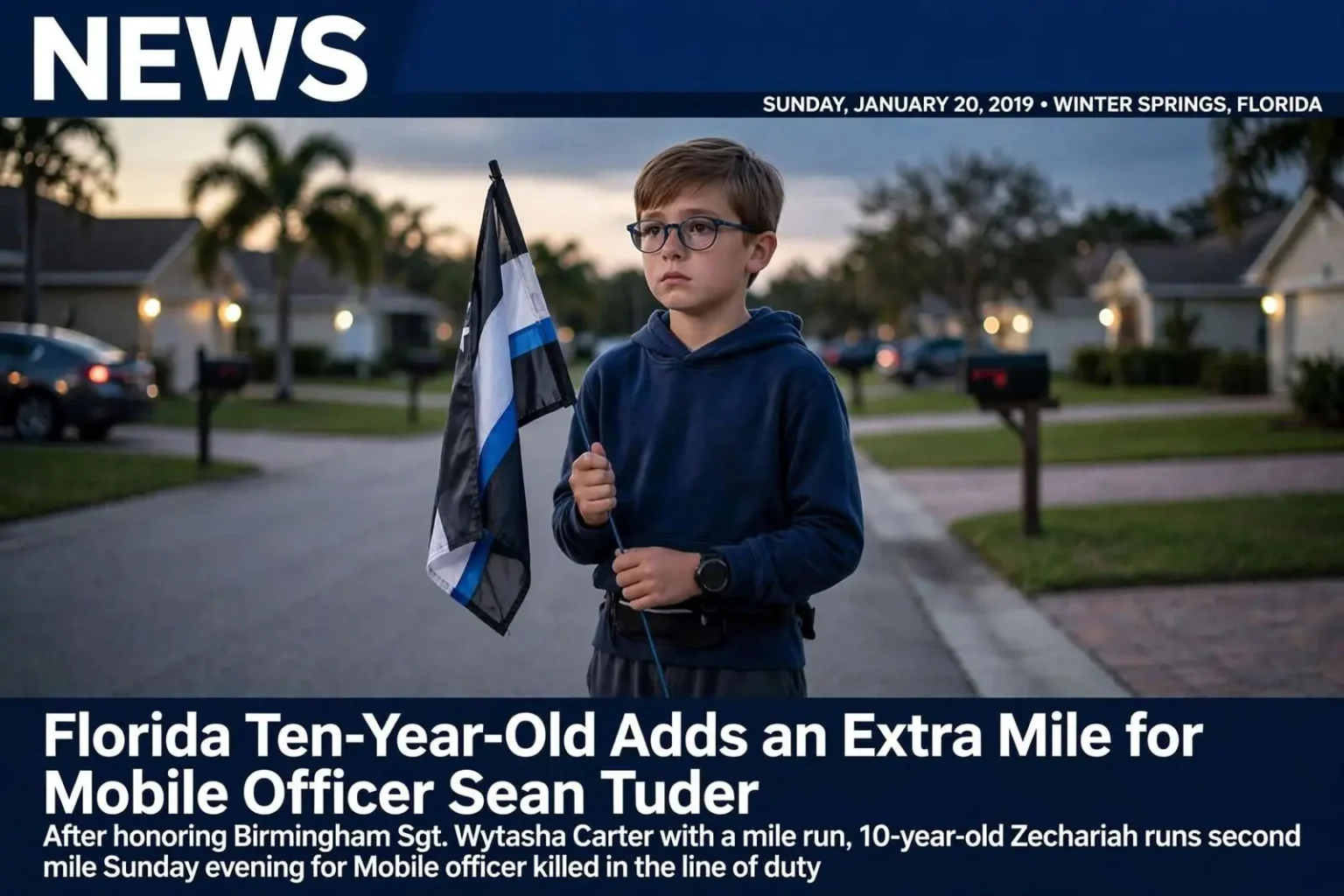
A 10-year-old from Winter Springs, Florida, ran an unplanned second mile Sunday evening after learning that Mobile Police Officer Sean Tuder had been killed in the line of duty, part of a personal project to honor every fallen officer in 2018 and 2019. Zechariah had just finished a mile dedicated to Sgt. Wytasha Carter, the 44-year-old Birmingham officer who was shot and killed days earlier, when word of Tuder’s death reached him. Rather than wait to schedule another run, he laced back up and went out again the same night.
The double run put into a single evening what had become the defining story of the boy’s winter: a mile, run live and dedicated by name, for every law enforcement officer who dies in the line of duty. What most children his age track in video game hours, he tracks in mileage accumulated across a memorial project that has already drawn attention well beyond his Central Florida hometown. By the time the sun set on that Sunday, he had run for two Alabama officers within a week — and he was already planning the next one.
‘This Needs to Stop’
Holding a police flag before the second mile, the boy said the news left him angry. “The reason why I wanted to do it tonight is because I am furious about this,” he said. “Why can’t they just go to peace cause this violence needs to stop because they go home to husbands, wives, children every day and if they can’t see them anymore then that’s just going to break their hearts.”
The words were his own, delivered before a run he had not planned when he woke up that morning, and they captured the raw logic of a child confronting news that adults struggle to process. Officer Sean Tuder, a 30-year-old Mobile police officer, was shot and killed Sunday, January 20, 2019, in the Toulminville area of the city while working to apprehend a suspect in a stolen vehicle case, less than a week after Sgt. Wytasha Carter was killed in Birmingham while checking on a suspicious vehicle before dawn. The two Alabama deaths came within about a week of each other, a stretch that drew attention from law enforcement supporters well beyond the state.
For Alabama’s law enforcement community, the back-to-back losses landed with particular weight. Line-of-duty deaths are rare enough that departments go years without one, and the grief that follows is compounded when a neighboring agency suffers the same loss days later. Dispatchers, chaplains and peer support teams moved between agencies in those days, and the public tributes — from patrol cars draped in black bunting to processions that shut down interstate lanes — gave residents a way to participate in the mourning.
A Mile for Every Fallen Officer
His father, Chad Cartledge, said the runs are his son’s own idea and his own way of paying respects. “Our son is an avid runner and is running a mile this year for every fallen officer in both 2018 and 2019,” Cartledge said. “Sadly, he has many miles to run but he wanted to do this as his way of paying his respects.”
The scope of the commitment explains his father’s word choice. Roughly 140 to 150 officers died in the line of duty across the United States in 2018, spanning traffic collisions, heart attacks, gunshots and job-related illnesses, and 2019 was already adding to the list in its first weeks. Running a mile for each officer means a distance most adult runners would call a serious training block, spread across a year of school days, homework and Sunday evenings. The boy had already completed eight runs early in the year, with another scheduled for Monday night in memory of Deputy Ray Horn of the Comal County Sheriff’s Office in Texas, who died Jan. 17 of a heart attack.
The boy documents the effort on a Facebook page called Running for Heroes, streaming each run live and naming the officer being honored. The live format turns each mile into a small ceremony: viewers join from their phones, the boy announces who he is running for, and the mile ends with the officer’s name spoken aloud into the record. The page has given families of fallen officers a place to find the tribute dedicated to their loved ones, and it has connected the Winter Springs family with departments and supporters far outside Florida.
Honoring officers who die of heart attacks and other non-violent causes, like Deputy Horn, is part of the project’s seriousness. The national memorials that track line-of-duty deaths include officers felled by job-related heart attacks, vehicle crashes and 9/11-linked illnesses alongside those killed by gunfire, and the boy’s project follows the same inclusive standard. A mile is a mile, whether the death it honors came in a shootout, a flood rescue or a shift that simply proved too much for the heart.
The Meaning of an Extra Mile
The Sunday-night double is what made the Mobile connection resonate with followers of the page. The boy had just completed his mile for Sgt. Carter when the news about Officer Tuder broke, and rather than folding the day’s running into a satisfied close, he went back out. The unplanned second mile carried a different emotional register than the scheduled ones — anger and grief in place of commemoration — and the police flag he carried made the point visible to everyone watching the stream.
Winter Springs sits in the Orlando suburbs, a world away from Toulminville and the Birmingham beats where the two Alabama officers worked, and nothing in the boy’s daily life connected him to either department. That distance is precisely what makes the gesture legible: the runs are not about a hometown hero but about a national community of families who lose officers and a child’s conviction that somebody should notice. Departments across the country have taken up the page as a result, sharing the streams when one of their own is honored.
His father’s description of the project — an avid runner’s miles, accumulated one officer at a time — deliberately avoids the language of activism. The boy is not campaigning for policy; he is doing what a 10-year-old can do, which is run, name names, and refuse to let the deaths pass unmarked. In a season when two Alabama families were planning funerals within days of each other, a stranger’s child running a second unplanned mile in a Florida subdivision counted for something real.
Remembering the Officers He Honored
Officer Sean Tuder served in Mobile’s police department as a young officer with a reputation for energy and commitment, and his death in the line of duty on January 20, 2019, made him the Mobile Police Department’s first line-of-duty loss in years. The department’s tribute — a procession of patrol vehicles from across the region that stretched for miles along the route to his services — drew officers from neighboring jurisdictions and states, and residents lined overpasses to watch. In the Toulminville neighborhood where he was killed, community members left flowers at the scene in the days that followed.
Sgt. Wytasha Carter, the Birmingham officer the boy honored first that Sunday, was killed in the early morning hours of January 13, 2019, after stopping to investigate a suspicious vehicle in the city’s North Pratt area. A veteran officer and an Army veteran, Carter left behind a family that Birmingham’s department and community rallied around, with tributes flowing from across the state. His death, days before Tuder’s, set the tone for a somber start to 2019 for Alabama law enforcement.
Deputy Ray Horn of Texas, the subject of the Monday-night run scheduled after the Alabama miles, died January 17 of a heart attack in the line of duty with the Comal County Sheriff’s Office, a department serving the communities north of San Antonio. His inclusion in the boy’s project the same week illustrated the breadth of what “fallen officer” means — three deaths, three different causes, three families grieving in the span of seven days.
Why the Runs Resonate
The simplicity of the format is what carries the emotional weight. There is no fundraising ask attached to the miles, no organization behind the page, and no institutional angle — just a boy, a measured distance and a name. Followers of Running for Heroes describe the streams as both heartbreaking and oddly restorative, and the comments under each run fill with badges, department patches and messages from officers’ families acknowledging the tribute.
Running a mile is also, not coincidentally, a familiar act of memorial in the law enforcement community, where 5Ks, memorial runs and honor-guard marches are standard tributes to fallen officers. The boy’s project compresses that tradition into its most basic unit and multiplies it across a year. Where a department hosts one memorial run for its own, he runs the distance for every department’s loss, treating the national roll call of line-of-duty deaths as a schedule to be honored mile by mile.
For Mobile, the tribute arrived as the city was still processing Officer Tuder’s death, and the story of the Florida boy’s extra mile made its way into the circulation of local posts and shares that followed the funeral coverage. His message — that officers go home to husbands, wives and children, and that the violence that takes them must stop — is not a policy argument a 10-year-old can advance through legislation. It is something simpler and harder to dismiss: the reaction of a child who believes that every one of those names deserves at least a mile.
The runs continue as the year does, with each mile streamed, named and added to the page’s growing ledger. Somewhere ahead on the calendar are more Sunday evenings, more unplanned doubles when the news turns bad, and a distance that will keep growing as long as the roll call does.


