FMC Corp. to Cut 41 Jobs at Axis Plant in Mobile County as Revenue Slides
FMC Corp. will lay off 41 employees at its Axis manufacturing center in Mobile County beginning Oct. 31, according to a WARN notice. The cuts follow reports of falling revenue at the agricultural sciences company.
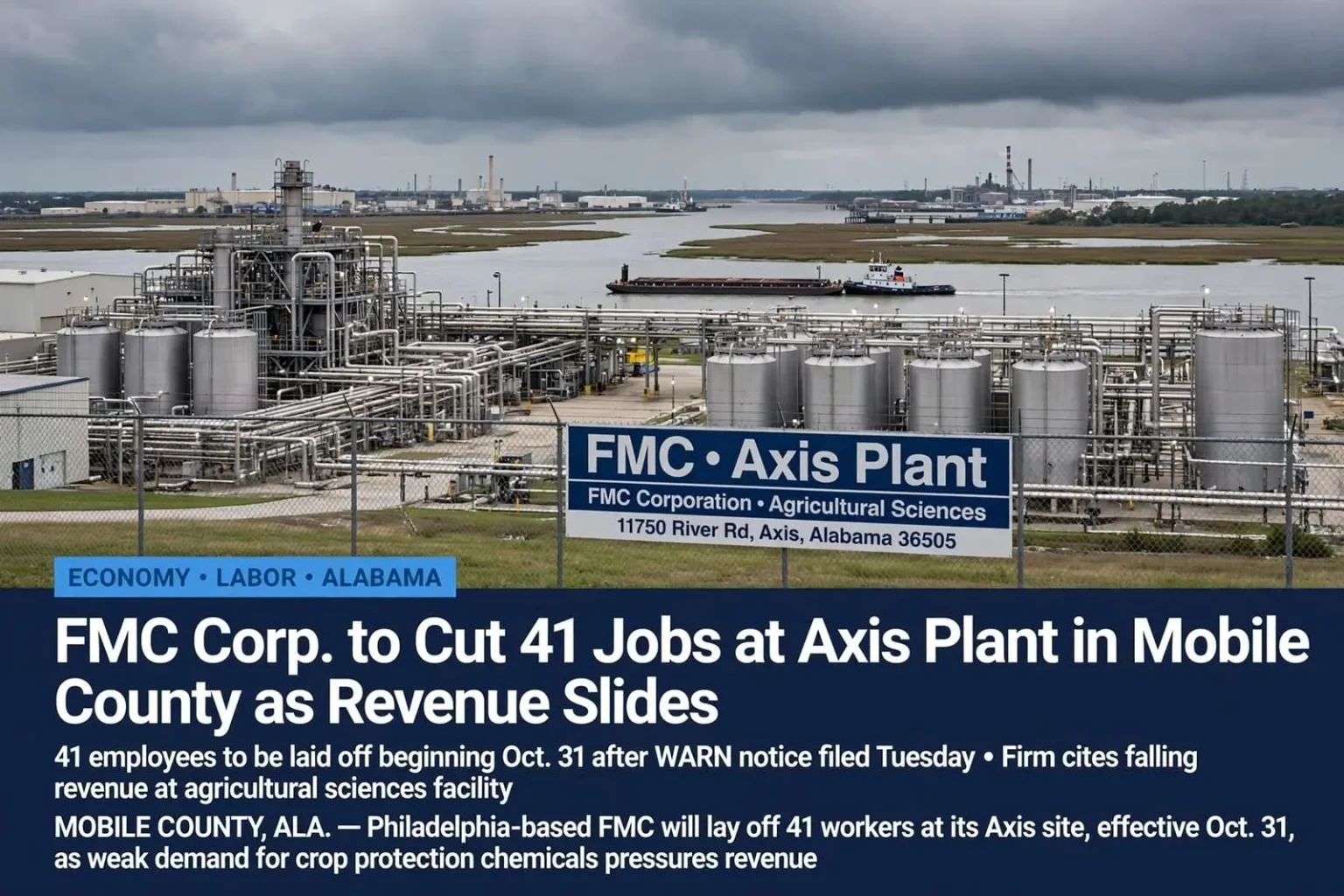
Philadelphia-based agricultural sciences company FMC Corp. will lay off 41 employees at its Mobile County site at the end of October, according to a WARN notice issued Tuesday. The layoffs are set to begin Oct. 31.
The notice puts a formal timeline on job losses that will reach one of the county’s longstanding industrial employers, and it starts a clock for affected workers: under the federal law that requires the filing, employees are entitled to advance notice and, in many cases, transition assistance as their final day approaches.
What FMC does in Axis
FMC Corp. was founded in Los Gatos, California, in 1883. The company purchased its Axis manufacturing center in 2017, and the site now produces agricultural chemicals for insect control and crop protection, according to the company’s website.
The company’s roots stretch back more than a century to its founding as a crop-dusting and insecticide enterprise, and over the decades it evolved into one of the world’s major agricultural sciences firms, with research operations and manufacturing sites spread across multiple continents. FMC’s product lines center on protecting crops from insects, weeds and disease — the chemistry that sits behind much of modern row crop and specialty agriculture.
The Axis site came to FMC as part of the company’s acquisition of a portion of DuPont’s crop protection business in 2017, a multibillion-dollar transaction that reshaped both companies and transferred several manufacturing assets to FMC as part of the deal. The Mobile County facility fit into FMC’s global production network, supplying active ingredients and formulated products for the company’s insecticide portfolio.
Axis sits in north Mobile County along the Mobile River industrial corridor, a stretch of chemical, paper and marine facilities that anchors a substantial share of the county’s manufacturing employment. The unincorporated community lies along the river north of the city of Mobile, where deepwater access, rail lines and highway connections have drawn heavy industry for more than a century. Facilities along the corridor range from paper mills and chemical plants to shipbuilding and cargo operations, and the jobs they provide tend to be among the better-paying industrial positions in the county.
For the communities around Axis, the plant’s loss of 41 positions will be felt beyond the workers themselves. Manufacturing jobs of this kind typically support additional local employment — contractors who maintain the site, suppliers who serve it, and the spending that payrolls generate at businesses in northern Mobile County. The magnitude of the impact depends on how many of the positions FMC eliminates permanently versus reassigns within its network.
The financial backdrop
The WARN notice follows reports of continually falling revenue at FMC — pressure significant enough that board members have been weighing a sale of the company, according to financial advisory site The Motley Fool. The agricultural chemicals sector broadly has faced a difficult stretch, with elevated channel inventories and soft crop prices squeezing demand for crop protection products across several product lines.
The dynamics behind those pressures trace back to conditions in farm country. When crop prices fall, farmers reduce spending on inputs like insecticides and herbicides, and distributors respond by drawing down the inventory they hold rather than placing new orders. That combination — weak farmer demand and distributors working through stockpiled product — hits chemical producers’ revenues hard even when underlying crop conditions are normal, and it has squeezed margins across the industry.
Companies in the sector have responded with cost-cutting programs, and workforce reductions at manufacturing sites are a common component. For FMC, the Mobile County layoffs fit that pattern: a global company with production capacity spread across sites adjusting its footprint to match demand that has not met projections.
Reports that board members have discussed a sale add another layer of uncertainty for the workforce. Companies under strategic review frequently trim costs to make themselves more attractive to potential buyers, and employees at affected sites are left to watch financial news as closely as their own plant’s production schedule.
Whatever the corporate outcome, the immediate reality for the 41 affected workers is a job search that begins now. Manufacturing employees with experience in chemical production hold skills — process operations, safety certifications, industrial maintenance — that are in demand along the Gulf Coast, where the petrochemical and industrial corridor from Mobile Bay to the Texas line continually seeks qualified operators. Alabama’s workforce development programs, including rapid-response services coordinated through the state when mass layoffs are announced, exist specifically to connect affected workers with retraining and job placement resources.
Those rapid-response services are a direct product of the same law that made this layoff public in the first place. When a WARN notice is filed, state and local workforce agencies mobilize to offer affected employees information about unemployment benefits, retraining programs and hiring events — often before the final day of work arrives.
What a WARN notice means
The federal Worker Adjustment and Retraining Notification Act requires employers of a certain size to provide advance notice of mass layoffs or plant closings. In Alabama, those notices are filed with the state and made public, which is why layoffs frequently become public knowledge months before the affected workers’ final day.
The law, generally known as the WARN Act, dates to 1988 and is designed to give workers and their communities time to prepare for major employment losses. Covered employers — typically those with 100 or more employees — must provide 60 days’ notice before a plant closing or mass layoff affecting a qualifying number of workers at a single site. The notice must go to affected employees or their representatives, along with state dislocated worker units and local government officials.
The advance notice requirement reflects the law’s core purpose: transition time. Sixty days gives workers the chance to begin job searches while still employed, to line up training, and to arrange their finances before the loss of income. For communities, it gives economic development officials a window to mobilize assistance and, in some cases, to begin courting new employers for affected facilities.
The law has limits that workers should understand. It does not require employers to keep plants open, and it does not create severance rights; its mandate is notice, not prevention. Exceptions exist for unforeseeable business circumstances and natural disasters, and companies sometimes dispute whether a particular layoff triggers the law’s thresholds. When employers fail to provide required notice, back pay liabilities can follow — a provision that gives the statute its practical teeth.
For Mobile County, the FMC notice adds to the region’s familiarity with the process. Industrial communities along the Gulf Coast see WARN filings periodically as global commodity cycles, corporate restructurings and market shifts ripple down to individual plants. The notices are watched closely by local officials because they offer the earliest hard data on job losses — the number of positions, the timing, and the company’s own characterization of whether the action is temporary or permanent.
Efforts to reach FMC representatives for comment were not immediately successful. In the absence of company comment, the notice itself provides the definitive public facts: 41 positions, the Axis site, layoffs beginning Oct. 31. Workers at the facility now face the transition the WARN Act was designed to anticipate — with roughly two months to prepare for the change, and with state workforce resources available to help them make it.
The Mobile River industrial corridor where the Axis plant operates has been central to Mobile County’s economy since the earliest days of the state’s timber and shipping industries. The river’s deepwater channel allows oceangoing vessels to reach facilities well north of downtown, and over the decades that access attracted paper mills, chemical producers, and the marine industries that serve both. Generations of Mobile County workers have built careers along that corridor, and industrial employment there has historically paid wages well above the county’s service-sector average, along with benefits that anchor family livelihoods in the surrounding communities.
That industrial base also shapes the tax revenue and civic life of northern Mobile County. Plant payrolls support municipal and county services, volunteer organizations and school systems in the small communities scattered along the river. When a facility trims its workforce, the effect ripples through those institutions in ways that a spreadsheet count of 41 jobs understates.
The agricultural chemicals business that FMC operates globally is itself a pillar of modern farming. Crop protection products — insecticides, herbicides and fungicides — are credited with a substantial share of the yield gains that allow the world’s farmland to feed its population, and the companies that develop and manufacture them occupy a specialized corner of the chemical industry requiring regulatory approval, technical manufacturing and continuous research investment. FMC’s position in that market makes it one of the significant employers in agricultural chemistry worldwide, with its decisions about where to locate production watched closely by the communities that host its plants.
The industry’s recent difficulties have been well documented in financial reporting. Companies across the sector reported weak sales as distributors in major markets worked down inventories that had been built up during earlier supply concerns, and farm economics — particularly in commodity row crops — gave growers little appetite for expanded input purchases. Analysts have described the stretch as one of the sector’s more prolonged downturns, with recovery tied to both crop prices and the pace at which channel inventories normalize.
For workers at Axis, the questions that matter most are practical: whether the layoffs represent a permanent reduction in the site’s workforce or a step toward consolidation, and what the plant’s long-term role in FMC’s network will be under whatever ownership or structure emerges from the company’s strategic deliberations. WARN notices do not answer those questions — they record the immediate action — and employees typically learn the broader picture through internal meetings and subsequent company announcements.
Local economic development officials, meanwhile, will be monitoring the site’s trajectory. A facility with chemical manufacturing infrastructure, rail access and deepwater proximity remains a significant asset regardless of corporate ownership, and north Mobile County’s industrial corridor has demonstrated for more than a century its ability to attract investment when facilities change hands. The coming months will show whether the Axis plant’s story follows that pattern of transition — or becomes another entry in the region’s tally of industrial workforce losses.