Foley Lands HCP Pumps Deal as Elberta Manufacturer Plans Major Expansion
HCP Pumps brings jobs to Foley's industrial park while Table Topics plans a $2 million Elberta expansion, adding employment across South Baldwin County.
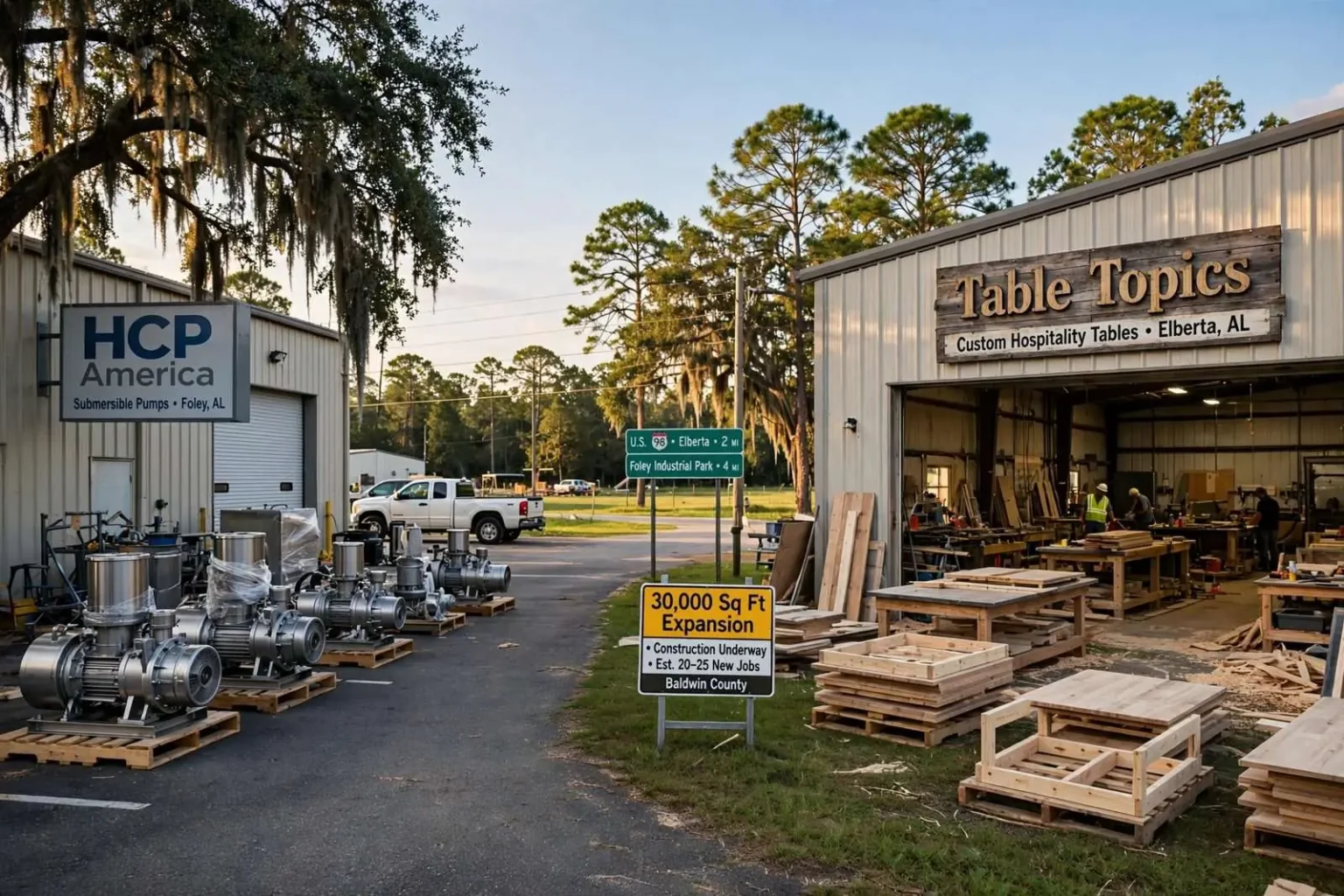
Two South Baldwin County manufacturers are bringing a combined wave of new employment to the area, with Foley closing a deal on new industrial property and an Elberta-area company planning a multimillion-dollar expansion. The moves come as Baldwin County continues to rank among the fastest-growing counties in Alabama, drawing both residents and employers to a corridor where municipal leaders have spent years courting industrial development.
Foley seals industrial park sale
The Foley City Council approved the sale of roughly two acres on the east side of the Foley Industrial Park to HCP Pumps during a special-called meeting, completing a transaction the council had intended to finalize at its regular session days earlier.
Council President Wayne Trawick acknowledged the board voted once to approve the sale but failed to take the required second vote before adjourning. “But we forgot,” Trawick said.
The procedural stumble forced the council to convene again to finish what it had started. Municipal codes in Foley, as in most Alabama cities, require certain actions — particularly the disposal of public property — to pass by repeated votes at the same meeting, a safeguard designed to give council members a moment to reconsider before public assets change hands. With the corrective vote in place, officials with HCP Pumps America closed on the purchase the following day.
The company, based in Lincoln, Alabama, manufactures submersible pumps for residential, commercial and municipal use and is a subsidiary of Taiwan-based HCP Pumps, LLC, founded in 1979. The parent company has built a global footprint in the pumping industry over more than four decades, producing equipment used to move stormwater, wastewater and groundwater in applications ranging from home drainage systems to large municipal infrastructure projects. Submersible pumps, which operate while fully underwater, have become a staple of modern water management, and coastal markets like South Alabama — where heavy rainfall, high water tables and hurricane-driven flooding are recurring facts of life — represent a natural customer base for the product line.
Lincoln, the company’s American base, sits in Talladega County in east Alabama, a community whose industrial landscape has been reshaped in recent decades by international manufacturers establishing U.S. operations there. HCP’s decision to expand into Baldwin County follows a familiar pattern for the state, which has positioned itself for years as a landing spot for foreign-owned manufacturers looking to serve the American market from a Southern base.
City officials said the operation is expected to create 10 to 15 jobs initially, with additional positions anticipated as the facility grows. Trawick described the positions as good-paying jobs for the area.
What the Foley deal means for the industrial park
The Foley Industrial Park has served as the city’s primary tool for attracting light manufacturing, distribution and service companies, offering sites with access to the region’s transportation network. Foley’s position along the U.S. 98 and Alabama 59 corridors, within reach of the Port of Pensacola, the Port of Mobile and Interstate 10, has made it attractive to companies whose customers and suppliers are spread across the Gulf Coast. Each sale of park acreage also returns property to the city’s tax rolls, strengthening the municipal revenue base that funds police, fire and street services.
For a growing city of Foley’s size, a 10-to-15-job operation may look modest on paper, but city leaders have consistently framed industrial recruitment as cumulative — each anchor tenant making the park more appealing to the next prospect, and each expansion adding to a payroll that circulates through local restaurants, retailers and service businesses. New residents moving into the area’s subdivisions add to the customer base those employers depend on, which is why municipal boards across Baldwin County have treated industrial growth and residential growth as two halves of the same equation.
Elberta company eyes 20-25 more workers
Nearby in Elberta, Table Topics — which builds custom tables for the hospitality industry — presented town leaders with plans for an additional 30,000-square-foot building along U.S. 98 near County Road 95. The project carries an estimated price tag of $1.5 million to $2 million and would add 20 to 25 employees.
Table Topics occupies a niche in the restaurant supply chain that most diners never see but every restaurateur understands. Custom table fabrication for the hospitality industry means outfitting new restaurants, retrofitting existing dining rooms and supplying the furniture that chains and independent operators alike need when they open or remodel locations. The Gulf Coast restaurant economy — from the tourist corridors of Gulf Shores and Orange Beach to the dining scenes in Mobile, Pensacola and beyond — gives a Baldwin County fabricator a dense circle of potential customers within a few hours’ drive.
A 30,000-square-foot addition represents a substantial expansion for a specialized manufacturer, providing space for additional production lines, raw material storage and finishing work. The estimated investment of $1.5 million to $2 million covers construction as well as the equipment needed to fill the building, and the 20 to 25 new positions would roughly represent a significant step up in the company’s workforce.
The site’s location along U.S. 98 places the expansion on one of South Baldwin County’s principal east-west arteries, a highway carrying a steady mix of commuter, commercial and tourist traffic. County Road 95, which intersects the highway near the project site, is among the rural routes that have seen rising volumes as development pushes east and north from the coast.
Jurisdictional questions outside town limits
Because the site sits just outside Elberta’s town limits but within its police jurisdiction, regulatory oversight of the expansion would be shared between the town and Baldwin County.
The arrangement is a common quirk of Alabama municipal law. Cities and towns in the state exercise planning, zoning and building-code authority within their corporate limits, but they also hold a measure of authority in the surrounding police jurisdiction — a band of territory generally extending beyond the town’s boundaries in which municipalities may enforce certain regulations, including building and sanitation codes. County commissions, meanwhile, retain authority over roads and other matters in unincorporated areas. When a development lands in that overlap, as Table Topics’ proposed building does, both governments have a seat at the table.
Mayor Marvin Williams said the town would nonetheless work closely with the company however it can.
For Elberta, a small town in the county’s agricultural south, the prospect of adding a few dozen manufacturing jobs is meaningful in a way that larger cities might not immediately appreciate. Communities of Elberta’s size have watched much of Baldwin County’s explosive growth concentrate along the Interstate 10 corridor and the beach highway, leaving the southern farming towns to balance their quiet character against the pressure to capture some share of the region’s expansion. A local company choosing to grow in place — rather than relocating to a larger market — keeps payroll and tax dollars rooted in the community.
A busy season for South Baldwin industry
Taken together, the Foley and Elberta projects illustrate how the manufacturing base of South Baldwin County is broadening beyond the tourism and construction sectors that have long dominated the local economy. Pump manufacturing and custom furniture fabrication sit in entirely different industries, but both serve markets that are growing along the Gulf Coast: infrastructure that must manage water in a flood-prone region, and restaurants that must equip themselves for a tourist trade that swells every year.
Local officials in both communities have emphasized that the new positions are the kind of year-round, skilled employment that helps balance an economy otherwise weighted toward seasonal service work. Whether the region’s growth keeps producing these opportunities — and whether the towns can supply the workforce to fill them — will be among the questions to watch as both projects move from announcement to construction.
The wider employment picture
The announcements land at a moment when Baldwin County’s labor market is being pulled in two directions at once. The county has added tens of thousands of residents over the past decade, feeding one of the state’s strongest population growth rates, and new employers arriving in Foley, Elberta, Loxley, Robertsdale and Daphne have often found themselves competing for many of the same workers. Positions like those HCP Pumps and Table Topics describe — full-time, year-round manufacturing work — tend to pay above the wages offered in the area’s dominant seasonal tourism sector, which gives local job seekers options they have historically lacked.
It also means the two companies will likely be recruiting from the same pool of prospective employees, along with the distribution centers, trade contractors and food processors already operating in the county. Workforce development officials in the region have pointed to the county’s technical training channels, including the high school career academies and the community college system, as the pipeline that companies like these draw from when they expand. Trades such as machining, welding, assembly and fabrication require training that local programs have worked to build out as manufacturers have multiplied along the Gulf Coast.
For residents of the southern end of the county, shorter commutes are part of the practical appeal. Much of Baldwin County’s manufacturing employment has historically been concentrated along the Interstate 10 corridor in the northern half of the county, leaving workers in Foley, Elberta, Summerdale and Bon Secour to drive north for industrial jobs or to take lower-paying work closer to home. New facilities opening in South Baldwin trim that commute, keep more household income spent in the communities where workers live, and give the southern towns a stake in the industrial growth that has largely bypassed them.
Neither project has a firm public timeline yet, and both remain subject to the ordinary course of construction, permitting and hiring. But officials in both towns have treated the announcements as a sign that the region’s manufacturing recruitment — long a side note to the beach economy — is starting to produce results on the ground.