Twelve New Businesses Fill Downtown Foley as Main Street Reports $44,000 in New Funding
Foley Main Street welcomed 12 new downtown businesses since November and secured more than $44,000 in grants, including money for decorative crosswalks and evening programming.
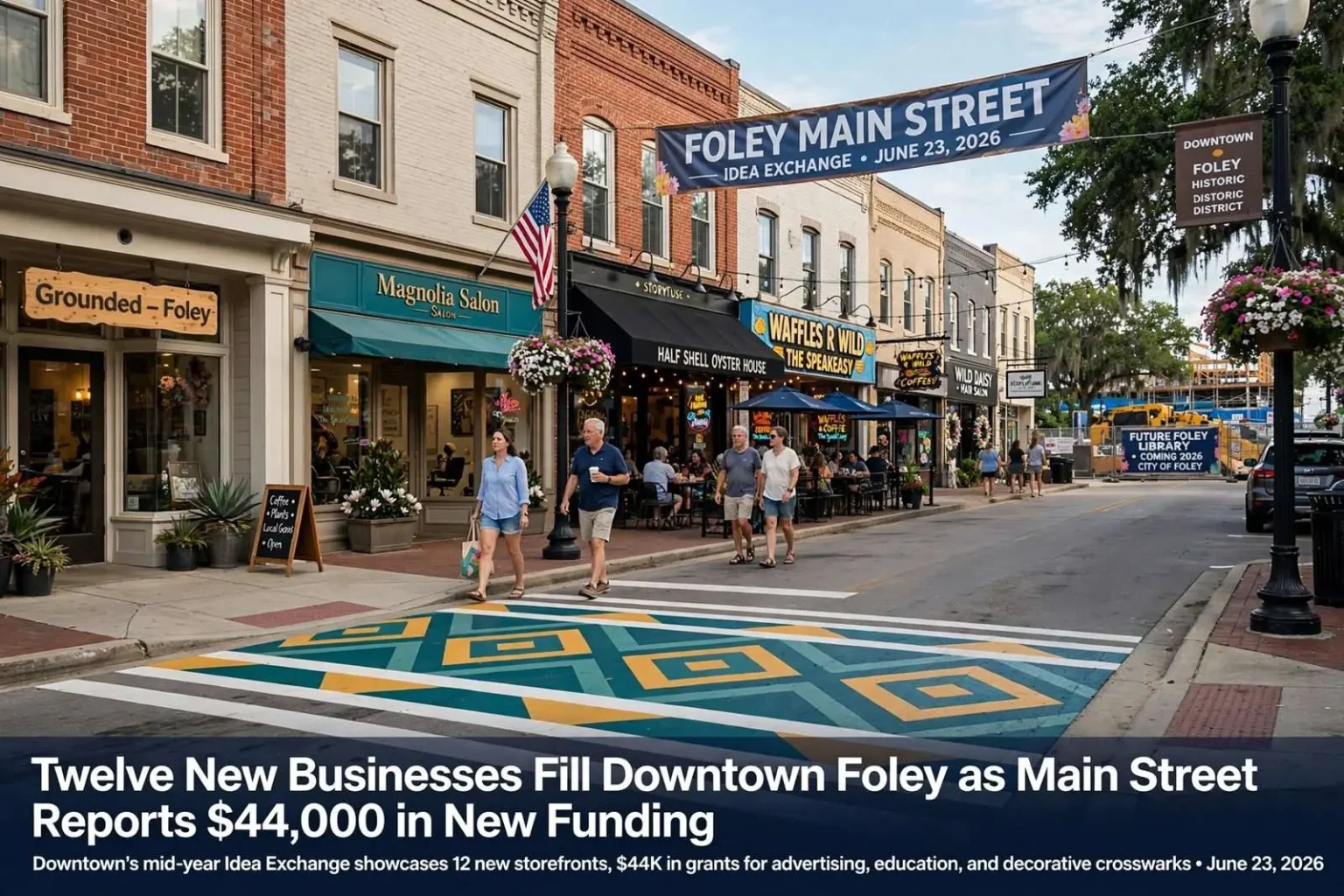
Downtown Foley added a dozen new businesses over the past eight months, and the organization that works to fill its storefronts says the growth is no accident. Foley Main Street laid out the numbers at its bi-annual Idea Exchange on June 23, a gathering of elected officials, board members, volunteers and entrepreneurs convened to review recent progress and map what comes next.
The meeting serves as the organization’s mid-year reckoning, a public accounting of what a downtown development organization actually does between ribbon cuttings. For a city of Foley’s size, the pace of the last eight months stands out: a dozen openings in a single downtown district represents a sustained run of private investment, and the organization attributes it to deliberate work rather than luck.
Money in hand
Since Nov. 1, 2025, Foley Main Street has secured more than $44,000 in grants and program funding, according to the organization. The breakdown:
$14,000 for advertising, promoting downtown and expanding evening programming. $10,000 for economic development education. $20,000, awarded in spring 2026, to install decorative crosswalks intended to beautify the district while improving safety for pedestrians and cyclists.
The crosswalk money is the kind of small-dollar investment that tends to punch above its weight. Painted, textured or otherwise visually distinct crosswalks slow drivers, mark the pedestrian zone clearly and signal to visitors that a district is meant to be walked rather than driven through.
The grant dollars also stretch the organization’s reach beyond what its own budget could support. Advertising funding keeps downtown in front of the tens of thousands of travelers who pass through Foley on their way to the beach, while the economic development education allocation lets local business owners and volunteers access training in the fundamentals of district management — everything from storefront improvement to event promotion — without each business paying its own way.
Matching buildings to businesses
Wes Abrams, who led the meeting, framed the organization’s core function in plain terms.
“A large portion of what we do is economic development — matching businesses to buildings and working closely with property owners and investors,” Abrams said. “The growth we are seeing is a direct result of these partnerships and a shared vision for a vibrant, walkable downtown.”
The matchmaking work is less visible than an opening day, but it is where most downtown deals begin. A vacant storefront with the wrong tenant can sit empty for years; a property owner connected with the right operator — one whose concept fits the building, the rent and the neighborhood — can turn a liability into a downtown anchor. Organizations like Foley Main Street act as the broker of that fit, maintaining knowledge of both the available spaces and the entrepreneurs looking for them.
That work is reflected in the roster of businesses that have joined the Foley Main Street district since November 2025: Baldwin County Resources LLC, Beyond Measure Therapy, Grounded – Foley, Half Shell Oyster House, Lillian’s Closet, Magnolia Salon, Melissa’s Kitchen, Nerd Out, Quality Alterations, Storyfuse, Waffles R Wild – The SpeakEasy and Wild Daisy Hair Salon.
The mix is telling: restaurants and food concepts, personal services, retail, therapy and professional services. A downtown that draws people for more than one reason tends to hold them longer, and a district that mixes daytime services with evening dining can generate foot traffic across a much wider slice of the day. A customer who books a salon appointment in the morning is more likely to return for dinner; a lunch crowd becomes a browsing crowd, and a browsing crowd becomes a return visitor.
A digital passport for downtown
Foley Main Street also introduced the Downtown Foley Digital Passport, a location-based mobile program that lets visitors earn points as they explore downtown shops and restaurants, then redeem those points for rewards. Digital passport programs have become a common tool in Main Street districts nationally, functioning as a low-cost way to nudge visitors past the two or three businesses they already know and into the storefronts they have never entered.
The mechanics are simple but effective. Because points accumulate for checking in at multiple locations, the program rewards exploration itself — a visitor who parks once and walks the whole district earns more than one who dashes into a single shop. For the businesses, the passport functions as a shared marketing engine: each participating storefront benefits from the traffic that the other participants generate, and the district as a whole collects a picture of how visitors actually move through it.
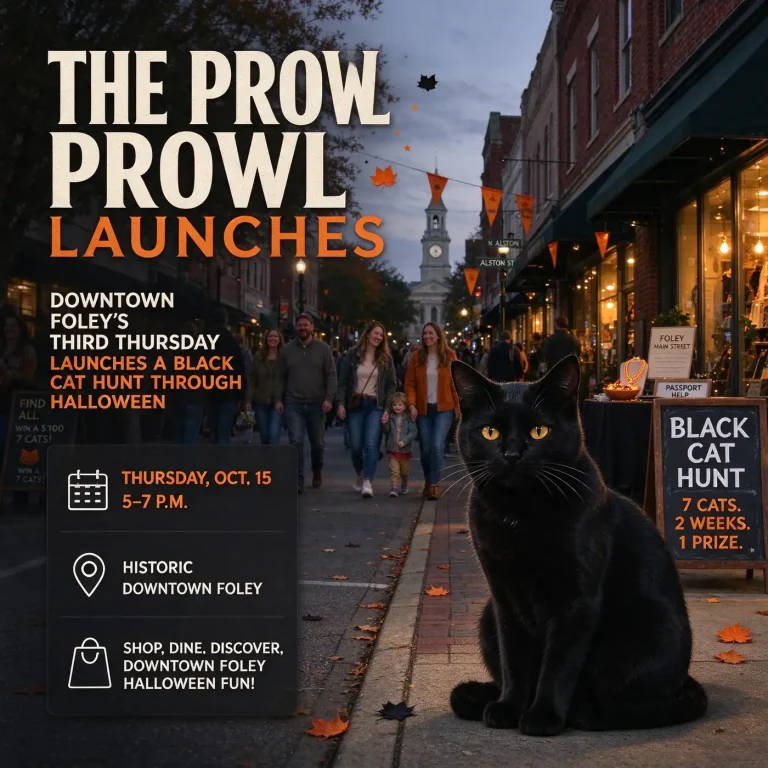
The launch comes as the organization’s Third Thursdays events continue to draw record attendance, giving Foley a recurring reason for residents from across south Baldwin County to come downtown after work.
Recurring events do quiet but compounding work for a district. A monthly event turns a downtown visit into a habit, and habits are what sustain storefronts between festivals and holidays. Record attendance at Third Thursdays also gives the new businesses on the roster an audience they did not have to build alone — a ready-made crowd of locals who come downtown on a schedule and are looking for something new to try.
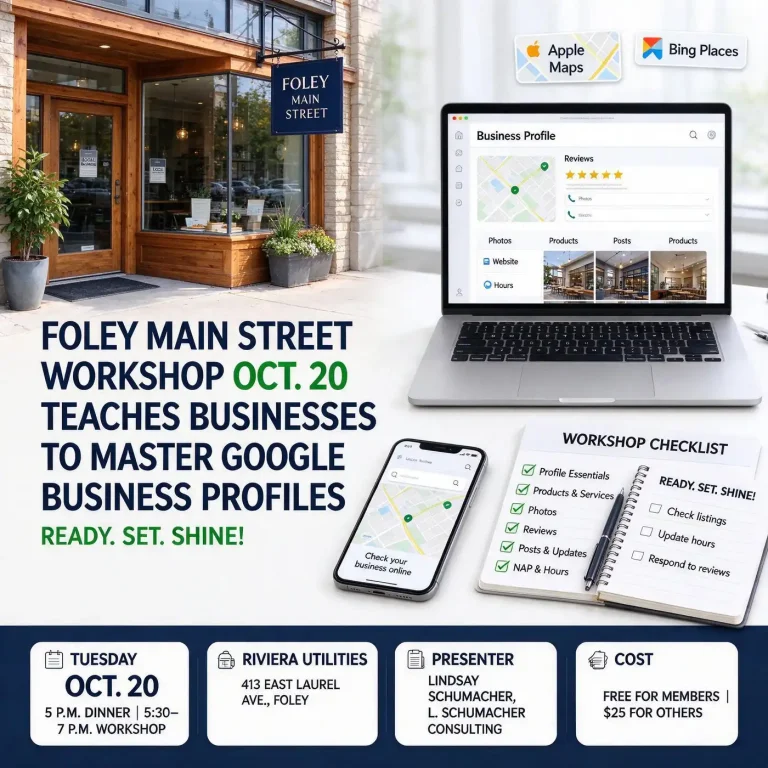
The organization has also hosted four professional workshops since its previous bi-annual meeting, aimed at giving downtown business owners practical skills and resources to compete. Training sessions of that kind have become a staple of the Main Street model, which pairs its promotional work with a commitment to strengthening the businesses already operating on the block — on the theory that a district’s health depends as much on keeping good operators in place as on recruiting new ones.
City projects coming down the pipe
Mayor Ralph Hellmich updated attendees on municipal projects expected to reshape the district in the coming years: the new Foley Library, currently under construction, which will anchor downtown with a civic destination that generates steady daily traffic; underground utilities, a transition intended to improve both appearance and reliability by removing overhead lines — a meaningful consideration on a coast where hurricane-force winds routinely take out above-ground power; and upgrades to the Dyas parking lot, addressing one of the persistent constraints on any growing downtown: where to put the cars.
Each project addresses a different weakness in the downtown experience. A library produces daily visits from readers, students and families — the kind of predictable, recurring foot traffic no promotion can manufacture. Undergrounding utilities removes the visual clutter of poles and wires from historic streetscapes and, just as importantly on the Gulf Coast, removes the frailty: districts that lose power for days after a storm lose customers for those same days. Parking, meanwhile, is the perennial complaint of every successful downtown, and expanding capacity before the growth outpaces it is a rare bit of forward planning.
The projects also complement one another. A visitor drawn downtown by the library or a Third Thursday event needs a place to park; a shopper walking between shops benefits from safer crossings; and a district free of overhead wires photographs better, which matters in an era when a downtown’s image travels through social feeds as much as through billboards. Municipal investment of this kind typically raises the value of the surrounding storefronts, which in turn makes the Main Street organization’s matchmaking work with property owners easier.
The bigger picture
Foley sits at a crossroads in south Baldwin County, straddling the corridor that funnels beach traffic toward Gulf Shores and Orange Beach. That position brings enormous volumes of passing vehicles, but passing traffic is not the same as downtown customers. The strategic question for Foley Main Street has always been how to convert people driving through into people who park, walk and spend.
It is a challenge with a long history in south Baldwin County, where the summer beach season turns the region’s highways into rivers of travelers. Towns along those corridors have learned that the difference between a bypass town and a destination town is the density of reasons to pull over: a distinctive downtown, a good meal, a place to stretch your legs that feels worth the stop. Foley’s answer has been to build those reasons deliberately — the events calendar, the passport program, the civic anchors — rather than waiting for beach traffic to discover the district on its own.
Twelve new businesses, a redesigned crosswalk plan, a library under construction and a rewards program built to move visitors from store to store all point in the same direction: an effort to give people a reason to stop.
For now, the district’s momentum rests on a simple equation: more reasons to come downtown, more places to go once there, and an easier walk between them. Foley Main Street’s next Idea Exchange will show whether the equation keeps adding up. More information about the organization is available at foleymainstreet.com.
For downtown’s new arrivals, the timing is favorable. A dozen businesses opening into a district with rising event attendance, new civic infrastructure on the way and an organization actively steering visitors through the storefronts gives each one a stronger starting position than most startups enjoy. The bi-annual Idea Exchange format means the next public accounting will come in six months, when the district will have its first full look at whether the momentum holds.