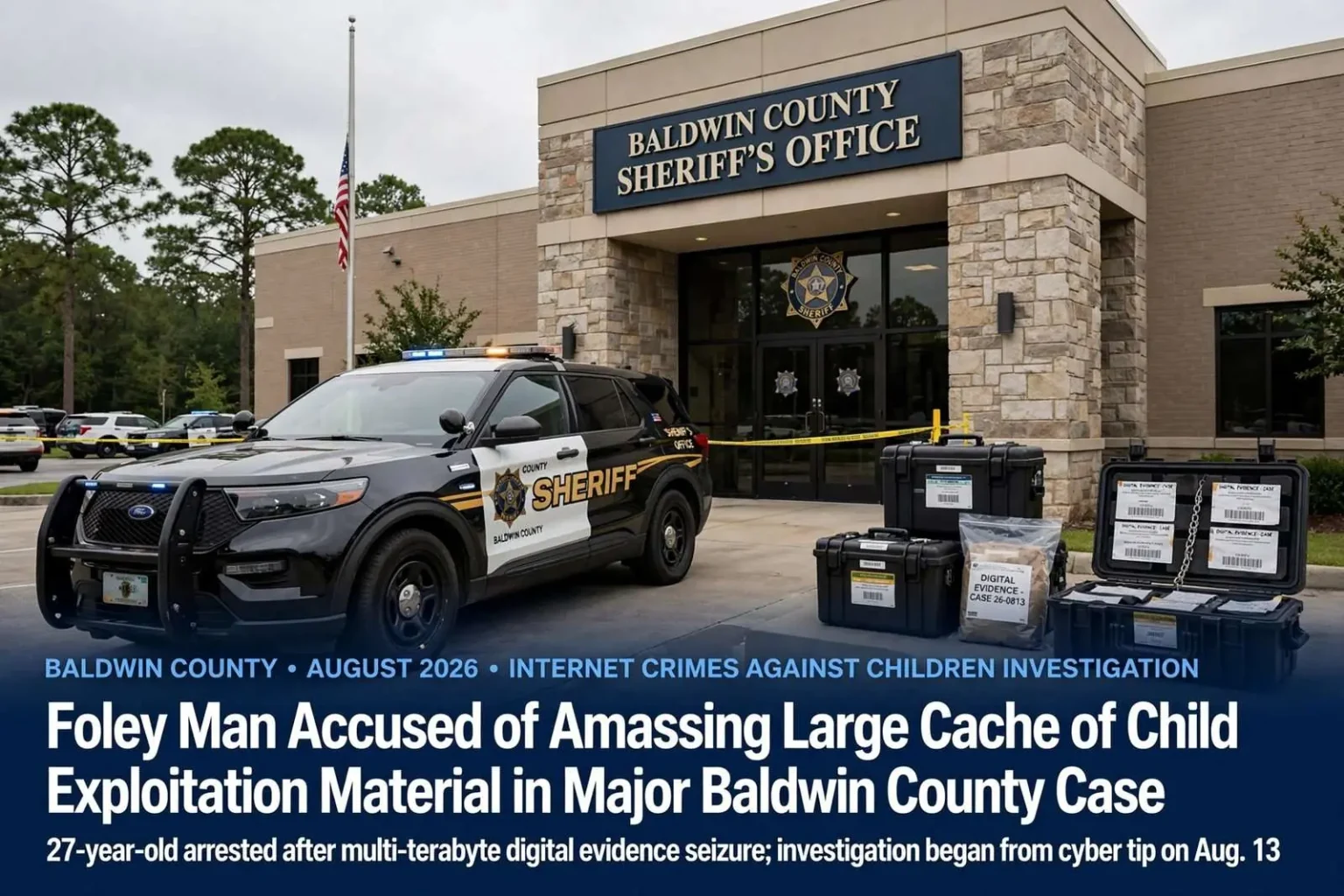
The Baldwin County Sheriff’s Office has arrested a 27-year-old Foley man following a large-scale investigation into internet crimes against children that officials say resulted in one of the agency’s largest digital evidence seizures ever recorded.
Douglas Smith, 27, of Foley, was taken into custody after investigators say cyber tips led them to illegal material linked to him. The case began in mid-August and moved quickly from an initial report to search warrants, an interview and an arrest — a pace that reflects how the modern system of online child-safety reporting operates across service providers, national organizations and local investigators.
How the investigation began
The investigation began Aug. 13, 2026, when the sheriff’s office received cyber tips from an electronic service provider that had detected illegal material on its platform and notified the National Center for Missing and Exploited Children. Those tips identified Smith as the suspect, according to investigators.
The routing of that report is standard practice in cases of this kind. Technology companies that operate online platforms are required to report detected child sexual abuse material to the National Center for Missing and Exploited Children, the national clearinghouse created by Congress to receive those reports. NCMEC in turn forwards tips to the law enforcement agency with jurisdiction over the suspect’s location — in this case, the Baldwin County Sheriff’s Office, which picked up the investigation from there.
That pipeline has become the front door for a large share of internet-crimes-against-children cases nationwide. Investigators rarely learn of these offenses through a victim’s report, because the material circulates online rather than through a direct complaint. Instead, the first signal typically comes from the platforms themselves, whose automated detection systems flag known illegal files and route the account information behind them to investigators.
Search warrants and the evidence seizure
Working from the tips, investigators obtained and executed search warrants at Smith’s residence in Foley and his vehicle in Robertsdale, seizing digital devices that they say contained evidence of unlawful activity. The two locations — a home address in Foley, near the county’s southern coast, and a vehicle stopped in Robertsdale to the north — covered the places investigators believed the suspect’s devices would be found.
During a subsequent interview, Smith admitted to accumulating and possessing a large quantity of illegal files over the course of several years, according to the sheriff’s office. That admission, combined with the physical evidence seized under warrant, forms the core of the case investigators will present to prosecutors.
The scale of what was recovered set this case apart. Investigators say they ultimately recovered multiple terabytes of illegal material from his devices, making it one of the largest digital evidence seizures in the agency’s history. In practical terms, multiple terabytes of files represent an enormous library of digital data — far beyond the storage capacity of ordinary personal use, and the kind of volume that takes forensic examiners weeks or months to catalog.
The forensic work ahead
Seizing the devices is only the first step in a digital evidence case. Forensic examiners must image each device, catalog the files found on it, establish timelines and link the material to the suspect’s ownership and use. With a seizure measured in terabytes, that analysis can stretch on for months, and prosecutors typically build their filing decisions around the examiners’ findings.
The size of the evidence collection also matters at sentencing. Federal and state guidelines for possession and distribution offenses take account of the number of files involved, and multi-terabyte collections sit at the extreme end of that scale. In Alabama, possession of child sexual abuse material is a felony, and prosecutors weigh whether state charges suffice or whether federal partners — who often bring greater sentencing exposure in large-scale possession cases — should take parallel action.
The sheriff’s office has not announced specific charges or whether federal agencies are participating in the prosecution. Cases that begin with NCMEC tips frequently involve coordination with agencies such as the FBI and Homeland Security Investigations, which maintain dedicated child-exploitation task forces across the Gulf Coast region.
What the case says about online dangers
Officials said the case underscores the ongoing dangers children face online. In a statement, the Baldwin County Sheriff’s Office reaffirmed its commitment to child safety: “The Baldwin County Sheriff’s Office and its law enforcement partners are committed to continuing their efforts to identify and apprehend individuals who engage in illegal online activities and to ensure the safety and well-being of all children.”
The statement reflects the reality that this work is a standing function of modern policing rather than an occasional investigation. The volume of digital material circulating online, the reach of file-sharing platforms and the anonymity of online spaces mean that every agency with an internet-crimes capability maintains a continuous caseload, and tips from providers arrive at agencies across the country every day.
The reporting system behind the tip
The path from a platform’s detection system to a Baldwin County search warrant runs through a framework built over three decades. Federal law requires electronic service providers to report apparent child sexual abuse material they find on their systems to NCMEC, which receives millions of reports annually and triages them by urgency and location. Each report carries the account details, timestamps and file identifiers that let local investigators connect an online trail to a physical address.
That system is why a tip received on Aug. 13 could produce warranted searches in Foley and Robertsdale within the investigation’s early days. The initial report already contained the provider’s findings; the investigators’ work was to verify the account holder’s identity, build the probable-cause case for the warrants and execute them before evidence could be destroyed.
Protecting children online
For parents in Baldwin County and across the Gulf Coast, investigators use cases like this one to renew familiar guidance: know what platforms and applications children use, keep devices in common areas where practical, maintain open conversations about online contact with strangers, and report anything concerning. Suspicious activity involving the exploitation of children can be reported directly to law enforcement or through NCMEC’s CyberTipline, which feeds the same pipeline that produced this case.
The arrest of a Foley man on these allegations does not close the broader concern that prompted it. The sheriff’s office framed the case as evidence of both the scale of the problem — a multi-terabyte collection accumulated over years, investigators say — and the capacity of the response: providers that detect, a national clearinghouse that routes, and a local agency with the forensic resources to take a case from a cyber tip to one of the largest seizures in its history.
Smith remains in the custody of the Baldwin County justice system as the case moves forward, with the seized devices now the subject of ongoing forensic examination and prosecutors determining the charges the evidence will support.
Inside an internet-crimes investigation
Investigations into online child exploitation follow a rhythm shaped by the evidence itself. Unlike offenses witnessed by victims or bystanders, these cases begin with files and account data, which means the early work is verification: confirming the identity behind the flagged account, matching it to a residence, and establishing that the activity was ongoing rather than an isolated historical file.
Once investigators establish that foundation, the warrants follow. Searches at a residence and a vehicle, like those carried out in Foley and Robertsdale, are aimed at capturing devices before they can be wiped or discarded, and the seizure itself is documented with a chain of custody that will carry the evidence through prosecution. An interview of the suspect typically comes after the searches, when investigators can confront the suspect with what was found.
The admission attributed to Smith — accumulating and possessing a large quantity of illegal files over several years — is the kind of statement that shapes the case’s trajectory. Multi-year accumulation, as described by the sheriff’s office, suggests sustained activity rather than a single incident, and the volume recovered will be central to how prosecutors frame both the charges and the sentencing arguments that follow a conviction or plea.
A standing commitment in Baldwin County
The Baldwin County Sheriff’s Office has built its internet-crimes capability over years, and cases of this scale demonstrate why the investment matters. Digital forensics requires trained examiners, specialized software and the storage infrastructure to preserve terabytes of evidence — capabilities that smaller agencies frequently lack and must borrow through task-force partnerships. Handling a seizure of this size in-house marks the agency’s capacity in the region.
The office’s public statement closing the announcement of the arrest made the point directly: efforts to identify and apprehend individuals engaged in illegal online activity will continue, with the safety and well-being of children named as the priority. For investigators, the end of one arrest is the beginning of the next tip in the queue — a queue that, across the country, never empties.
Where the case goes from here
The next milestones in the case are administrative and legal: formal charges, an initial court appearance, and the forensic report that will convert the seized devices into a prosecutable file inventory. Baldwin County District Attorney’s prosecutors will weigh the state case, and any federal referral would add a parallel track with its own timeline.
What is already public stands: a cyber tip received Aug. 13, 2026, a suspect identified through provider reports, warrants executed in Foley and Robertsdale, an admission describing years of accumulation, and a multi-terabyte seizure that ranks among the largest in the sheriff’s office history. The investigation began with a platform’s automated detection and ended with an arrest in Foley — the system working, in this instance, exactly as designed.