West Orange Avenue Streetscape Leads a Sprawling Foley Council Agenda
Foley leaders take the first step toward redeveloping downtown West Orange Avenue with a $100,000 engineering contract, part of an agenda that also covers a senior center, a $2 million grant application and a retiring K-9.
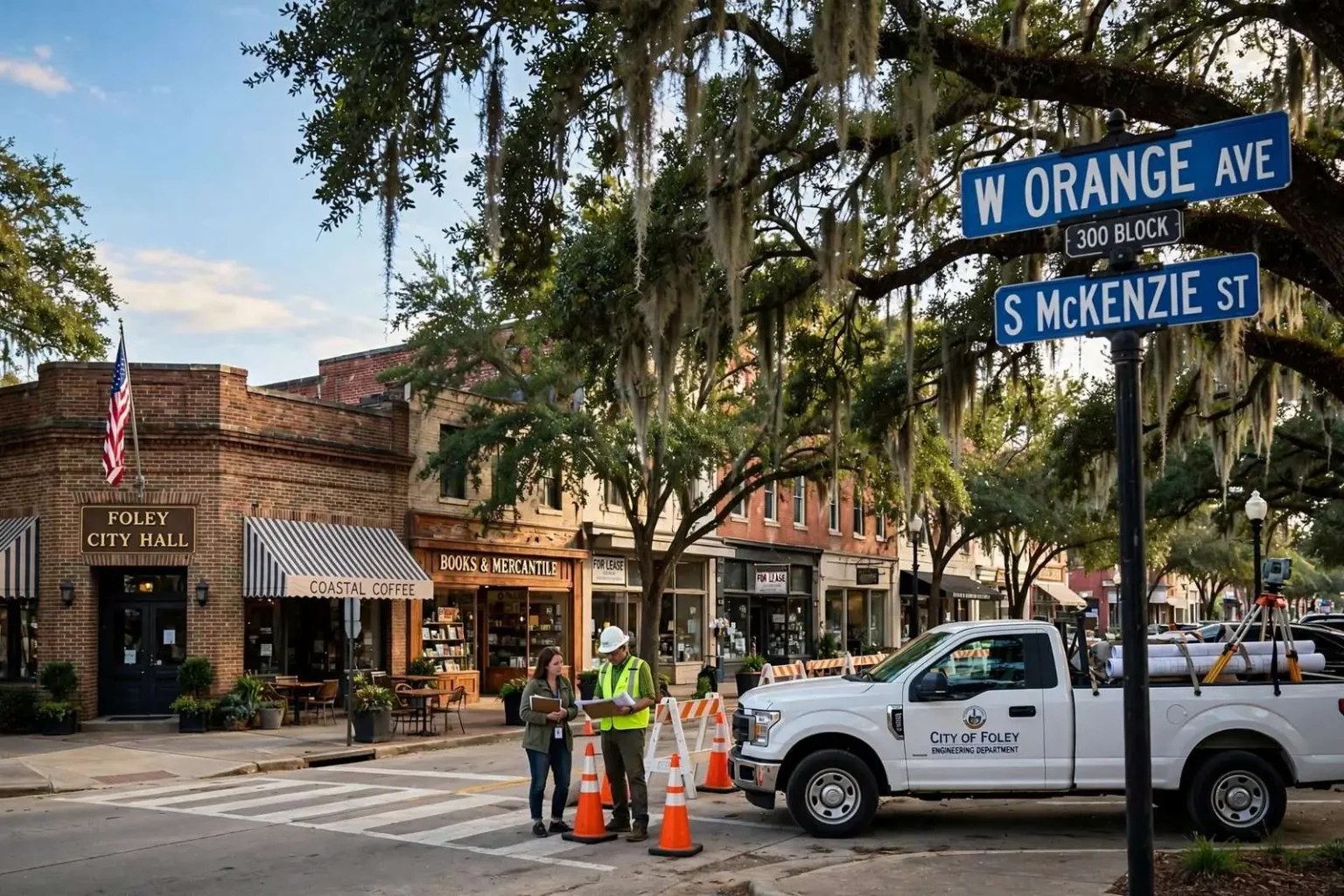
The heart of downtown Foley may be in for a substantial change. The city council has taken up a contract that represents the first concrete step toward upgrading the streetscape along West Orange Avenue, the sort of project that quietly determines whether a downtown becomes a destination or remains a place people drive through on the way somewhere else.
The Orange Avenue Contract
According to a memo from Daisha Barnes in the city’s Engineering Department, the $100,000 contract provides “a professional services proposal to develop a full set of construction documents to redevelop Orange Avenue’s revitalization.”
In plain terms, the city is hiring an engineering firm to produce the plan and the supporting documents that any actual construction would be built from. Nothing gets poured until this stage is finished. Streetscape projects typically involve sidewalks, curbing, lighting, crosswalks, landscaping, drainage, on-street parking configuration, and utility relocation, and each element has to be engineered against the others before a bid can go out. The $100,000 buys the drawings, not the street.
A Long Agenda Behind It
The streetscape contract came before the council at a joint work and regular session with an unusually crowded docket. The breadth of it is a useful reminder of how much ground a growing city covers in a single evening.
Land Use and Development
- A public hearing and second reading on rezoning a Vulcan-owned property at 339 E. Berry Ave. from light industrial to local business.
- An amendment to the zoning ordinance addressing signage for bed-and-breakfast businesses.
- An amendment to the Magnolia East planned development removing 23 acres, reducing the project from 102 acres to 76 acres, while broadening permitted uses to include commercial. A first reading would rezone those 23 acres to extended business. The property sits at the northeast corner of Miflin Road and the Foley Beach Express, and the planning commission gave a favorable recommendation.
- Public hearings on nuisance litter and junk at four properties, on East Myrtle Avenue, Litton Lane, East Azalea Avenue, and East Gate Circle, with cleanup orders. A fifth hearing, for a property on Cedar Court, would be set.
Streets, Safety and Infrastructure
- A second reading and public hearing on amended speed limits and traffic controls on Irwin Street between Azalea Avenue and Michigan Avenue.
- A resolution to install a three-way stop at Albatross Drive and Lakeview Drive.
- A $15,000 contract with Capstone Engineering for professional services on North Cedar Street sidewalk improvements from West Peachtree Avenue to Village Square Boulevard.
- $185,000 for in-house construction of the north-south corridor of Wilson/Equestrian Park Road, a project originally budgeted at $750,000, plus a $25,000 change order for design and engineering.
- An application for a federal pre-disaster mitigation grant seeking $2 million for an underground utilities project.
- A decision on assuming monthly electrical costs for street lights in GlenLakes Phase 3, along with a broader policy establishing rules for ownership, operation, maintenance, replacement, and electrical costs of streetlights within HOA-controlled subdivisions.
City Operations and Services
- Terminating an agreement with Symbol Health Solutions, which has provided a clinic for city employees and their dependents, and moving those services to Baldwin Health.
- Amending the pay classification plan in the Street Department.
- Implementing CivicPlus digital government software to modernize the city’s digital services, at a first-year cost of $102,154, including $60,000 for implementation, and $54,410 in the second year.
- A request for an opinion from the state attorney general regarding the city’s record retention obligations for audio and video recordings of council meetings.
- An application for a Homeland Security grant through the Alabama Law Enforcement Agency.
- Proposals from Williams Blackstock Architects adding $32,000 to the $466,920 Foley Senior Center project.
Community, Parks and a Retiring K-9
- A presentation on the Mobile Bay Estuary Program.
- An amendment adding $50,000 to the city’s support agreement with Baldwin County Schools, raising the donation to $350,000, to be matched by the county school board.
- A $15,000 grant from the Gulf Coast Resource Conservation and Development Council for new interpretive signs at the Graham Creek Nature Preserve.
- A resolution memorializing the purchase and donation of food, water, and condiments for a Juneteenth celebration.
- Approval of the retirement of K-9 officer Bo, who would be declared surplus so that he can be kept by his handler.
- Rescinding an earlier resolution to purchase an emotional support dog for the city.
- Approval of a downtown parade in August and a chamber supper club event in October.
Reading the Room
Agendas like this one rarely make the evening news, but they are where a city is actually governed. A $100,000 engineering contract today is a rebuilt downtown street in three years. A $15,000 sidewalk design is the reason a child can walk to school. And an aging K-9 goes home with his handler, which is the right ending.