Foley’s D.J. Fluker placed on NFL COVID-19 reserve list
Foley native and Alabama product D.J. Fluker was placed on the Baltimore Ravens' reserve/COVID-19 list, threatening the team's games against Pittsburgh and.
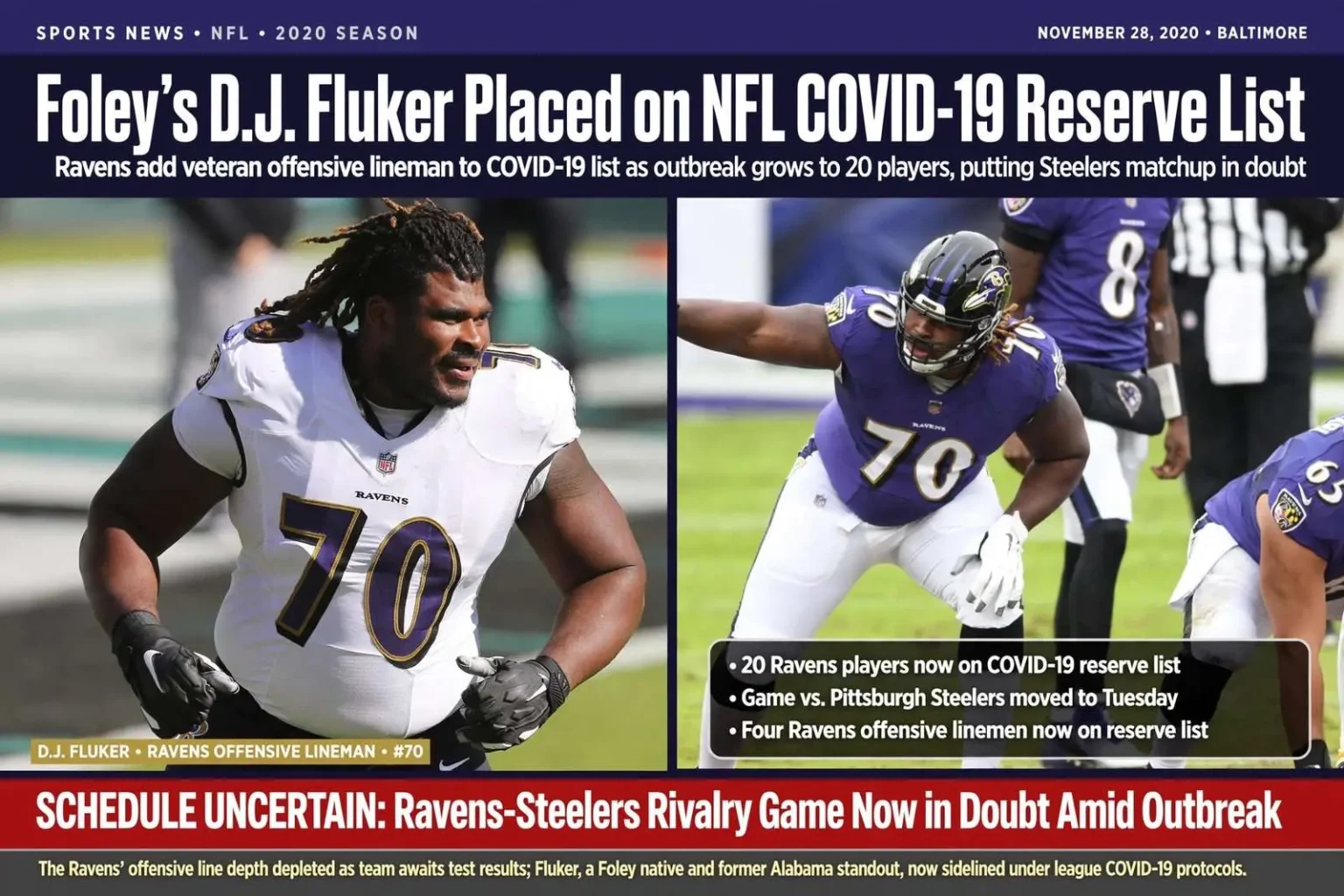
BALTIMORE — Foley native and veteran NFL offensive lineman D.J. Fluker was among six Baltimore Ravens players added to the team’s reserve/COVID-19 list on Saturday, casting doubt on the Ravens’ upcoming schedule. With Fluker’s addition, Baltimore had 20 players on the COVID-19 list, raising questions about whether the team’s game against the Pittsburgh Steelers — already moved from Thursday to Tuesday — could be played.
The situation left the Ravens in uncharted territory even by the disrupted standards of the 2020 NFL season. Twenty players on the reserve/COVID-19 list represents a significant slice of a 53-man roster, and the outbreak touched nearly every position group at once. League officials and team personnel spent the weekend working through contact tracing data and test results while the schedule for one of football’s fiercest rivalries hung in the balance.
For Fluker, the timing was particularly costly. The big right tackle had worked his way into a starting role in Baltimore’s offense, and the Rams-sized hole his absence creates comes at the worst possible moment for a team fighting to hold its position in the AFC playoff race. Baltimore entered the stretch run with one of the league’s best rushing attacks, an identity built directly on the health and cohesion of its offensive line.
That line is now in tatters. Four of the Ravens’ offensive linemen have now landed on the reserve list, leaving only five on the active roster and one on the practice squad. NFL rules require eight offensive linemen among a team’s 48 active game-day players, which means Baltimore would need at least two elevations just to field a legal gameday lineups against Pittsburgh — assuming no further positive tests among the remaining group.
How the roster crisis unfolded
The Ravens’ outbreak began in early November, shortly after a game against the Tennessee Titans, and grew steadily through contact tracing rather than in a single dramatic wave. Each round of testing and tracing added new names to the list, and each addition complicated the calculus for the league office, which must weigh competitive fairness, player safety, and the practical realities of a broadcast schedule when deciding whether a game can proceed as planned.
The Steelers game, one of the most anticipated matchups of the season, was originally set for Thanksgiving night and had already been pushed back before Fluker’s name joined the list. Under the revised schedule the league ultimately adopted, the game moved from Thursday to Tuesday, an almost unheard-of slot for a marquee matchup and a reflection of how serious the situation had become. Whether even that date could hold remained an open question as the list of unavailable players kept growing.
Fluker is also expected to miss Baltimore’s Week 13 matchup against the Dallas Cowboys, a game the league shifted from Thursday, Dec. 3 to Monday, Dec. 7. For a player, landing on the reserve/COVID-19 list means a minimum absence measured in days but potentially stretching across multiple games, depending on symptoms and testing results. For the team, it means practicing without key contributors and game-planning around a lineup that may not be set until days before kickoff.
Under league protocols, any player who tests positive for COVID-19 must self-quarantine for at least 10 days unless asymptomatic and cleared by two negative tests at least 24 hours apart. Players who are close contacts but test negative face shorter quarantine windows under the protocols in effect that season, but the cumulative effect of multiple positive cases in one position group can idle a unit for weeks. The Ravens’ offensive line situation fit that pattern precisely.
What the reserve/COVID-19 list means
The reserve/COVID-19 list, introduced when the league played through the pandemic in 2020, functions much like the injured reserve list in one key respect: players on it do not count against the active roster and cannot practice or play until cleared. Teams are permitted to promote players from the practice squad to fill the gaps, which Baltimore did as its line thinned, but the replacements are rarely equivalent to the veterans they stand in for.
The protocols that season evolved almost weekly as the league learned from each outbreak. Early in the season, the emphasis fell on isolation and contact tracing; later, the league tightened rules on mask-wearing in facilities, limited in-person meetings, and prohibited players on the list from accessing team facilities in any capacity. Testing ran daily for players and essential staff, and any positive result triggered an immediate review of the individual’s recent close contacts, whose own status would then depend on vaccination history, timing of exposure, and test results.
For Baltimore, the outbreak’s concentration among offensive linemen was especially punishing because of how the unit works. Offensive line play depends on continuity: five men moving as one, with communication calls and spacing refined through thousands of repetitions together. Swapping in a practice squad elevation or a backup forced into a new position ripples through every snap, and the Ravens’ offense — built around quarterback runs, misdirection, and a punishing ground game — asks more of its line than most schemes do.
Fluker’s road from Foley to the NFL
Fluker’s connection to the Gulf Coast runs deep. A product of McGill-Toolen Catholic in Mobile and Foley High School, he arrived at those schools by way of a childhood that stretched across Mississippi and Alabama, and he became one of the most heavily recruited offensive line prospects in the country while playing for Foley. His high school career established the two traits that would define him: enormous natural strength and a mean streak that coaches covet in a run blocker.
He went on to star at the University of Alabama, where he played for Nick Saban’s powerhouse teams in Tuscaloosa and anchored the right side of a line that cleared the way for one of the most productive rushing offenses in program history. Fluker started at right tackle for the Crimson Tide during a stretch when Alabama was winning national championships, and he left school early after a junior season in which he earned All-SEC recognition and established himself as a first-round talent.
The Seattle Seahawks and other suitors evaluated him heavily heading into the draft, and he heard his name called in the first round in 2013, beginning an eight-year NFL career that has included stops with the Chargers, the Giants, the Seahawks, and the Ravens. Along the way he showed the versatility that has kept him employed — starting games at both right tackle and right guard — and the durability that teams prize in a big body who can absorb a sixteen-game season in the trenches.
His signing with Baltimore restored a role he had held earlier in his career as a full-time starter, and injuries along the Ravens’ line opened the door for him to play significant snaps this season. He has started the Ravens’ last three games at right tackle, and the coaching staff had been publicly complimentary of the physical presence he brought to the run game. That momentum made the timing of the positive test all the more frustrating for a player fighting to prove he belongs in a starting lineup.
What it means for the Ravens and the season
The Ravens entered the pandemic-altered season with championship expectations after winning the AFC North in 2019, and the year has instead become an exercise in adaptation. The outbreak forced the team to hold virtual meetings, shortened its practice week, and left coaches preparing game plans for an opponent with only a fraction of the usual on-field preparation. Baltimore’s staff has leaned on the phrase “next man up,” but no roster is built to absorb twenty absences at once.
The AFC playoff picture sharpens the stakes. Baltimore sits in a crowded race where every game carries tiebreaker implications, and a divisional loss to Pittsburgh — already the AFC’s last unbeaten team at the time of the postponement — would compound the damage. Playing shorthanded against the best team in the conference, with a patchwork offensive line protecting an MVP quarterback, is about as difficult a draw as the schedule can produce.
For Fluker personally, the protocol calendar will determine when he can return. Ten days of quarantine from the positive test, plus the conditioning work needed to get back to game shape, likely rules him out of the Dallas game that follows. His absence will give younger linemen extended snaps, and how the line holds up in his absence will go a long way toward determining whether the Ravens’ season survives its strangest stretch intact.
The broader lesson of the Ravens’ outbreak — one the whole league has absorbed — is that in 2020, depth charts are provisional. Rosters can change overnight, game days can move, and the teams that navigate the chaos best will be the ones with the flexibility to rebuild their lineups on short notice. For now, Baltimore waits on test results, the league waits on the Ravens, and a Foley native watches from quarantine while his teammates try to hold the line without him.