For first time in years, no Mobile area player in Super Bowl LV
For the first time in five years, the Super Bowl will not feature a Mobile area player, after Daphne's T.J.
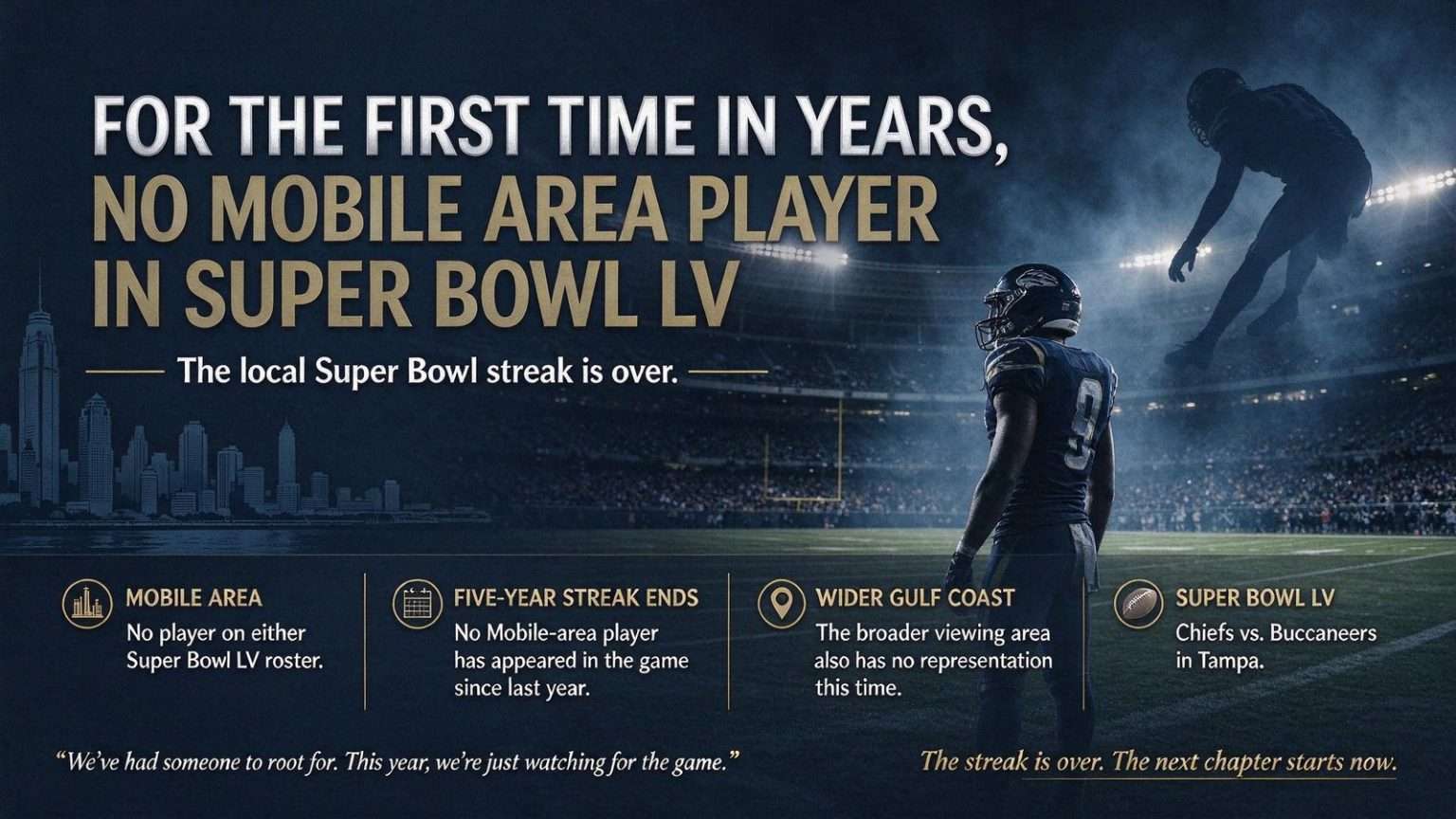
For the first time in five years, the Super Bowl will not feature a player from the Mobile area, and for the first time in six years, the big game will have no one from the wider viewing area. The streak of local representation — a point of pride for a region that has exported talent to the NFL for generations — ends this February, and the season’s final hopefuls fell one by one as the playoffs ran their course.
The last chance for Super Bowl LV was Buffalo Bills running back T.J. Yeldon of Daphne, whose team lost Sunday’s AFC Championship Game to the Kansas City Chiefs, 38-24. Yeldon, the former Daphne High star who went on to a college career at Alabama and then a professional run that has taken him from Jacksonville to Buffalo, was the only Mobile-area player still alive in the postseason when championship weekend arrived. The Bills’ loss closed the book on the region’s hopes, and left Kansas City and Tampa Bay — the Chiefs and the home-team Buccaneers — to play the finale with no local connection on either sideline.
The absence will be felt in living rooms across the Gulf Coast, where Super Bowl Sunday has usually come with a name to root for. For a stretch of five straight years, at least one player with Mobile-area roots appeared in the game, and the region’s high school coaching ranks have long pointed to those players as proof of the area’s standing in the football world. This year’s broadcast will instead be about watching for the sake of the game itself. For fans who track local products the way other cities track weather, the game will feel incomplete — the first February Sunday in half a decade without a hometown name on the roster sheet, and a reminder of how unusual the region’s run of representation really was.
A recent history of local representation
In recent years the region was well represented. Last year, San Francisco 49ers safeties Jimmie Ward and Jaquiski Tartt, both of Davidson High School, played in Super Bowl LIV, giving the city two alumni on the same Super Bowl stage. The pairing was remarkable not just for its quantity but for its origin: two defensive backs from the same Mobile high school reaching the NFL and meeting again on the sport’s biggest night, a decade-plus after sharing a sideline in high school.
Mark Barron of St. Paul’s played the previous season for the L.A. Rams, appearing in Super Bowl LIII after establishing himself as one of the league’s steadiest defensive backs. Barron’s path — from St. Paul’s Episcopal School to Alabama to the first round of the NFL Draft — made him one of the most decorated products of Mobile’s high school pipeline, and his Super Bowl appearance extended the streak of local players in the big game.
Super Bowl LII featured defensive end Eric Lee of the New England Patriots, who carved out his role as a depth pass rusher on a championship-contending roster after arriving from Buffalo. And in Super Bowl LI, Foley’s Julio Jones played with the Atlanta Falcons in the most dramatic Super Bowl of the modern era — the overtime loss to New England in which Jones’ spectacular catches were nearly enough to deliver Atlanta its first title. Jones, a Foley High legend who starred at Alabama before becoming one of the NFL’s premier receivers, remains the region’s most famous active export.
Super Bowl 50 had no Mobile-area players, but the Pensacola area was represented by Courtland Finnegan and Graham Gano with the Carolina Panthers. Finnegan, the veteran cornerback, and Gano, the kicker, gave the wider Gulf Coast its link to that game even as Mobile itself sat out. That detail explains the distinction between the two streaks: the wider viewing area, which stretches from Mobile Bay east into the Florida panhandle, has often been covered even when the immediate Mobile area was not.
The losing side of history
One quirk of the record stands out: every local player in the last five Super Bowls has played for the losing team. Ward and Tartt’s 49ers fell to Kansas City in Super Bowl LIV after leading at the half. Barron’s Rams lost to New England in LIII, a defensive struggle that ended 13-3. Lee’s Patriots were undone by Philadelphia in LII. Jones’ Falcons suffered the historic collapse in LI, squandering a 28-3 lead in the game’s most famous turnaround. Even Yeldon’s Bills, the last hope this season, exited with a championship-game defeat. For a region that has grown accustomed to having someone to cheer for on Super Bowl Sunday, the results have been consistently bittersweet — five players, five appearances, and not a single ring to show for any of them.
The last Mobile area players to win a Super Bowl were Leon Lett of Fairhope and Sherman Williams of Blount, who won Super Bowl XXX with the Dallas Cowboys in 1996. Lett, the defensive tackle who played his college ball in the area before becoming a fixture of the Cowboys’ dominant 1990s defenses, and Williams, the running back out of Blount High School who starred at Auburn before joining Dallas, delivered the region its most recent championship moment nearly three decades ago. That the drought for winners has now stretched longer than the streaks of appearances makes the record all the more striking: local players keep reaching the game, but none have finished on the winning side since the Cowboys’ dynasty days.
Why Mobile keeps producing NFL talent
The streak of appearances — and the frustration of its end — reflects a deeper truth about the region: Mobile has long been one of America’s most productive football cities relative to its size. The city’s high school programs, from Davidson and Blount to St. Paul’s and Murphy, have sent dozens of players to Division I rosters and the NFL over the decades, and the annual Senior Bowl, hosted in Mobile, keeps the city on the league’s calendar every January. Coaches and scouts treat the area as must-recruit territory, and the list of Super Bowl participants with local ties in recent years is simply the visible edge of a much larger pipeline.
The reasons are structural as much as cultural. The Gulf Coast’s football season runs nearly year-round, with spring practice, seven-on-seven summer competitions, and intense regional rivalries that prepare players for the next level. College programs across the SEC and beyond stock their rosters with area talent, and the exposure that comes from playing in Alabama’s and Auburn’s recruiting shadows means standout seasons rarely go unnoticed. Baldwin County schools, from Daphne to Foley, add their own chapters to the story, with Yeldon and Jones among the most famous exports.
The Senior Bowl connection matters here too. Every February’s game is played roughly a week after the NFL’s premier scouting event concludes in Mobile, and the league’s attention to the city during that stretch has helped keep local talent visible. Players like Ward, Tartt, Barron, Jones, and Yeldon came up through a system — youth leagues, middle school programs, and high school staffs — that has been producing professional talent continuously for generations.
Looking ahead to next year
The 2021 absence is unlikely to last. The region’s current NFL roster remains deep, with Julio Jones still among the league’s top receivers, Jaquiski Tartt and Jimmie Ward anchoring the 49ers’ secondary, and a steady supply of younger players from Mobile and Baldwin County programs moving up the depth charts around the league. If recent history is any guide, the streak of local Super Bowl participants will resume — the question, as it has been since 1996, is whether the next one to arrive will finally play for the winning team.
For now, Super Bowl LV will be watched in Mobile like any other big game: for the football, the commercials, and the company. The rooting interest that usually comes standard will be missing, a small but noticeable absence for a region that measures its football heritage in Super Bowl rings and high school championships alike. When the game kicks off at Raymond James Stadium in Tampa, the Gulf Coast will be cheering — just without one of its own on the field for the first time in half a decade.
The record books will note the gap the way they note all gaps: as a stat to be broken. Somewhere in the region’s high school locker rooms this fall, the next generation of Mobile-area talent is already working on it. And when the streak resumes — as history suggests it will — the region’s attention will shift from whether a local player reaches the Super Bowl to whether one finally ends the championship drought that stretches back to 1996.