Former Escambia County corrections officer sentenced to 18 months for bribery
A former Escambia County corrections officer from Monroeville was sentenced to 18 months in federal prison for smuggling contraband into the Brewton jail.
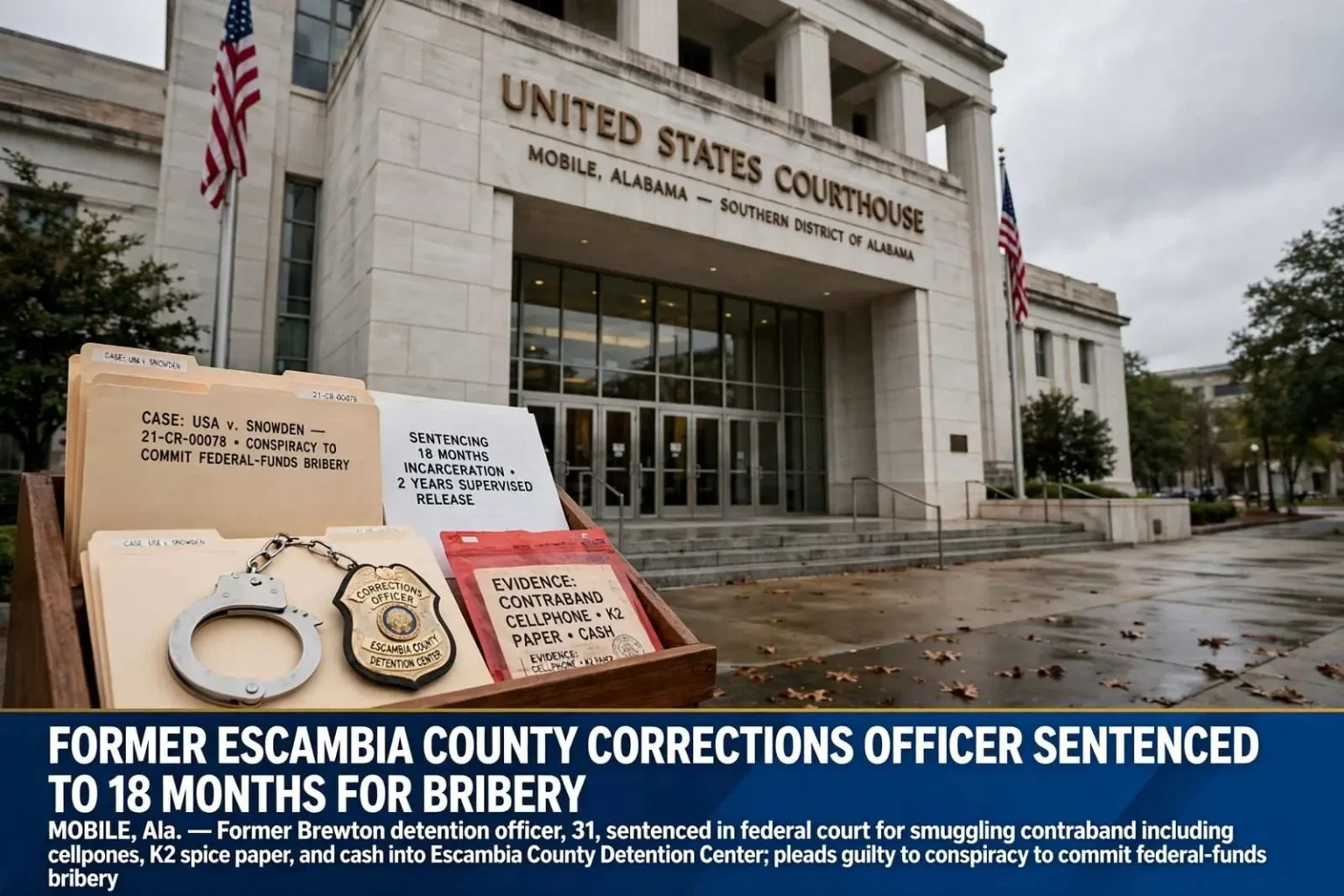
MOBILE, Ala. — A former corrections officer from Monroeville was sentenced to 18 months in federal prison for conspiracy to commit bribery, according to the U.S. Attorney’s Office for the Southern District of Alabama.
Lakerdra Shanta Snowden, 31, abused her position as a corrections officer at the Escambia County Detention Center in Brewton, Alabama, smuggling prohibited items into the jail and committing other crimes on behalf of a detainee housed there, prosecutors said.
On July 20, 2021, Snowden pleaded guilty to conspiracy to commit bribery, admitting she conspired with members of the jail to commit federal-funds bribery. She also acknowledged using her official position to bring prohibited objects into the facility in exchange for money, with cash payments totaling more than $5,000.
Among the items Snowden smuggled into the jail were cellphones, K2 spice paper and U.S. currency — all of which threatened the order, security and safety of the facility and those housed there, according to the release. U.S. District Judge Kristi K. DuBose ordered Snowden to serve two years of supervised release after her prison term and to pay $100 in special assessments.
What federal-funds bribery means
The charge at the center of the case — conspiracy to commit federal-funds bribery — reaches conduct that might otherwise be handled as a state offense because the jail involved receives federal money. Under federal law, employees of organizations that receive federal funding can be prosecuted when bribery corrupts the programs those funds support, a theory prosecutors regularly use in cases involving public institutions across Alabama and the nation.
In practical terms, the charge meant that the conduct alleged — a detention officer taking cash to move contraband inside a county jail — was treated as a federal crime rather than being left entirely to state court. Federal prosecution brought with it the sentencing framework of the U.S. District Court, supervised release instead of parole, and investigation by federal agencies working alongside local authorities.
Snowden’s guilty plea in July 2021 resolved the charge months after the conduct came to light, and her sentencing before Judge DuBose concluded the criminal case with an 18-month term of imprisonment followed by two years of supervised release.
Why cellphones and K2 paper endanger a jail
The contraband involved in the case was not incidental. Cellphones inside a detention facility allow inmates to communicate with the outside world beyond the monitored channels jailers control — arranging further crimes, coordinating with associates, intimidating witnesses or continuing to run illicit operations from inside custody.
K2 spice paper presents a different but equally serious threat. The synthetic cannabinoid soaks into paper that can be torn into strips, written on, or disguised as ordinary correspondence, making it one of the most difficult forms of contraband to intercept at mail screening. Inside facilities it has been linked to overdoses, unpredictable violence and medical emergencies, because synthetic compounds vary wildly in potency from batch to batch.
Cash circulating inside a jail functions as currency for an underground economy — paying for favors, settling scores and incentivizing further smuggling. Together, the items Snowden admitted bringing in threatened, in the government’s words, the order, security and safety of the facility and everyone housed there, including the officers responsible for keeping it secure.
The Escambia County Detention Center
The Escambia County Detention Center in Brewton houses inmates for the county in south Alabama’s timber country, near the Florida line. Like county jails across the state, it holds people awaiting trial and those serving shorter sentences, populations that depend on staff maintaining strict control over what enters the building.
Corrections officers occupy one of the most sensitive positions in that system. They control the movement of people, property and information inside the walls, and a single officer willing to smuggle contraband can undermine the security measures every other employee is working to uphold. Prosecutors across Alabama have made jail corruption cases a priority for that reason, and officers caught bringing in phones or drugs routinely face both criminal charges and the loss of their careers.
Brewton sits at the center of a small-community network that includes Monroeville, Snowden’s hometown, roughly a half-hour’s drive to the north in neighboring Monroe County. The case was prosecuted in federal court in Mobile, which serves as the seat of the Southern District of Alabama, the judicial district covering the state’s Gulf Coast and southern counties, including Escambia and Monroe.
The Southern District of Alabama’s role
The U.S. Attorney’s Office for the Southern District of Alabama prosecutes federal crimes across a stretch of the state that runs from the Mississippi line to the Florida line and north past Montgomery’s outskirts. Public corruption — from city hall to county jails — is among the office’s standing priorities, and prosecutions of jail employees who smuggle contraband have become a recurring feature of its docket.
Such cases typically begin when jail administrators or investigators detect contraband patterns that point to an inside source, after which coordination with federal partners brings the matter into the U.S. court system. The office’s public releases, like the one announcing Snowden’s sentence, are intended both to inform the public and to warn public employees that misuse of their positions carries federal consequences.
Judge DuBose, who imposed the sentence, serves on the federal bench in Mobile and has handled a wide range of criminal and civil matters for the district. Sentencing in federal court follows hearings at which the judge weighs the offense conduct, the defendant’s history and the advisory sentencing guidelines before imposing a term within the statutory range.
The sentence and what follows
Snowden’s punishment — 18 months in prison, two years of supervised release and $100 in special assessments — reflects the typical architecture of a federal felony sentence. Supervised release functions as court supervision after imprisonment, with conditions that can include reporting requirements, employment restrictions and searches; violations can return an offender to prison without a new trial.
The special assessments, a $100-per-count fixture of federal sentencing, are mandatory payments to the crime victims’ fund. The relatively short prison term nonetheless carries lasting consequences: a federal felony conviction forecloses future work in law enforcement or corrections, follows the offender through background checks, and marks the permanent record of a case that began with cash passed inside a county jail.
For the Escambia County jail, the prosecution closed the loop on a breach that had put officers and inmates at risk. For corrections officers across south Alabama, the message from the U.S. Attorney’s Office was unmistakable: the badge is not for sale, and the federal courthouse in Mobile is prepared to make the cost of selling it clear.
How contraband reaches Alabama jail populations
The smuggling method in cases like Snowden’s is a persistent problem for detention facilities of every size. Contraband typically enters jails through a handful of channels — through staff, through visitors, through mail and legal correspondence, and through lapses during transport — and facilities respond with layered defenses: body scanners, drug-detecting K-9 teams, screened and photocopied mail, and random staff searches.
Despite those measures, investigations across Alabama have repeatedly shown that a single compromised employee defeats nearly every technological barrier. Staff members pass through screening without suspicion, know the schedules and blind spots of the facility, and can move items during routine rounds that would be caught coming through any intake channel. That is why prosecutors treat staff corruption cases as the most serious category of contraband breach.
The dollar amounts in such cases are often modest relative to the damage. The more than $5,000 Snowden admitted receiving compares unfavorably with the cost of a single overdose response inside a facility, an extended lockdown, or the litigation that follows when contraband fuels violence among inmates.
The consequences inside the walls
When phones, synthetic drugs and cash circulate in a jail, the effects reach far beyond the transactions themselves. Inmates with hidden phones can continue directing criminal enterprises, coordinating testimony, and threatening victims and witnesses — activities that otherwise would be interrupted by custody. Drug emergencies force medical responses and lockdowns that disrupt the entire facility, and the presence of cash creates debts and power structures among inmates that staff must then manage.
For the officers who work in the facility, contraband driven by an inside source is demoralizing as well as dangerous. Every unexpected phone found in a cell, every inmate who appears intoxicated on synthetic drugs, raises the question of who brought it in — a question that corrodes the trust a jail’s operation depends on.
Facility administrators who uncover such conduct face a choice between handling it internally and referring it for prosecution. The federal charges in the Snowden case indicate that Escambia County authorities chose the latter route, putting the matter in the hands of investigators and prosecutors equipped to build a case beyond the walls of the jail.
A cautionary case for small-town Alabama
The geography of the case — a Monroeville corrections officer, a Brewton jail, a federal courtroom in Mobile — traces the network of small south Alabama communities where a job in corrections is among the better-paying positions available, and where the pressures and temptations of the position can be magnified by close community ties.
Corrections departments screen applicants and train them on the state’s ethics laws, but cases like this one show how quickly a career can collapse when an officer takes cash to move contraband. An 18-month federal sentence, followed by two years of supervised release, ends a law enforcement career definitively and leaves a permanent federal felony record.
Prosecutors said the sentence reflected both the seriousness of the conduct and Snowden’s decision to plead guilty and accept responsibility. For the public, the case stands as a reminder that the integrity of a county jail depends on each individual officer — and that the justice system watches its own doors as closely as it watches everyone else’s.