A former finance director for the city of Prichard is facing a felony theft charge after investigators say she improperly claimed thousands of dollars in overtime pay while running the city’s finance department earlier this year. The case adds another chapter to a period of financial turmoil at City Hall that has already cost the finance director her job and set the mayor against the city council in court.
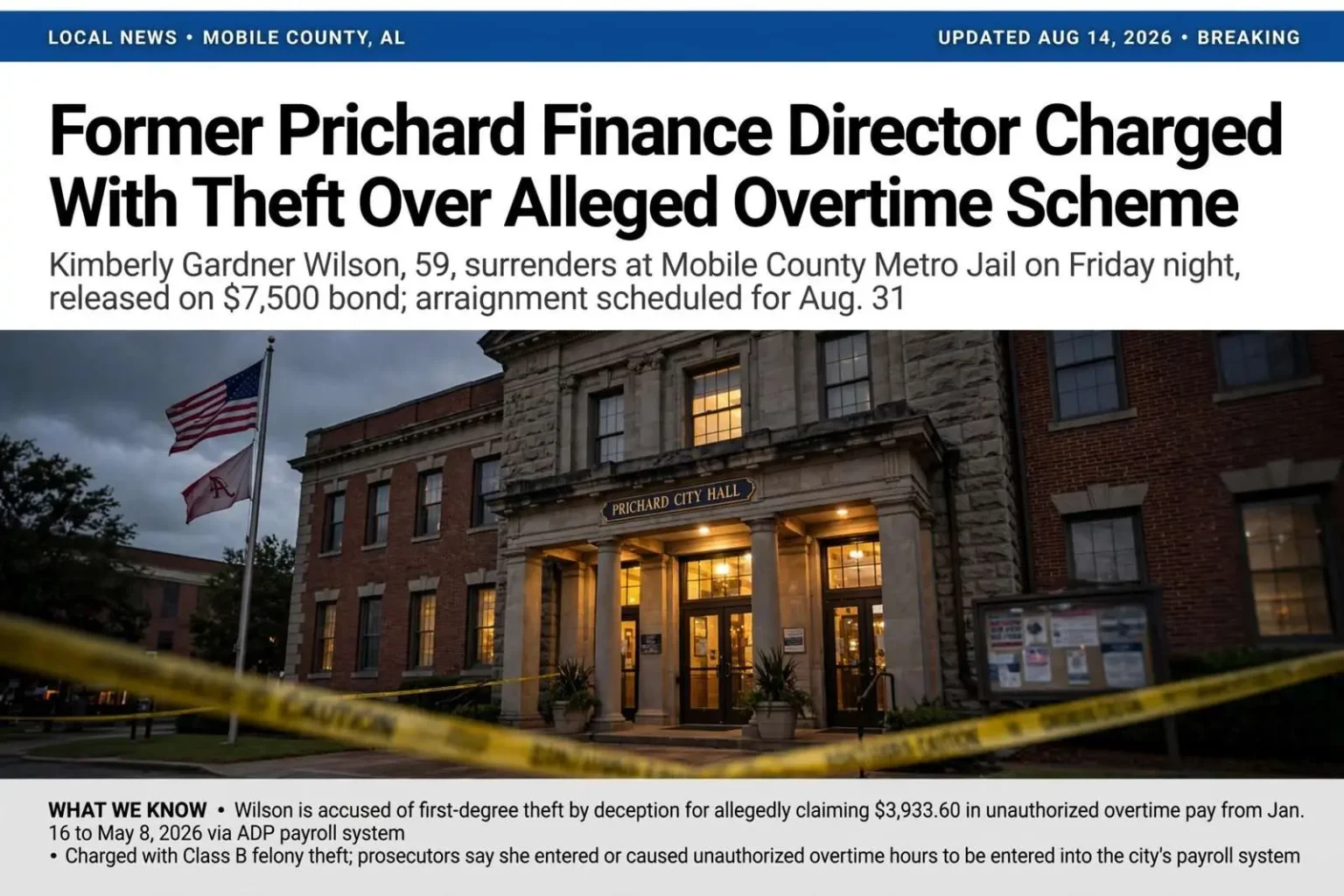
Kimberly Gardner Wilson, 59, turned herself in at the Mobile County Metro Jail on Friday, Aug. 14, at about 10:30 p.m. and was released roughly an hour later after posting a $7,500 bond, according to jail records. She is scheduled for an arraignment on Aug. 31. An arraignment is the formal proceeding where a defendant hears the charges and enters an initial plea, and it marks the first step in a criminal case that is expected to unfold over coming months in Mobile County District Court.
Mobile County District Attorney Keith Blackwood said Monday that Wilson is accused of stealing overtime money from the city between January and May 2026, while she served as head of Prichard’s finance department. He said the alleged theft came to light as investigators continued a broader review of the Prichard Police Department, though the criminal complaint against Wilson does not indicate any direct connection between her case and that investigation. “The allegation is it’s money, theft of money that was the city of Prichard’s funds,” Blackwood said. “This is an allegation of overtime theft. We expect this to develop over time.”
The Charges in Detail
A criminal complaint filed against Wilson accuses her of first-degree theft by deception, alleging that between Jan. 16 and May 8 she “knowingly obtained by deception control over $3,933.60 … by entering or causing unauthorized overtime hours to be entered into the city’s ADP payroll system, thereby falsely representing that she was entitled to the additional compensation and that the payments were properly authorized.” The complaint was signed by Todd Partin, a financial crimes specialist with the Mobile County District Attorney’s Office.
Under Alabama’s theft statute, the classification turns on the amount involved: theft of property or services valued at more than $2,500 is charged as first-degree theft, a Class B felony that carries significantly harsher potential penalties than the misdemeanor-level third-degree offense. “Theft by deception” covers situations where a person obtains property through a false representation — in this case, prosecutors allege, payroll records that showed overtime hours that were never authorized or never worked. The ADP system referenced in the complaint is the commercial payroll platform many Alabama municipalities use to process employee pay, meaning the alleged scheme would have left an electronic trail of the entries in question.
The felony classification matters beyond the label. A Class B felony conviction in Alabama carries a potential sentence of up to 20 years in prison, along with fines and restitution, and it is the kind of charge that prosecutors generally do not file unless the evidence includes documentation — in this case, presumably, the payroll records themselves showing what hours were entered, by whom, and against what authorization. The comparatively modest dollar amount, under $4,000, still crosses the felony threshold because first-degree status hinges on the statutory amount rather than the position held. The charge’s specificity, down to the date range of Jan. 16 through May 8, signals that investigators traced the entries individually rather than alleging a general pattern of misconduct.
The Firing and the Fight at City Hall
Wilson was fired from her position in early June by Mayor Carletta Davis, who said in a press release at the time that the move was “part of the administration’s ongoing commitment to responsible financial management, transparency, and accountability.” Her dismissal came in the middle of a larger dispute between Davis and the Prichard City Council. Council members had accused the mayor of failing to provide legally required monthly financial reports.
In a related court case between the mayor and the council, Davis said she had been unable to supply those reports because her own finance department was not providing them to her. That admission put the finance office — the department Wilson ran — at the center of the city’s governance crisis. Alabama’s municipal code requires cities to keep the council and the public informed of the city’s financial condition, and monthly reports are the mechanism by which a council is supposed to exercise budgetary oversight. When those reports stop flowing, the council’s ability to monitor spending effectively disappears, which is why the dispute escalated into litigation rather than staying an internal disagreement.
The leadership change at the finance department did not settle the turmoil. Patricia Scott, who was named as Wilson’s replacement, told the mayor and council shortly after taking over that the city’s finances were “a mess,” attributing some of the problems to difficulties with new accounting software. Scott said she had discovered issues involving garnishments, applied payments, unpaid invoices, agreement renewals, correspondence with the state, unfiled payroll information, and past-due invoices, among other problems. Her inventory of troubles suggested the city’s books needed an extensive cleanup before the monthly reporting dispute could even be resolved.
Wilson’s Background
Wilson’s LinkedIn profile indicates she previously worked as an accountant and financial director for the Prichard Housing Authority before joining the city. The housing authority is one of the larger public agencies in Prichard, managing federal housing programs for the city of roughly 19,000 people, and experience there would have made her a familiar figure in Prichard’s public-sector financial circles before she took over the city’s finance department.
As with any criminal case, Wilson is presumed innocent unless and until a court finds otherwise. The complaint filed by the District Attorney’s Office is an accusation, and the evidence behind it will be tested through the court process — beginning with the Aug. 31 arraignment — where prosecutors will have to prove each element of the charged offense beyond a reasonable doubt before any conviction can stand.
The Broader Probe
Wilson’s case surfaced during a wider investigation that has shaken Prichard’s government this year. That scrutiny has produced a federal indictment against a former Prichard police officer on charges including soliciting bribes and framing innocent men, and state indictments against the police chief and a major over allegations that they ran private funeral procession work while on duty. The Mobile County Sheriff’s Office took over law enforcement operations in the city in mid-June, and a county grand jury recommended abolishing the police department and rebuilding it from scratch. Blackwood has said the overtime allegation came to light during that police review, though the criminal complaint itself does not tie Wilson’s case to it.
Prichard’s Long Financial History
Any accusation involving Prichard’s city finances draws heightened attention because of the city’s history. Prichard, a city of roughly 19,000 just north of Mobile, became one of the most closely watched municipal insolvencies in American history when its pension fund ran out of money and the city filed for bankruptcy — first in the late 1990s and again in 2009, when it stopped paying retired city workers their pension checks. The second bankruptcy drew national coverage and became a cautionary tale cited in debates over public pension funding across the country.
The city eventually emerged from bankruptcy and worked to rebuild its finances, but the legacy of those years is a government operating with little margin for error and a public that watches its finances closely. Financial management failures in Prichard are not abstract governance questions; residents remember pension checks that stopped arriving, and the city’s credit and budget flexibility remain fragile. That history is part of why the council’s insistence on monthly financial reports, and the mayor’s difficulty producing them, escalated so quickly into a court fight.
It also explains the seriousness with which a payroll theft allegation lands. A city that has been through bankruptcy twice cannot easily absorb even the $3,933.60 named in the complaint without consequence, and the accusation that unauthorized hours were entered into the payroll system strikes at the controls the city depends on to keep its books reliable.
How the Case Is Likely to Proceed
After the Aug. 31 arraignment, a felony case in Alabama typically moves through a preliminary hearing, where a judge decides whether probable cause exists to send the charge to a grand jury, and onward to Mobile County Circuit Court if the case is bound over. District Attorney Keith Blackwood’s remark that “we expect this to develop over time” suggests investigators are still gathering records — payroll data, authorization documents and statements from city personnel — before the case reaches trial.
The defendant’s role as finance director could complicate the evidence picture in both directions. Prosecutors will likely point to her position as the person with authority over the payroll system; the defense, in turn, may focus on the software transition problems and bookkeeping disorder that Scott’s own review documented, arguing that confusion in the system rather than deception explains any discrepancies. Either way, the city’s own messy financial records will be Exhibit A territory for both sides.
No additional court dates beyond the Aug. 31 arraignment have been announced. For Prichard residents, the case will be watched not just for its outcome but for what it reveals about how the city’s financial controls failed — and whether the reforms the mayor promised when she fired Wilson are taking hold under the new finance leadership.
Update: Wilson enters written plea of not guilty
Kimberly Wilson has filed a written plea of not guilty to the theft-by-deception charge. Wilson, who served as Prichard’s finance director until Mayor Carletta Davis fired her earlier this year, is due back in court on Sept. 21 for a preliminary hearing.
Prosecutors allege that Wilson caused overtime hours to be entered into the city payroll system by falsely representing that she was entitled to the pay from January until May 8, and that she obtained more than $3,900 in overtime as a result. The written plea takes the place of an in-person arraignment entry; the Sept. 21 preliminary hearing is where a judge will consider whether probable cause exists to move the felony charge forward in Mobile County District Court.