Fort Rucker Picked as Army’s Drone and Autonomy Center of Excellence
The Army named Fort Rucker its Unmanned Aircraft Systems and Autonomy Center of Excellence, a day after a new four-star command for unmanned warfare was announced. Alabama's delegation hailed the decision.
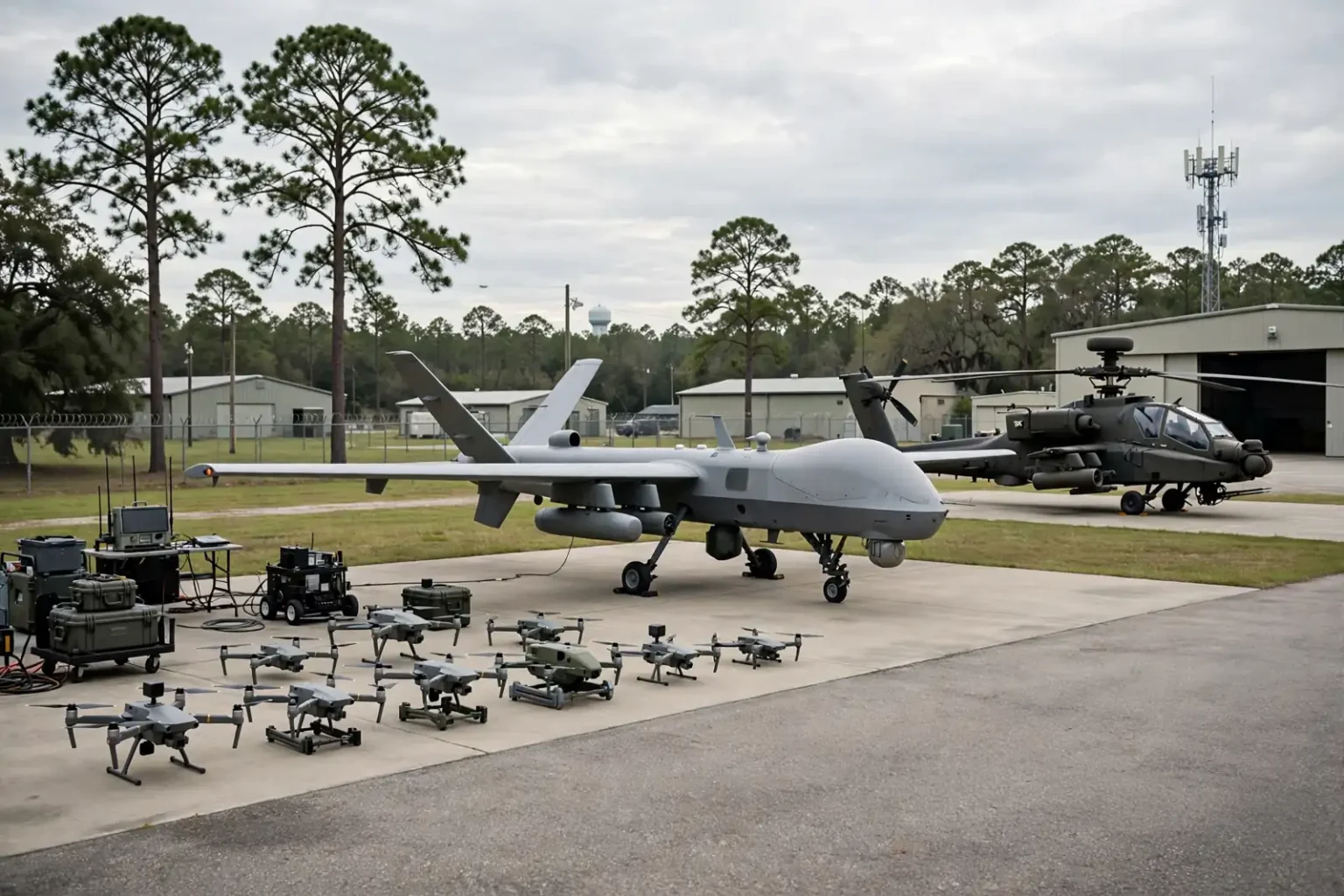
FORT RUCKER, Ala. — Fort Rucker, the Wiregrass post that has trained generations of Army helicopter pilots, will become the U.S. Army’s Unmanned Aircraft Systems (UAS) and Autonomy Center of Excellence, the Army announced Tuesday, Oct. 13. The designation puts the Alabama installation at the center of the service’s push to test and field drones and other autonomous systems.
The move is part of a new Army initiative to speed up testing and integration of autonomous systems, building on the post’s long experience with both manned and unmanned rotary-wing aircraft. The announcement came a day after Secretary of War Pete Hegseth announced a new four-star military command dedicated to unmanned and autonomous warfare.
Army leaders: ‘Test technology the way we intend to fight it’
Acting Army Chief of Staff Gen. Christopher LaNeve said Fort Rucker can “bring together warfighting experts and cutting-edge commercial capabilities to test technology the way we intend to fight it.”
LaNeve said the Army’s broader effort goes beyond drones. Other installations will test concepts that include autonomous watercraft, armored reconnaissance, breaching operations and aerial intelligence, surveillance and reconnaissance.
“We’ve got to change our approach from bolting on technology to rethinking how we fight,” LaNeve said.
“Technology doesn’t fight; Soldiers do. Our job is to get them the best kit; theirs is to make it lethal. It’s that magic between industry, leadership, and Soldiers that keeps our Army ahead of anyone looking to do America harm,” he said.
The Army did not immediately release details on how many personnel, how much funding or what new construction the designation would bring to the post.
Alabama’s congressional delegation reacts
Members of Alabama’s congressional delegation praised the decision.
“Fort Rucker has long been the beating heart of Army Aviation, and today’s announcement makes clear it will lead the Army into the next era of warfare,” U.S. Sen. Katie Britt said in a statement.
U.S. Sen. Tommy Tuberville said there is “no better home for this pioneering facility than Fort Rucker,” and U.S. Rep. Barry Moore called the designation a “major win for Alabama and our national defense.”
Earlier this year, Fort Rucker opened a new training facility and barracks that will be used to house and train more than 300 soldiers going through advanced individual training, the job-specific instruction soldiers receive after basic training.
The home of Army Aviation
Fort Rucker sits mostly in Dale County, with smaller sections in Coffee, Geneva and Houston counties, and its gates open toward Daleville, Ozark and Enterprise. The post opened as Camp Rucker in 1942 on land that had been marginal farmland and a wildlife refuge, and it became a permanent installation, Fort Rucker, in 1955.
The Army Aviation School moved to the post from Oklahoma in 1954, and all Army Aviation training has taken place there since 1973. Today the U.S. Army Aviation Center of Excellence at Fort Rucker is responsible for aviation training, doctrine and testing. The post trains Army helicopter pilots and crews and also trains U.S. Air Force and allied helicopter aircrews. It is also home to the U.S. Army Aviation Museum, which is open to the public.
Student pilots typically spend more than a year in flight school there, starting with survival and water-egress training and moving through basic, instrument and combat flight instruction before advancing to aircraft such as the AH-64 Apache, UH-60 Black Hawk and CH-47 Chinook.
A name that changed twice
The post’s name has changed in recent years. In April 2023, it was redesignated Fort Novosel, honoring Chief Warrant Officer Michael J. Novosel, an Army aviator and Medal of Honor recipient, as part of a Defense Department effort to rename installations that honored Confederate officers. In June 2025, at Hegseth’s direction, the post was renamed Fort Rucker again, this time honoring Capt. Edward W. Rucker, a World War I aviator.
Not the post’s first drone mission
Unmanned aircraft are not new to Fort Rucker. In 2008, the Army unveiled an Unmanned Aircraft Systems Center of Excellence at the post’s Air Maneuver Battle Lab, consolidating work on UAS capability development that had previously been based at Fort Huachuca, Arizona. That center served as the Army’s main point of contact for developing and integrating drone capabilities and coordinated with the other military services.
The Battle Lab had already been studying what the Army calls manned-unmanned teaming, in which helicopter crews work alongside drones that scout ahead, relay information or extend the reach of aircraft. The new initiative builds on that kind of work with manned and unmanned rotary-wing aircraft.
Why autonomy is a priority
Military planners in the United States and abroad have focused heavily on drones and autonomous systems in recent years, in part because of their widespread use in the war in Ukraine, where inexpensive unmanned aircraft have been used for reconnaissance and attack. The Army has said it wants to move faster in adopting commercial technology and in testing new equipment with soldiers in realistic conditions rather than adding new systems to existing formations piecemeal.
For the Wiregrass, the decision reinforces the region’s reliance on and identity with Fort Rucker, one of the largest employers in southeast Alabama. Communities around the post, including Enterprise, Ozark, Daleville and Dothan, are home to many of the soldiers, civilian employees, contractors and retirees connected to the installation.
The Army has not yet said when the new center will be fully up and running or how it will be organized alongside the existing Aviation Center of Excellence.