
Four Charged After Woman Robbed Inside Her Pensacola Hotel Room
Escambia County deputies charged four people after a woman was beaten and robbed inside her Pensacola hotel room on Barrancas Avenue.
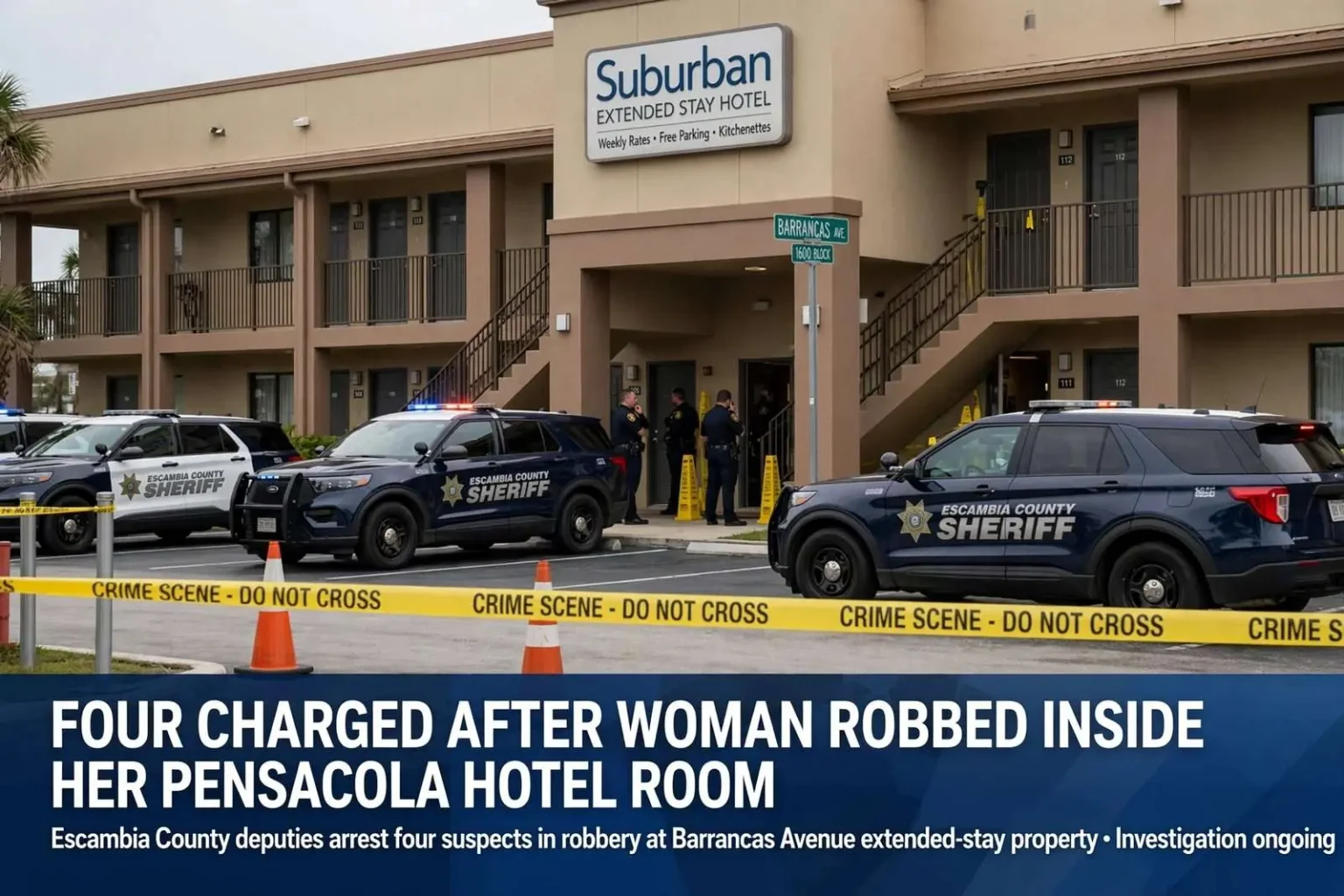
Escambia County deputies have charged four people in connection with the robbery of a woman inside her hotel room along Barrancas Avenue in Pensacola. According to the arrest report, the trouble began when 21-year-old Adam Royster knocked on the victim’s door at the Suburban Extended Stay Hotel, asking whether his girlfriend was inside. The woman said no but allowed him in to look around and confirm she wasn’t there — a decision that set the entire confrontation in motion.
Within minutes, deputies say, the visitor had become part of a group that took the woman’s purse and punched her repeatedly as they tried to leave with her belongings. All four suspects were in custody a short time later, and the case has drawn attention to security conditions at extended-stay properties along one of Pensacola’s busiest commercial corridors.
How the Robbery Unfolded
The arrest report lays out a sequence that moved from a knock at the door to a robbery in a matter of minutes. Royster told the woman he was looking for his girlfriend, and she permitted him to step inside and check the room for himself. While he was searching, his girlfriend, 20-year-old Gabrielle Charley, arrived at the room and grabbed the woman’s purse, and Richeyana Arnold then walked in as well.
Deputies say Royster, Charley and Arnold punched the victim repeatedly as they tried to leave the room with some of her belongings. What had begun as a seemingly innocent search for a missing friend turned into a physical struggle over the woman’s property, carried out by three people inside her own room.
The report notes that the victim told investigators she recognized two of the suspects from school, a detail that underscores how often victims of these encounters know — or at least recognize — the people who target them. That familiarity appeared to be what put the suspects at the woman’s door in the first place, since Royster’s girlfriend was apparently someone the victim knew well enough to open the door and allow a search.
The Charges Each Suspect Faces
Royster faces the most serious charges, including robbery while armed with a pistol, possession of a firearm by a convicted felon and battery on a law enforcement officer, among others. A records check showed six prior felony convictions, a history that will factor heavily into how prosecutors handle the case and what bond conditions a judge considers. The battery charge relating to a law enforcement officer stems from events connected to his arrest, adding a second layer of allegations on top of the robbery itself.
Charley is charged with robbery, larceny and resisting officers, while Arnold faces a robbery charge. The fourth suspect, Shanaveyah Carter, was later charged with accessory after the fact, an accusation that she helped after the robbery rather than participating in the incident inside the room.
The distinction matters in Florida criminal law. Robbery while armed with a weapon is among the most serious non-homicide charges on the books, carrying a potential prison term measured in decades, and possession of a firearm by a convicted felon is a separate felony that prosecutors pursue independently of the underlying crime. Accessory after the fact, by contrast, is a lower-level offense that applies to people accused of helping someone avoid arrest after a crime is complete.
Deputies located the suspects a short time later on East Scott Street, a short distance from the hotel, and recovered property belonging to the victim. The woman’s purse — containing $100 in cash, her Navy Federal card and her hotel room keys — was found in Arnold’s purse, according to the report. The quick recovery of the purse gave investigators physical evidence tying at least one suspect directly to the stolen property, in addition to the victim’s account of what happened inside the room.
The Corridor Where It Happened
The Suburban Extended Stay Hotel sits along Barrancas Avenue, a stretch of road west of downtown Pensacola that carries heavy traffic between the city and the Naval Air Station area. The corridor is lined with restaurants, retail strips, motels and extended-stay properties that serve travelers, military personnel in transition, and residents who use weekly-rate rooms as long-term housing. That mix makes the corridor both economically important and periodically troubled by the issues that come with properties that rent by the week.
Extended-stay hotels occupy a specific niche in the lodging market. They cater to guests who need a place for weeks or months rather than a night, often at rates far below apartment move-in costs, and they frequently become de facto housing for people between jobs, between homes, or newly assigned to a nearby base. When a property’s screening practices are loose, sheriffs’ deputies in corridors like Barrancas tend to see the consequences in their call logs.
Navy Federal Credit Union, the financial institution whose card was in the stolen purse, is headquartered in the Pensacola area and serves members of the armed forces, veterans and their families across the region. Its name on a stolen card in this case is a small detail, but a familiar one for residents of a military town, where service members and their families make up a large share of the local population.
The Hotel’s Response
The hotel’s manager said the property is under new management and working to change how it operates and which customers it targets, with a goal of eventually offering housing to Navy personnel. In a statement, the manager acknowledged the investigation without addressing its specifics.
“We cannot comment on an ongoing investigation but we sympathize with the alleged victim and we apologize,” the manager said in a statement. “We are taking measures to improve security at the hotel.”
The pivot toward housing Navy personnel would represent a significant change in the property’s business model. Hotels near Naval Air Station Pensacola have long served visiting families, new arrivals waiting for housing assignments, and graduates of training programs, and a property that deliberately courts that population would be competing with national-brand hotels closer to the base. Whether the transition succeeds will depend on the same security measures the manager described, since military-linked guests and their families tend to be selective about where they stay.
What Victims of Hotel-Room Robberies Face
For the woman in the room, the ordeal involved more than the punches deputies say were thrown. Losing a purse takes cash, identification and payment cards all at once, and each of those losses triggers a cascade of follow-up problems: canceling cards, replacing a driver’s license, changing locks when keys are gone. In this case the hotel room keys were inside the stolen purse, meaning the victim’s own room was temporarily inaccessible to her and accessible to whoever held the purse until the locks or keys were addressed.
Victims of home-invasion-style robberies in hotel settings also face a practical question most robbery victims do not: whether it is safe to stay in the room where the attack happened. Extended-stay guests often have few immediate alternatives, particularly when their stay is tied to work or a housing transition, and property managers are frequently the ones who decide whether a victim is moved to another room or offered any accommodation at all.
Deputies have not indicated whether additional charges are possible as the investigation continues. The four suspects who were charged face a court process that will determine culpability, and the report’s account of the incident will be tested against evidence and testimony as the cases move forward.
A Warning for Guests at Extended-Stay Properties
Sheriff’s deputies and hotel operators alike point to the same set of precautions for guests, and this case illustrates why. Opening a door to anyone — even someone asking a simple question about a third party — gives them an opportunity to enter, and a search of the room is an invitation to see what is worth taking. Guests who are approached by strangers at their rooms are advised to answer through the door without opening it and to report the encounter to the front desk immediately.
The case is also a reminder of how quickly a confrontation can escalate when multiple people arrive at a room in sequence. The victim admitted one person she believed she had reason to trust; within minutes, three people were inside the room and the encounter had turned violent. For the managers of properties along Barrancas Avenue, the episode is a data point in the argument they are already making internally: that the clientele a hotel attracts, and the security it maintains, shape everything else that happens on the property.
As the criminal cases proceed through the Escambia County court system, the hotel’s management says its focus remains on the changes it has promised. The alleged victim, meanwhile, is left to recover from an attack that began with a knock on her door and a question about someone she had never met.


