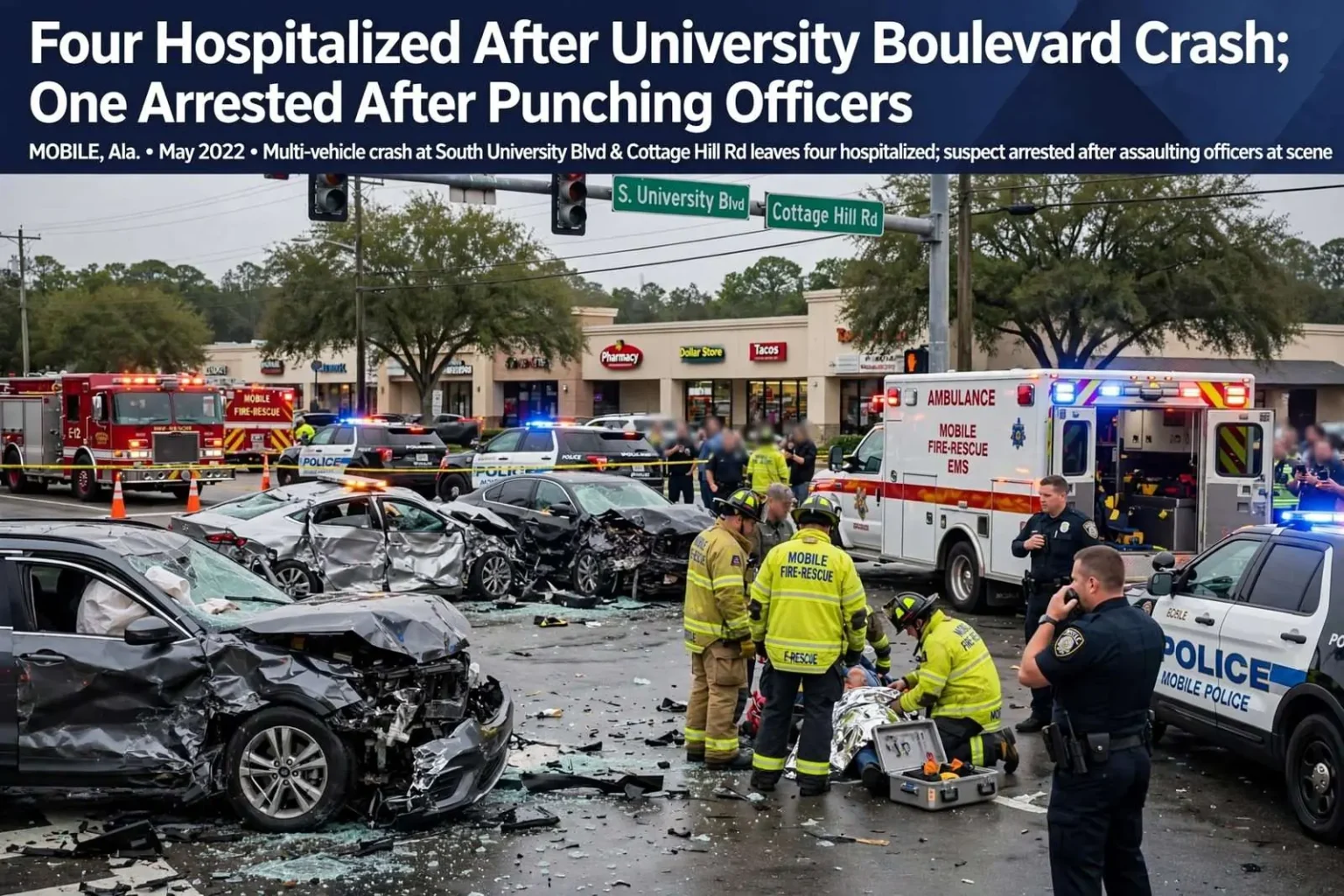
MOBILE, Ala. — Four people were hospitalized after a multi-vehicle crash at South University Boulevard and Cottage Hill Road in May 2022, and one of them was arrested after authorities said he punched officers at the scene. The collision unfolded at one of west Mobile’s busiest intersections, where heavy commuter traffic and multiple lanes of turning vehicles make it a familiar setting for serious wrecks, and it quickly drew responses from both fire crews and police.
Mobile Fire-Rescue crews were dispatched to the intersection in west Mobile, where officials confirmed four people were taken to the hospital with injuries of unknown severity. Fire department units arrived to find damaged vehicles in the roadway and immediately began triaging the injured, stabilizing patients and preparing them for transport to area hospitals. The severity of the injuries was not released at the scene, leaving family members and commuters who passed the wrecked cars to wait for word from officials. Firefighters also asked drivers to avoid the area while crews worked, since the wreckage blocked enough of the intersection to snarl traffic through surrounding neighborhoods during the response.
How the arrest unfolded
The arrest stemmed from a video that surfaced showing a man yelling at law enforcement before striking officers. The footage, which circulated on social media as word of the crash spread, showed the confrontation that followed the wreck — a man visibly agitated and shouting at officers who were trying to manage the chaotic scene and care for the injured. Mobile police said the man “refused to comply with officers and became unruly,” and after he began hitting officers, he was subdued with a Taser and taken into custody.
The incident raised immediate questions about what provoked the outburst. In the aftermath of serious crashes, emotions often run high for drivers and passengers who may be injured, disoriented or in shock, and officers working a crash scene have the difficult task of keeping bystanders clear of traffic while medics do their work. In this case, police said the man’s refusal to comply escalated to physical violence toward officers, at which point they used the Taser to end the confrontation safely. He was one of the four people taken to the hospital, meaning he received medical evaluation alongside the other injured parties before any booking process could proceed.
Police did not immediately say what led to the crash itself or whether additional charges were expected. That left several open questions: whether impairment played a role, how many vehicles were involved and in what sequence they collided, and whether the man’s outburst would bring charges beyond anything connected to the wreck itself. Investigators planned to reconstruct the collision, review the video that surfaced and interview witnesses before determining the full picture. Striking a law enforcement officer is a serious offense in Alabama, and prosecutors would review the evidence — including the widely shared video — in deciding what charges to pursue.
The intersection and its history of trouble
The corner of South University Boulevard and Cottage Hill Road is one of the most heavily traveled junctions in west Mobile. University Boulevard carries traffic between Airport Boulevard and Government Boulevard, passing near residential neighborhoods, shopping centers, schools and medical offices along the way, while Cottage Hill Road stretches east to west across a broad swath of the city. Both routes funnel thousands of vehicles a day through the intersection, which features multiple turn lanes and signal phases — a configuration that keeps traffic moving but also multiplies the chances for driver error. Crashes at major west Mobile intersections like this one are common enough that they routinely tie up emergency crews during morning and evening rush hours.
Multi-vehicle crashes at busy intersections typically follow a familiar pattern: a driver runs a red light or misjudges a turn, and vehicles traveling in several directions are caught in the resulting chain reaction. Investigating agencies reconstruct those sequences using physical evidence — skid marks, vehicle damage, data from vehicle computers and surveillance or bystander video — to determine which driver or drivers contributed to the collision. The findings can determine whether traffic citations are issued and whether criminal charges follow, particularly if impairment or reckless driving is suspected.
How first responders handle a crash scene
The response to a wreck of this kind involves a carefully choreographed set of roles. Fire-rescue crews are typically first through the door: they assess the scene for hazards such as fuel leaks, establish a safe work zone, and begin triage of the injured. Patients are evaluated for internal injuries, head trauma and other conditions that may not be obvious at first glance, which is why “injuries of unknown severity” is a common early report — paramedics transport patients so doctors can rule out hidden injuries even when victims appear stable. Extra ambulances are called when the number of patients exceeds the capacity of the first-arriving unit.
Police, meanwhile, manage traffic around the scene and begin the investigation that determines what happened. That work includes interviewing drivers and witnesses, photographing the vehicles and roadway, and clearing lanes as quickly as safety allows. When a confrontation erupts at a scene — as it did here — officers must divide their attention between the traffic investigation and managing the combative individual, and the safety risk is real: medics, firefighters and other officers are working in close quarters alongside moving traffic. The decision to use a Taser reflects departmental policy on escalating force, which allows officers to use intermediate weapons when physical confrontation threatens the safety of everyone at the scene.
What happens next
In the days after a crash like this, the injured recover or receive further treatment, and the legal process moves at its own pace. The man arrested at the scene would face the charges connected to his conduct once he was medically cleared, and any additional charges related to the crash itself would depend on the findings of investigators. Mobile police generally release updates when investigations conclude or when charges are formally filed, though the department did not immediately provide a cause for the wreck in the hours after the collision.
For residents of west Mobile, the crash served as a reminder of both the dangers of the area’s busiest corridors and the pressures facing the people who respond to them. Firefighters and police asked drivers to slow down and move over for emergency scenes — a courtesy and a legal requirement in Alabama — so that medics can work safely and so that secondary collisions do not add to the toll. As the investigation continued, the four injured residents and the community waited for answers about how a routine trip through a familiar intersection ended in a hospital and a jail cell.
Emergency crews and the toll on traffic
Responses to crashes at major intersections draw on substantial resources from across the city. A typical serious collision in Mobile brings at least one engine company and a rescue unit, an ambulance for each patient requiring transport, a district chief to command the scene, and multiple police officers to redirect traffic and investigate. When four patients are involved, those numbers grow quickly, and units are often staged from fire stations several miles away — stretching coverage for the rest of the city during the call. That is one reason firefighters so often ask drivers to avoid the area: every driver who detours around a wreck scene reduces the odds of a second crash and keeps lanes open for apparatus that may still be arriving.
The stretch of University Boulevard near Cottage Hill Road sits within minutes of several west Mobile neighborhoods, and drivers who frequent the corridor know that a blocked intersection can add significant time to a commute. When a wreck closes the junction, police route traffic through side streets that were never designed for heavy volumes, and residents along those cut-through routes often bear the noise and congestion until the scene is cleared. Clearing a multi-vehicle crash — investigating, documenting, waiting for tow trucks and sweeping debris — can easily take more than an hour, longer still when an arrest occurs in the middle of the response.
Accountability and the legal road ahead
When a crash leads to an arrest at the scene, two parallel processes follow. The traffic investigation determines the cause of the collision and can produce citations or criminal charges tied to driving conduct, depending on what evidence shows about speed, impairment or signal violations. Separately, the confrontation with officers becomes its own matter: assaulting a law enforcement officer in Alabama is a felony, and cases of that kind move through the court system with their own review of body camera footage, bystander video and witness statements. The video that surfaced in this case gave investigators and eventually prosecutors an independent record of the confrontation, which in modern practice has become a routine and often decisive piece of evidence.
Advocates for both public safety and civil liberties generally agree on one lesson from incidents like this: the moments after a crash are among the worst times for anyone involved to confront responders. Shock, injury and stress can all produce erratic behavior, and officers are trained to de-escalate where possible — but a physical attack leaves them little room to do so. For the community, the episode at University Boulevard and Cottage Hill Road was a reminder that a traffic crash can spiral quickly, and that the men and women working the scene are juggling patient care, traffic control and their own safety all at once. The four people hurt in the wreck — and the officer injuries that were not reported — underscored how one moment of chaos at a busy intersection can ripple outward into hospitals, courtrooms and an entire neighborhood’s evening.