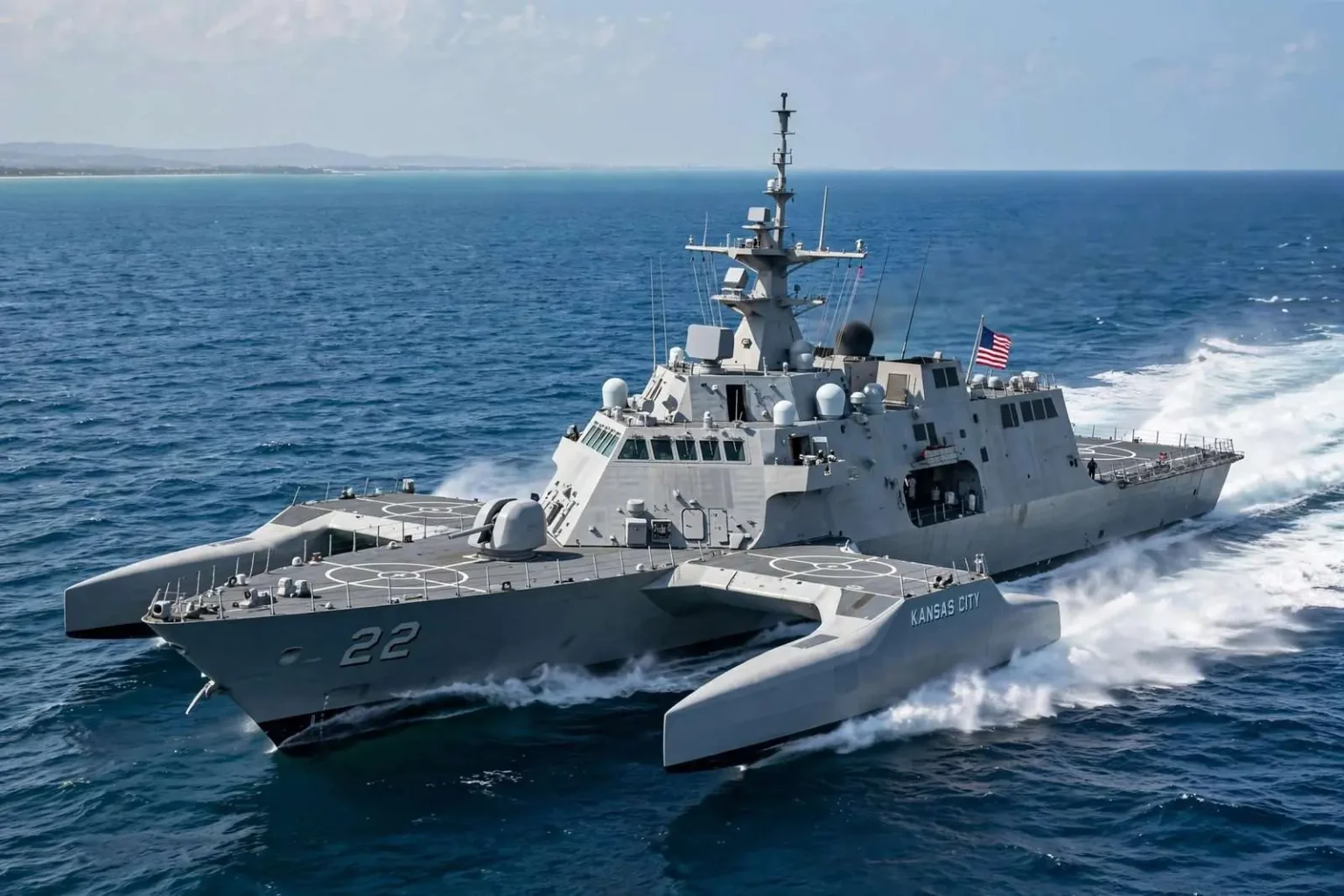
The future USS Kansas City (LCS 22) has cleared its final major hurdle before joining the fleet, completing acceptance trials in the Gulf of Mexico. The ship is the 11th Independence-variant littoral combat ship built by Austal USA on the Mobile River to reach the milestone, a mark of how steadily the Mobile shipyard has turned out the fast, trimaran-hulled warships for the Navy’s littoral fleet.
Acceptance trials put a new warship’s major systems and equipment through their paces, demonstrating to the Navy that everything operates as designed. Over the course of the trial, the ship’s crew and Navy inspection teams run the vessel through high-speed runs, maneuvering drills, damage-control scenarios and live demonstrations of its combat and propulsion systems, verifying that months of construction and testing have produced a ship that is ready to fight. It is the last significant milestone before the vessel is delivered and commissioned, and a successful trial sends the ship into final crew certification with its major questions answered.
“I take great pride in how our LCS team has elevated this program to be an example of manufacturing excellence,” Austal USA President Craig Perciavalle said at the time. “This is the 11th LCS sea trials completed successfully and more to follow.” The remark captured the shipyard’s position in 2019: what began as a challenging, much-scrutinized program had settled into a reliable production line, with hulls moving from the module shop to the ways to the Gulf on a predictable rhythm.
A busy year on the Mobile River
Kansas City was set to become the third ship Austal delivered to the Navy in 2019 alone, an extraordinary tempo for a yard building warships of this size. The Independence variant — an aluminum trimaran more than 400 feet long, capable of sprint speeds well beyond those of conventional surface combatants — is designed for operations close to shore, where its shallow draft and large flight deck make it useful for mine countermeasures, surface warfare and maritime patrol missions.
The yard’s Independence-variant hulls were already at work around the world. USS Montgomery (LCS 8) and USS Gabrielle Giffords (LCS 10) had recently deployed to Singapore, where the class has become a familiar presence in the South China Sea and Southeast Asian waters. Meanwhile, seven other ships of the class were homeported in San Diego, forming the core of the fleet’s West Coast littoral force. The forward-deployment to Singapore gave the class a chance to prove its concept in the Indo-Pacific, where its speed and shallow draft suit the region’s crowded littoral waters.
Back in Mobile, six ships were under construction at the same time, a workload that stretched across every corner of the sprawling riverfront facility. The future USS Oakland (LCS 24) had launched and was preparing for its own trials, final assembly was well underway on the future USS Mobile (LCS 26) and USS Savannah (LCS 28), and modules for the future USS Canberra (LCS 30) and USS Santa Barbara (LCS 32) were taking shape in the facility’s module manufacturing plant.
The littoral combat ship program has been an economic anchor for Mobile’s waterfront for more than a decade, sustaining thousands of jobs along the Gulf Coast. Austal’s USA operation grew from a modest aluminum-shipyard footprint into one of the largest employers on the river, and the steady flow of LCS work supported a network of suppliers, subcontractors and trades across south Alabama. Each hull that slides down the ways represents years of sustained employment for welders, shipfitters, electricians and the engineers who keep the production line moving.
The program’s rhythm has also shaped Mobile itself. Shipyard workers and their families fill neighborhoods across the city, naval architects and program managers have put down roots, and the sight of gray-painted trimarans moored along the Mobile River has become part of the city’s working waterfront identity. When ships like Kansas City head down the bay toward the Gulf for trials, it is a visible reminder of the connection between the city’s industrial base and the Navy’s fleet.
What acceptance trials mean
Acceptance trials are the Navy’s formal look at a ship before it takes custody. Conducted under the Navy’s Board of Inspection and Survey process, the trials bring an inspection team aboard to witness the ship perform the missions it was built for, from high-speed runs on open water to the operation of sensors, weapons and self-defense systems. The crew that will sail the ship trains alongside the builders during this period, an intentional overlap that sends the vessel to its commissioning crew already broken in.
For Kansas City, named for the Missouri city and sponsored to honor its namesake community, the successful trial capped a construction period that began with modules stacked in the fabrication plant and ended with a warship maneuvering in the Gulf. Ships that complete acceptance trials typically move to delivery within weeks, followed by the crew certification and final preparations that lead to a commissioning ceremony — the moment the vessel enters active naval service and becomes USS Kansas City.
The milestone also underscored the steady hand Austal had developed with the Independence variant after the program’s rocky early years. Early hulls in the class absorbed criticism over cost growth, design changes and reliability concerns, but by the time Kansas City reached trials the production process had matured: lessons from each delivered ship were folded into the next, and the yard’s pace and quality both improved. The Navy’s continued investment in the class, including mission-module packages that give each hull its focused capability, rested in part on that growing consistency on the Mobile River.
With Kansas City’s trial behind it, attention along the waterfront shifted to the ships still in the yard — Oakland heading toward its own trials, Mobile and Savannah coming together on the ways, and Canberra and Santa Barbara growing module by module in the fabrication shop. For a yard that had delivered its first littoral combat ship only a few years earlier, eleven completed sea trials stood as the clearest evidence that Mobile had become a permanent fixture in American warship building.
The Gulf of Mexico, where Kansas City ran its trials, has long served as the shakedown ground for Austal’s hulls. The open water south of the bay offers the depth and sea state needed to test a high-speed trimaran at full power, and the proximity of the yard to the trial area keeps sea trials efficient — a ship can leave the pier in the morning and be conducting trial events within hours. The same geography makes Mobile unusual among American warship builders: few yards can complete construction, launch, trials and delivery without the vessel ever leaving home waters.
The Independence variant’s twin goals — speed and shallow-water versatility — drive much of its distinctive design. The trimaran hull provides the stability of a wide deck with the drag characteristics of a slender hull, letting the ship sustain sprint speeds that conventional combatants cannot match. A large flight deck and hangar accommodate helicopters and unmanned aircraft, while the mission-bay concept lets the same hull carry mine-hunting packages, surface warfare gear or interchangeable equipment depending on the deployment. That flexibility is central to how the Navy has employed the class from Singapore to San Diego.
For the sailors who crew these ships, the littoral combat program has meant a new kind of surface navy assignment: smaller crews, waterfront homeports and rapid operational cycles. The class’s forward presence in the Pacific has grown steadily as more hulls deliver, and ships built on the Mobile River now routinely conduct patrols, port visits and combined exercises thousands of miles from the yard where they were welded together. Kansas City’s classmates have proven the design in real-world conditions — chase operations, drug interdiction, maritime security and joint exercises with partner navies — giving each new hull a documented record to build on.
Completion of acceptance trials also triggers a final round of activity across the yard’s support network: correcting any deficiencies the inspection teams noted, finishing punch-list items, and preparing the ship’s documentation for turnover. The weeks between trials and delivery are among the busiest of a ship’s construction, as the builder and the Navy’s supervisors work through the last details that stand between a completed trial and an accepted warship. For the Kansas City’s future crew, those weeks mark the transition from guests of the shipyard to owners of the ship — the final step before the hull takes its place in the fleet as the newest product of Mobile’s riverfront shipyard.
Kansas City’s delivery would also keep alive a string of milestones the yard had been assembling all year. Three deliveries in a single calendar year, on top of six hulls in simultaneous stages of construction, represented the kind of output few American shipyards could claim, and it arrived just as demand for the class was climbing overseas. Every successful trial added to the record that Mobile’s workforce had been building since the first Independence-variant hull entered the water, and by the yard’s own accounting, the program had grown from an experiment into the backbone of its production line.