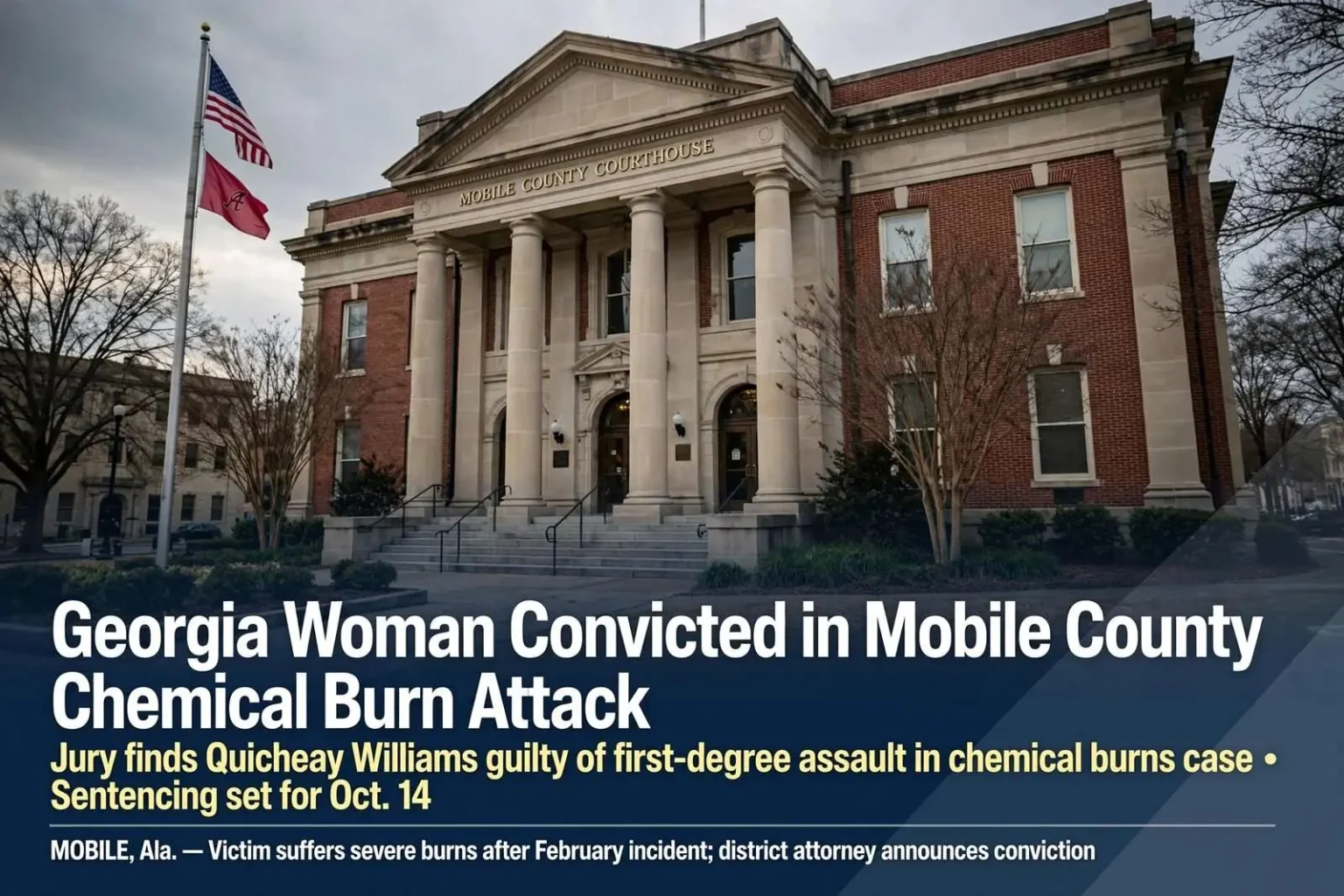
MOBILE, Ala. — A jury found Quicheay Williams guilty of first-degree assault Wednesday in a case in which a woman suffered severe burns after a chemical substance was thrown on her. The verdict capped a trial in which prosecutors laid out what they described as a deliberate, premeditated attack inside a Mobile home, carried out by a guest against the very person who had taken her in. The case drew attention across the Gulf Coast for the severity of the victim’s injuries and the unusual method used to inflict them.
Jasmine Clausell had invited her longtime friend Quicheay “Q” Williams to stay with her. Prosecutors say the friendship turned violent after Clausell asked Williams to leave. What had begun as an act of generosity between two women who knew each other for years instead became, in the state’s telling, the setup for one of the more disturbing assaults Mobile police have investigated in recent memory. The trial required jurors to sort through questions of intent, sequence and credibility as both sides presented their accounts of how a shared living arrangement collapsed into violence.
The Attack
Clausell said an argument with Williams turned violent on Feb. 25 after she asked Williams to move out. Mobile police say Williams heated a chemical substance in the microwave, threw it on Clausell and then pulled a gun. The details laid out in testimony described a rapid escalation: an ordinary household appliance repurposed into a weapon, a scalding liquid deployed at close range, and a firearm introduced to keep the wounded victim from responding. Investigators documented the scene in the days that followed, and the physical evidence — burn patterns, the container, the appliance itself — figured prominently in the state’s case.
Clausell’s grandfather testified that he saw the women tussling before hearing Clausell scream that something had been thrown on her. His account placed a family member at the scene as events unfolded, and his testimony helped establish the sequence of events for jurors. Witnesses in cases like this are often asked to reconstruct chaotic moments that lasted only seconds, and the grandfather’s recollection of the tussle followed immediately by screaming matched the timeline prosecutors advanced.
Clausell spent two months in the hospital with severe burns across much of her body, mainly on her left side. The extent of the injuries meant her treatment went far beyond emergency care. She lost her left eardrum and hearing, has limited vision in her left eye and underwent multiple skin grafts. Skin grafting for burn victims involves harvesting healthy skin from uninjured parts of the body — or using donor tissue — to cover areas where the burn destroyed the patient’s own skin, and patients frequently need several rounds of grafting as damaged tissue is removed and replaced. She has also had several laser treatments to reduce scarring.
Recovery from injuries of this type typically stretches over years rather than months. Burn survivors face repeated surgeries, physical therapy to keep scarred skin and joints flexible, and treatment for the psychological toll of a sudden, disfiguring injury. The two months Clausell spent hospitalized represents only the opening phase of that process, and her testimony and presence in the courtroom — visible proof of what the attack cost her — became part of the case’s emotional weight.
Verdict and Reaction
After hearing testimony, the jury found Williams guilty of first-degree assault. “Justice was served today and me and my family are just grateful that the jurors, they just saw what it was and justice was served,” Clausell said. “I am very satisfied with the verdict, we appreciate all of you for all the prayers.” Her statement outside the proceedings thanked the community members who had followed the case and prayed for her recovery, an acknowledgment of how widely the attack had resonated in Mobile since February.
District Attorney Keith Blackwood said the outcome brought accountability for what the victim endured. “We’re very happy with this verdict, it brings some sense of justice that Jasmine Clausell suffered at the defendant’s hand. This week was the time in court where that was proven beyond a reasonable doubt,” Blackwood said. The district attorney’s office prosecutes felony cases from across Mobile County, and prosecutors there have pointed to cases like this one in describing their approach to violent crime — taking serious injury cases to trial when the evidence supports it and letting jurors weigh the facts.
First-degree assault under Alabama law covers assaults in which a person causes serious physical injury to another, and it is charged when the circumstances show the severity that separates it from lesser assault offenses. Prosecutors must prove the elements beyond a reasonable doubt, the same standard Blackwood referenced in his remarks. The charge carries substantial prison exposure, which is what makes the upcoming sentencing hearing the next consequential date in the case.
What Happens Next
Williams, who is from Georgia, had been prohibited from leaving Alabama while on probation. She will remain in Metro Jail as she awaits sentencing. The detail that she was on probation at the time of the attack, and restricted to the state, added another layer to the proceedings, since her presence in Mobile was itself conditioned on court-imposed limits. Jail records list her in custody at the Mobile County Metro Jail facility, where defendants charged with violent felonies are typically held while awaiting trial and sentencing.
First-degree assault is a Class B felony in Alabama, and Williams could face up to 20 years in prison. Her sentencing is scheduled for Oct. 14. At that hearing, Circuit Court will hear from prosecutors and the defense before imposing a sentence within the statutory range, and the severity of Clausell’s injuries is expected to weigh heavily in the state’s recommendation. For Clausell and her family, the sentencing will mark the formal end of a court process that began with a phone call on a February night — and the start of the longer work of recovery that no verdict can complete.
Chemical burn cases present particular challenges for both investigators and prosecutors. Unlike attacks involving firearms or knives, a scalding chemical can cause catastrophic internal and external injury without leaving a traditional wound pattern, so the medical documentation of burns — their depth, location and cause — becomes central evidence. Jurors in this trial heard testimony tracing the injuries Clausell suffered to the substance that was heated and thrown, tying the medical record directly to the events of Feb. 25. That linkage between the kitchen appliance, the substance and the burns was among the most consequential proof the state presented.
The case also illustrates a pattern that victim advocates describe in assaults between people who know each other: violence that erupts not between strangers but inside homes and relationships, where the victim has no reason to anticipate an attack. When the attacker is a houseguest, the victim’s own hospitality becomes part of how the dangerous situation develops, and the decision to ask a guest to leave — an ordinary step in any shared living arrangement — is what prosecutors here said set the attack in motion. Advocates note that victims in these situations often delay reporting or minimize injuries at first, which makes cases in which witnesses testified promptly and the victim pressed forward to trial especially significant.
Mobile County’s circuit court system handles the county’s felony docket, and trials like this one depend on the work of grand juries, which hear the initial evidence and issue indictments; circuit judges, who manage the cases; and trial juries, drawn from county residents, who render verdicts. The jury that convicted Williams heard days of testimony before reaching its decision Wednesday, and its verdict now shifts the case from the guilt phase to sentencing. Until the judge imposes sentence, the maximum exposure of 20 years remains a ceiling rather than a fixed outcome, and the defense will have the opportunity to present mitigating factors at the Oct. 14 hearing.
Prosecutors who handle chemical assault cases also point to the recovery timeline as a factor jurors weigh. A victim’s injuries are not a single event but an ongoing series of treatments, and testimony about the grafts, the laser treatments and the months of hospitalization gives a jury a fuller picture of the harm than a snapshot taken the night of the attack. In this trial, the record of Clausell’s medical care served that purpose, documenting not only what was done to her on Feb. 25 but what she has endured every day since.
For the family, the verdict delivered the answer they had waited months to hear. Clausell’s gratitude, expressed in her remarks to those who had followed the case, was directed as much at the jurors as at anyone — the twelve county residents who listened to her grandfather describe the tussle, heard the police account of what was heated in that microwave, and saw for themselves the lasting evidence of what was thrown. The sentencing hearing next month will determine how much of the next twenty years Williams spends in prison, but the family says the verdict itself already gave them what they came to court for.