Gill Nets in the Statehouse: A Bayou La Batre Lawmaker Faces Down a Conservation Campaign
The Coastal Conservation Association pressed Alabama lawmakers to ban commercial gill nets in April 2008. State Rep. Spencer Collier, the netters' champion, wanted science and a voluntary buyout instead.
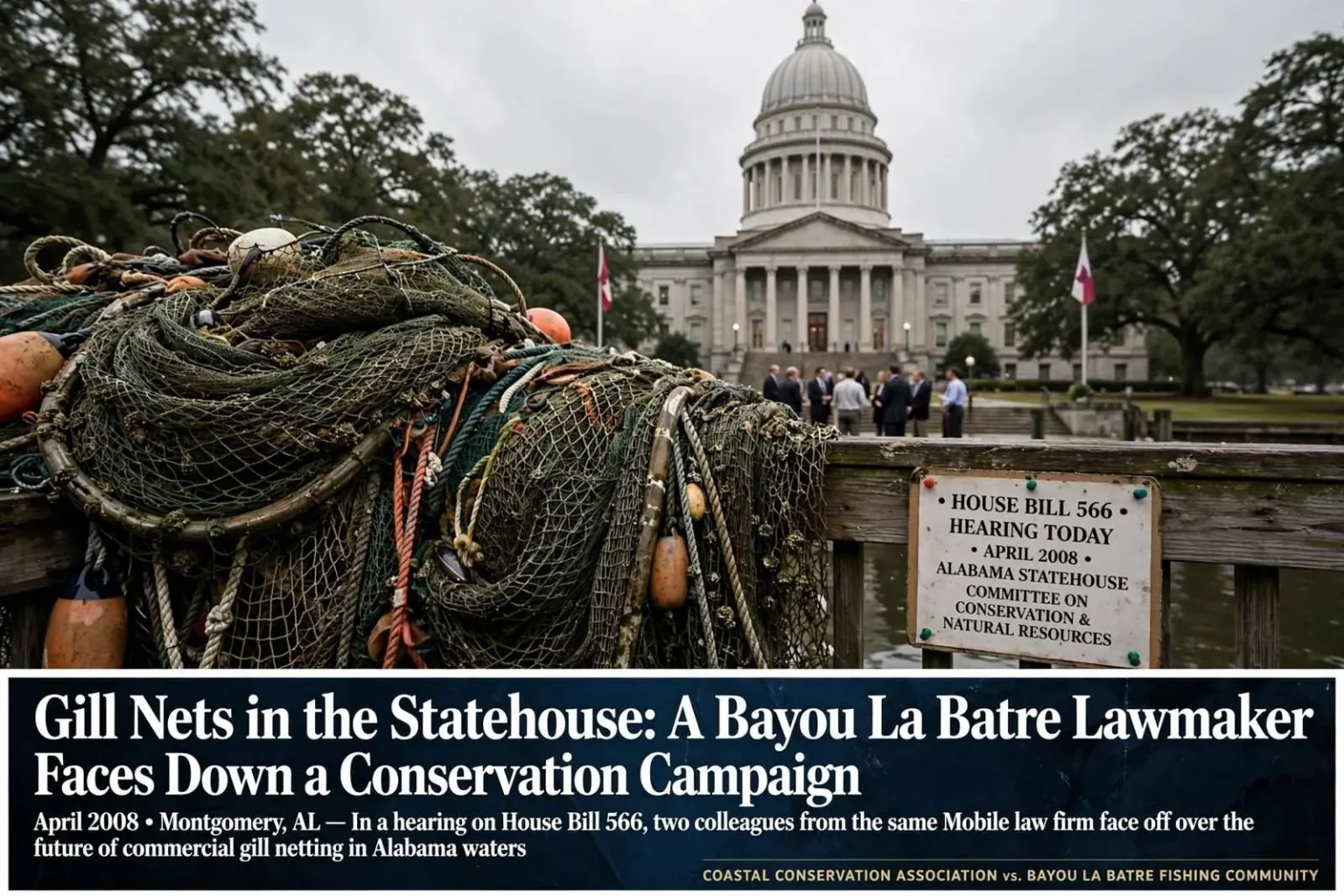
In April 2008, a familiar fight over who gets to catch Alabama’s fish reached a House committee room in Montgomery, and two men from the same Mobile law firm found themselves on opposite sides of it. State Rep. Spencer Collier, R-Bayou La Batre, was in the position of welcoming his own co-worker to the hearing. Both Collier and attorney Edwin Lamberth worked for the Mobile plaintiffs’ firm of Cunningham Bounds, one of the most accomplished trial practices in the state. Lamberth appeared that day on behalf of the Coastal Conservation Association, which was campaigning to rid Alabama waters of commercial gill nets. Collier was the gill netters’ champion in the Legislature.
The Bill
The vehicle was House Bill 566. The Coastal Conservation Association, a national organization of recreational anglers with a strong Gulf Coast membership, had made the elimination of commercial gill netting a signature cause across several states. Its argument, then as now, was that the nets are indiscriminate, taking fish the netter never intended to catch and depleting stocks that recreational fishermen, and the tourism economy built around them, depend on. Lamberth and other CCA delegates presented information to the committee in support of the bill’s passage.
The gill net debate was hardly new to Alabama or to the Gulf. Texas had banned commercial gill netting in saltwater decades earlier, Florida had phased out the gear after a citizen initiative in the 1990s, and the CCA had carried the same argument state by state along the coast. Recreational fishing groups pointed to those precedents as proof that a state economy built on sportfishing could thrive without the nets, while commercial interests pointed to the same states and noted the fleets and fishing communities that disappeared along the way.
For the committee hearing the bill, the stakes were concentrated in a small number of fishing families and a much larger number of anglers. Alabama’s saltwater fishery — speckled trout, redfish, flounder and the seasonal runs that move through Mobile Bay — supported a charter fleet, tackle shops, marinas and a tourism sector that marketed the state’s waters to anglers across the Southeast. The CCA’s case rested on the proposition that the public benefit of a healthy fishery outweighed the livelihoods of the relatively few license holders who stretched nets across the bays and passes.
Collier’s Counterproposal
Collier did not argue that gill nets were harmless. He argued that nobody had proved they were harmful enough, and that the men who fished them deserved better than to be legislated out of a livelihood on contested evidence. His position had two parts: further scientific study of the actual impact of commercial gill net fishing on fish stocks, and a voluntary buyout program for the roughly 110 licensed commercial gill netters then operating in Alabama.
The buyout idea is the more revealing of the two. It concedes that gill netting may eventually end, and asks that it end by purchase rather than prohibition, with the state compensating the license holders instead of simply extinguishing their permits. Buyout programs had been used elsewhere in Gulf fisheries as a way to retire capacity without ruin — paying a boat owner for the value of a permit is cheaper for everyone, the argument runs, than forcing a family business to fail through litigation and enforcement. Collier’s proposal borrowed that logic and applied it to a fishery where the number of affected licensees, at roughly 110, was small enough that a buyout was at least conceivable as a budget matter.
Why Bayou La Batre
Collier’s district explains his position better than any argument he made. Bayou La Batre calls itself the Seafood Capital of Alabama, and the description is earned. Its shrimp boats, oyster luggers and processing houses have supported generations of families, including a substantial Vietnamese and Cambodian community that arrived after 1975 and rebuilt the town’s fishing economy alongside its older families. The town’s identity is the water: its docks, its processing plants, and the fleet culture that runs through every family and church and civic institution in the city.
By 2008 that economy was under sustained pressure. Imported shrimp had driven down dock prices. Fuel costs were climbing. Hurricane Katrina had wrecked boats and homes across south Mobile County less than three years earlier. A commercial fisherman in Bayou La Batre had every reason to see a gill net ban as one more thing being taken away.
That accumulation of pressures framed the hearing in Collier’s telling. A fleet already squeezed by cheap imported shrimp at the dock and diesel at the pump, still rebuilding from a hurricane that had scattered boats and houses across the bayou, would hear a gill net ban in Montgomery not as conservation policy but as the latest blow in a series. Collier, whose district contained the epicenter of that pressure, took the position his constituents would expect: no more burdens without proof, and compensation if the state decided the burden was necessary anyway.
The recreational side had its own case, made with equal conviction: that the fishery is a public resource, that its decline harms everyone, and that a small number of commercial licenses should not determine the health of the whole. To anglers, the nets represented an allocation question disguised as a biological one — every fish a net took was a fish a family fisherman or charter client would not — and they had the organizational muscle, in the CCA and its membership, to press that argument in every coastal capital in the Gulf.
Two Lawyers, One Firm
The detail that gave the hearing its flavor was the workplace both men shared. Lamberth’s practice concentrated on medical malpractice, products liability, workplace and construction site injuries, toxic torts and environmental law, and fraud. Collier, a former state trooper, worked as an investigator at the same firm. The firm’s civil docket, built on representing individuals and families in injury and fraud cases, had nothing to do with fisheries — and that separation was exactly what made the April hearing possible: two colleagues could face each other across a legislative divide without a client or a case between them.
Collier went on to a considerable public career, serving as Alabama’s Secretary of Law Enforcement and later becoming a central figure in the events that led to Gov. Robert Bentley’s resignation in 2017.
His trajectory from Bayou La Batre city councilman to state representative to statewide law enforcement post made him one of the region’s most consequential political figures of the era, and the gill net fight was an early showcase of the qualities that defined him: an instinct for the underdog constituency, a willingness to contest the science behind a proposed burden, and a legislative style that treated every issue through the lens of who in his district would pay for it.
The hearing itself followed a pattern familiar to anyone who has watched Montgomery process coastal legislation. Committees hear from the sponsoring interest — in this case the CCA’s delegates, armed with the experience of other Gulf states — and from the affected industry, represented by its legislators. The scientific claims on each side rarely meet in the middle, because the underlying data rarely can: fish populations move, gear impacts vary by season and location, and the recreational and commercial sectors count their catches differently. Into that gap step the economists, the charter operators, the processors and the coastal legislators, each translating biology into livelihood.
Alabama’s commercial fishing regulation had long been negotiated in exactly that forum. Oyster harvest rules, shrimp license moratoriums, size and creel limits, and gear restrictions had all been fought out over the years between Montgomery and the coastal communities that lived with the results. The gill net question fit the pattern precisely — a gear-specific ban, promoted by an organized recreational constituency, opposed by a small but concentrated commercial one, with the science serving as ammunition rather than arbiter.
The Long Argument
The gill net question was not settled in 2008, and in some form it has never been settled. It belongs to a family of Gulf Coast disputes, over nets, over oyster reefs, over red snapper seasons, in which the science is contested, the economics are brutal for somebody either way, and the people arguing frequently know each other well. In this instance, they worked at the same firm.
The snapper wars that followed only sharpened the contrast. Federal red snapper season shortened year after year, pushing recreational anglers into direct conflict with federal managers and giving the CCA’s argument about allocation new urgency from the other direction. Meanwhile, the commercial fleet that survived kept shrinking, and the pressure on Bayou La Batre’s working waterfront continued — from imports, from storms, from the BP oil spill that would close the very waters the town fished in 2010. Each new pressure re-opened the same question the April 2008 hearing had framed: who bears the cost when the state decides how the public’s fish are divided?
House Bill 566’s fate mattered less than the argument it staged. The hearing put on record the two positions that have defined Gulf fish politics since: the recreational case that the resource belongs to everyone and must be protected from gear that takes too much, and the commercial case that conservation imposed on working families without proof or compensation is something else entirely. Collier and Lamberth stood in for those positions on that April day in Montgomery, colleagues by day and adversaries in the committee room — the most civil possible version of an argument the Gulf Coast has never stopped having.