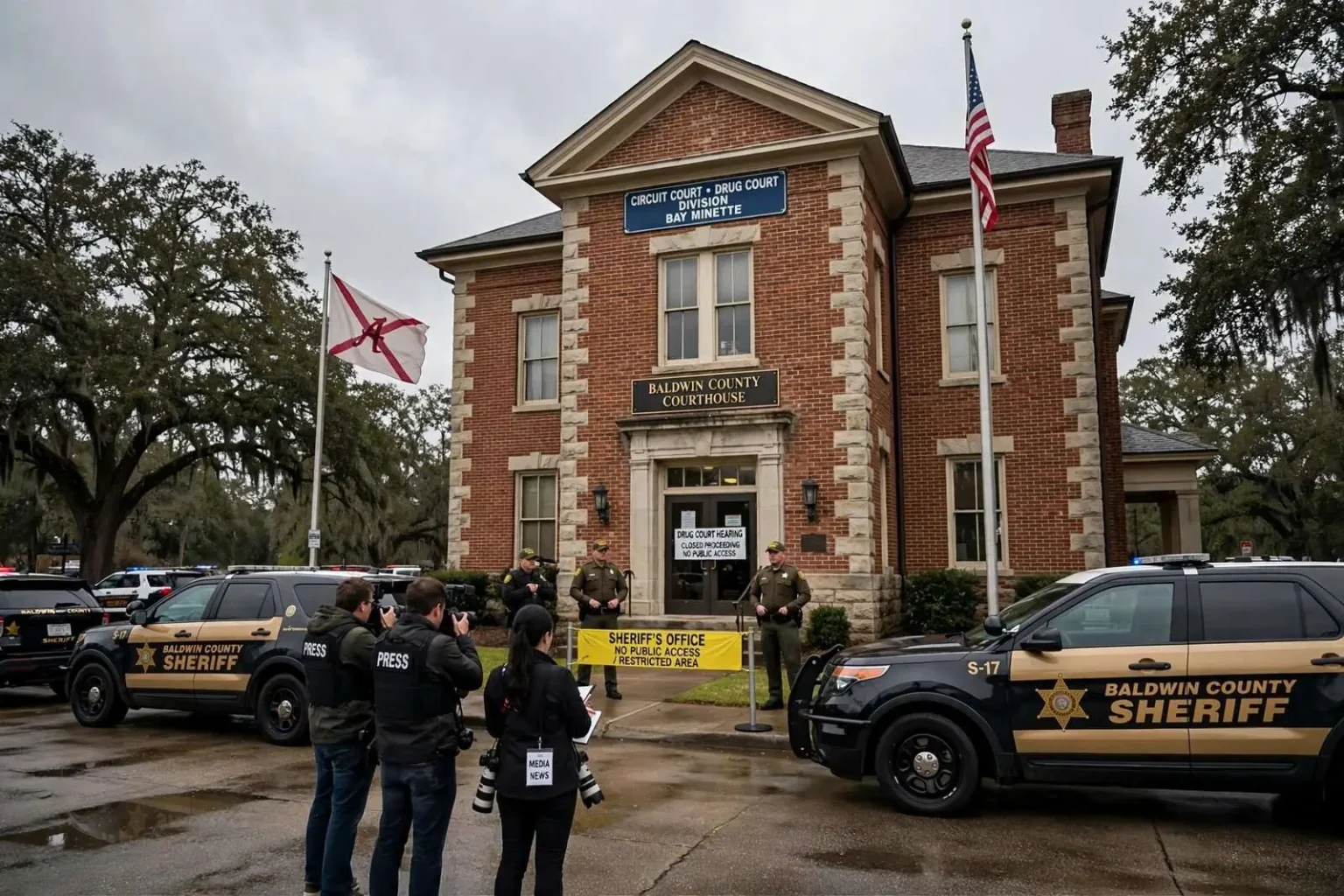
Former Tallahassee Mayor Andrew Gillum returned to a Baldwin County courtroom Thursday while still in custody, more than a week after his bond was revoked in connection with a drug case stemming from a July traffic stop in Daphne. The hearing drew attention far beyond Baldwin County because of Gillum’s political profile, but inside the Bay Minette courthouse the proceeding unfolded with the routine mechanics of a drug court docket — and, unusually, almost entirely out of public view.
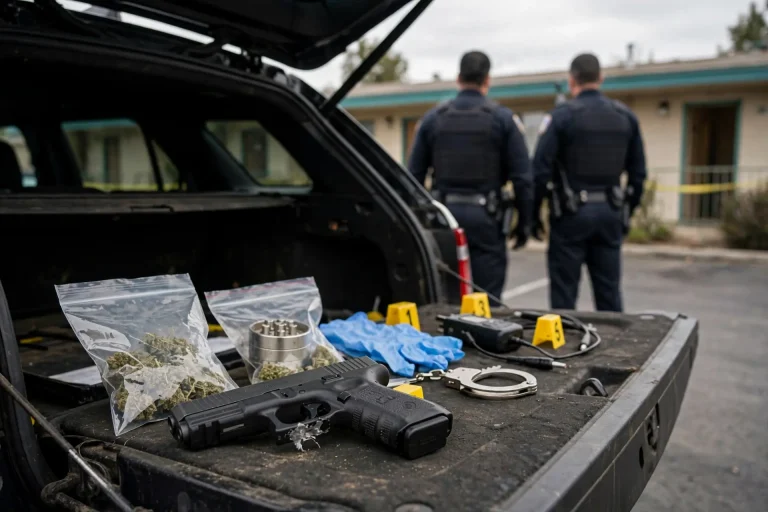
Gillum, the 2018 Democratic nominee for Florida governor, was arrested in July after police stopped his vehicle in Daphne. He is accused of having methamphetamine, marijuana and drug paraphernalia inside the vehicle at the time of the stop. Daphne police made the stop in the Eastern Shore city along U.S. Highway 98, and the charges landed Gillum in the Alabama court system rather than his home state, where his political career had played out for more than a decade.
He was initially allowed to remain out of custody, but his bond was revoked last week after court records show he missed a required drug screening and then tested positive for methamphetamine. Bond conditions in drug cases commonly require the defendant to stay in contact with supervision officers, submit to random screenings and refrain from drug use, and a missed screening followed by a positive test is the combination most likely to send a defendant back to jail before trial. Once bond is revoked, the defendant generally remains in custody unless a judge later grants reinstatement under stricter conditions.
Thursday’s hearing was held in Baldwin County’s drug court, but much of it played out away from public view. Cameras were not able to show Gillum in the courtroom because he was kept separated from the general public gallery. When his case was called, only the assistant district attorney and Gillum’s defense attorney approached the bench to speak with the judge, and their conversation could not be heard by those in the courtroom. Bench conferences like that one are a standard part of court proceedings, typically covering legal arguments, scheduling and discussions of a defendant’s status that counsel would rather resolve quietly than in open argument.
Despite the lack of visibility into most of the proceeding, the judge could be heard telling Gillum’s attorney more than once that the court did not intend to treat Gillum any differently than it treats other defendants who come through Baldwin County’s drug court program. That framing — equal treatment, neither better nor worse — has been the consistent public posture of the court since the case began drawing cameras and national attention to a docket that usually proceeds without any.
Gillum served as mayor of Tallahassee from 2014 to 2018 before becoming the Democratic nominee for Florida governor in 2018, a race he narrowly lost to Republican Ron DeSantis. His tenure as mayor of Florida’s capital city and his narrow gubernatorial defeat made him one of the most recognizable Democratic politicians in the Southeast, which is why an arrest on drug charges in a south Alabama county attracted coverage well beyond the Gulf Coast.
He remains in the Baldwin County Jail, and his next court date has been set for Aug. 27. Until then, the case returns to the ordinary rhythm of the drug court calendar, where defendants appear regularly before the judge and progress is measured month to month.
How Alabama’s Drug Courts Work
Drug courts occupy a distinct place in Alabama’s judiciary. They are specialized dockets designed for defendants whose cases are rooted in substance abuse, combining court supervision, mandatory testing, treatment requirements and regular appearances before the same judge. Participants who comply can earn reduced charges or other leniency; those who miss screenings or test positive face sanctions that can include jail time, exactly the sequence that preceded Thursday’s hearing. Baldwin County’s program handles a steady volume of such cases from the county’s fast-growing population along Interstate 10 and the Eastern Shore, and its judges are accustomed to defendants whose compliance records swing week to week.
What the program is not designed for is a nationally known defendant, and the court’s handling of the publicity — separating Gillum from the public gallery while insisting his treatment mirror everyone else’s — reflects that tension. Judges in Alabama have broad discretion over courtroom access and security arrangements, and keeping an in-custody defendant apart from the gallery is a routine security measure. The bench conference, where the assistant district attorney and the defense attorney spoke privately with the judge, likewise kept the substance of the discussion off the public record for the moment.
The Legal Road Ahead
The Aug. 27 court date will be the next public milestone in the case. Between now and then, the question of Gillum’s custody status can be revisited if his attorneys file to have bond reinstated, though such motions typically require showing changed circumstances — completed evaluations, a treatment plan or verified compliance — before a judge will release a defendant whose bond was revoked for positive tests. Prosecutors, for their part, will move the underlying charges through the standard pretrial process while the drug court docket continues.
For defendants whose bond is revoked, time in the county jail before resolution is a significant consequence in itself, and it underscores how strictly Alabama courts enforce drug-related conditions of release. A missed screening alone can draw a warning or a sanction; a missed screening paired with a positive test for methamphetamine leaves little room for a judge to do anything but revoke. That is the posture Gillum found himself in Thursday, more than a week into custody, with his counsel arguing whatever could be argued at the bench.
Alabama’s Court System in Brief
Alabama’s judicial system includes trial courts, the Court of Civil Appeals and Court of Criminal Appeals, the state Supreme Court, and a network of district and circuit courts that handle matters ranging from traffic offenses to serious felonies. Baldwin County’s circuit and district courts share the Bay Minette courthouse complex, with drug court and other specialty dockets operating within the circuit structure. Judges in Alabama are elected in partisan races, and the state’s high courts have frequently been involved in election-law disputes, including those arising from redistricting. Cases originating in state trial courts can be appealed through the appellate hierarchy and, where federal questions are presented, may ultimately reach federal courts.
Alabama is governed under a constitution that vests executive authority in a governor, with a bicameral Legislature composed of the House of Representatives and the Senate. State agencies administer programs in areas such as education, transportation, public health and corrections, and the Legislature meets in regular session in Montgomery, the state capital, though it may be called into special session by the governor to address specific subjects. Many of the policies debated in Washington originate as state-level decisions that directly affect Alabamians’ daily lives, and the courtroom in Bay Minette where Gillum appeared is one of the places where those state structures meet individual defendants case by case.
For now the case proceeds as it would for any defendant: a drug court docket, an Aug. 27 return date, and a judge who has made a point of saying, out loud and more than once, that the same rules apply here as apply to everyone else.
Why This Case Draws a Crowd
The attention on the Bay Minette courtroom comes from Gillum’s biography as much as the charges. He was elected mayor of Tallahassee in 2014, the youngest person to hold the office in decades, and he rode a progressive platform and national fundraising network to within roughly 30,000 votes of the Florida governor’s office in 2018, the closest statewide race in Florida that year. A politician who came that close to leading the nation’s third-largest state now finds himself navigating a county-level drug docket in Alabama, a contrast that explains the out-of-state press interest in a hearing that would otherwise pass unremarked.
Baldwin County itself rarely hosts such attention. The county has been one of Alabama’s fastest-growing for years, drawing new residents across Mobile Bay with its schools, beaches and lower cost of living, but its courts handle the ordinary commerce of a suburban judicial circuit: DUIs, drug possession cases, family matters and property disputes. The drug court docket exists because the county, like most in Alabama, has embraced the specialty court model as a way to move substance-driven cases toward treatment rather than only toward jail beds. Thursday was, in most respects, an ordinary session of that docket — with one defendant whose name emptied a parking lot of camera crews.
The contrast between the routine and the extraordinary played out in small ways: a defendant kept apart from the gallery for security, lawyers leaning into a bench conversation the microphones could not carry, and a judge repeating, in sentences the room could hear, that no exception would be made. For observers trying to read the court’s posture toward the case, those audible remarks were the most substantive signal of the morning. Everything else — the strategy discussions, the state of any negotiation between prosecutors and the defense — stayed at the bench where such conversations belong.
What Comes Next
Aug. 27 now functions as the case’s next checkpoint. Defendants in Baldwin County’s drug court program appear with regularity, and each appearance is an opportunity for the judge to review compliance — screening results, treatment attendance, supervision check-ins. A defendant in custody awaiting that review is in the most difficult position the program offers, since the privileges of the program are earned through demonstrated compliance and Gillum’s record at the moment includes the missed screening and positive test that cost him his bond.
Whether the case remains on the drug court track or moves to conventional pretrial proceedings will become clearer over the coming weeks, as will the question of whether Gillum returns to court as a free man on conditions or from the county jail. What is already settled is the court’s public answer to the question everyone was asking: the same rules apply here as apply to everyone else, and the calendar, not the cameras, sets the pace.