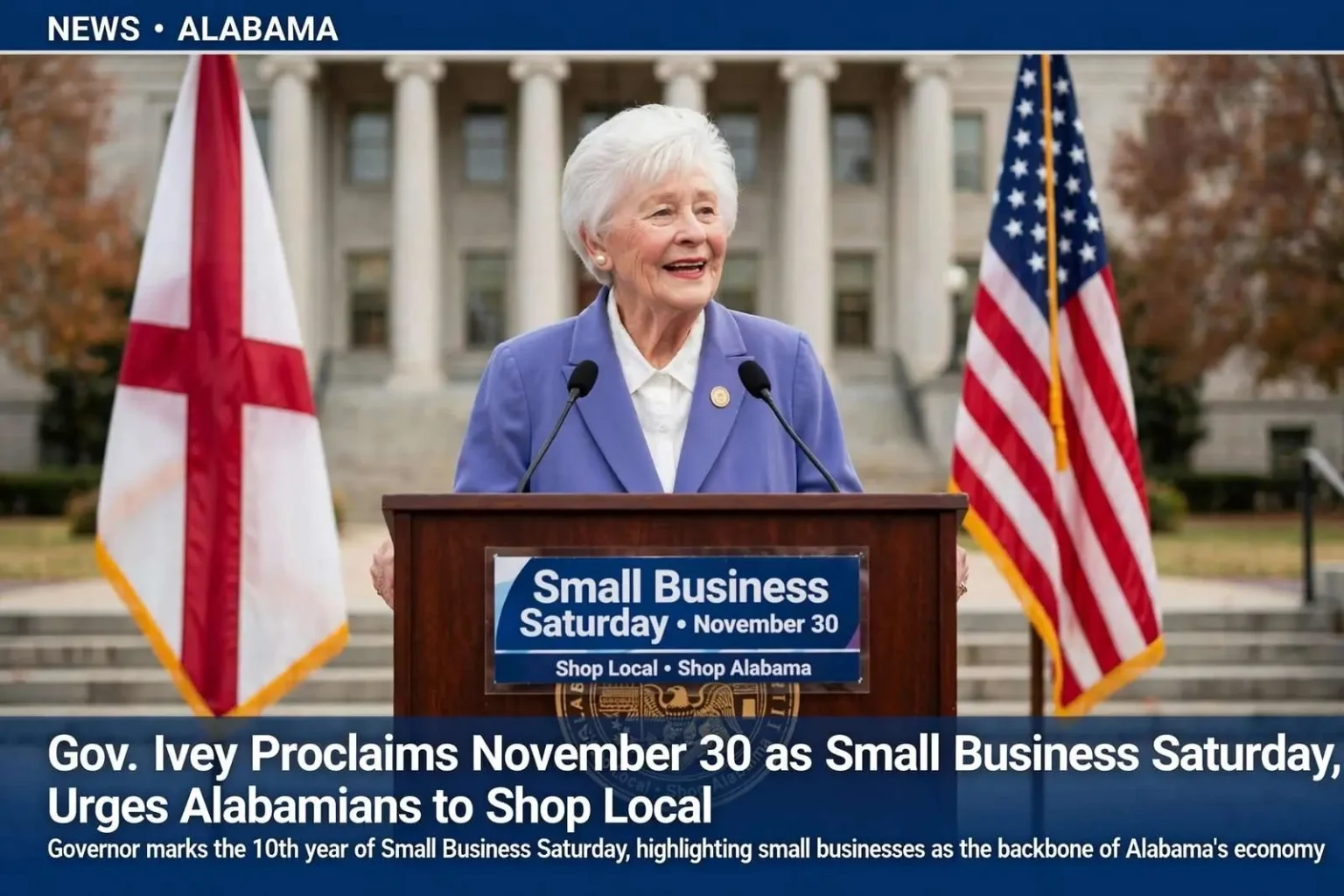
Gov. Kay Ivey has proclaimed November 30 as Small Business Saturday in Alabama, marking the tenth year of the nationwide shopping day that kicks off the holiday season by steering customers toward locally owned businesses. The proclamation places Alabama alongside the states and communities across the country that have embraced the Saturday after Thanksgiving as a counterweight to the big-box and online rush of Black Friday and Cyber Monday. In a state where small businesses account for the overwhelming majority of employers, the designation is both a shopping prompt and a statement about what keeps Main Streets from Huntsville to Mobile economically alive.
“Small businesses continue to serve as the backbone of Alabama’s economy, as well as a staple to the character and charm that make our state so special to call home,” Ivey said in the proclamation. “I urge Alabamians across the state to shop local on Small Business Saturday and throughout the year.” The governor’s message framed the day in terms that go past a single weekend: the shops, restaurants, trades, and family firms that anchor Alabama’s towns are presented not as a seasonal cause but as a year-round economic priority, with the Saturday after Thanksgiving serving as the annual reminder.
Small Business Saturday began in 2010, created by American Express at a moment when the recession had hollowed out retail districts nationwide, and it has since grown into a fixture of the holiday calendar. Falling between Black Friday — the traditional opening of the holiday shopping season at national chains — and Cyber Monday’s online blitz, the day deliberately routes holiday traffic to independent retailers, restaurants, and service businesses. A decade in, the shopping day has drawn proclamations from governors, mayors, and even the U.S. Senate, and it has become one of the busiest days of the year for many small merchants, second only to Black Friday itself in some retail surveys.
Why Shopping Local Matters
Rosemary Elebash, Alabama state director for the National Federation of Independent Business, said spending at local shops keeps more money close to home. Citing an American Express study, she noted that 67 cents of every dollar spent at a small business stays in the community. The arithmetic behind that figure is the core of the shop-local argument: small businesses bank locally, hire locally, buy supplies from other local firms, sponsor local teams, and pay local taxes, so each dollar re-circulates through the same economy instead of departing immediately for a distant headquarters.
For Alabama’s communities, that multiplier effect is more than an abstraction. Main Street merchants in towns across the state — from downtown Mobile’s independent shops to the boutiques of Fairhope and the family hardware stores of the Black Belt — employ neighbors, pay property taxes that fund schools, and occupy storefronts whose vacancy would depress the districts around them. When holiday spending flows through those businesses instead of national chains and online marketplaces, the difference shows up in local payrolls in December and local tax rolls in the new year. Elebash’s organization, the NFIB, represents small and independent businesses in every state and has been a national partner in the Small Business Saturday campaign since its early years.
The numbers also suggest the shopping day has lasting effects: 96 percent of shoppers surveyed by American Express and NFIB said Small Business Saturday makes them want to shop at small businesses throughout the rest of the year. That follow-on behavior is what organizers and business groups prize most about the day — the idea that a customer introduced to an independent shop while holiday shopping will keep returning in January and beyond, long after the season’s decorations come down.
The Tenth Year of a Holiday Tradition
The tenth annual Small Business Saturday arrived in a strong year for Alabama’s retail economy, with holiday sales projected to grow and unemployment low across the state. November 30 capped a holiday weekend that has evolved its own rhythm for many Alabama families: Thanksgiving on Thursday, Black Friday at the malls and big-box stores, then Saturday in the home neighborhoods — the downtowns, walkable districts, and corner shops where the state’s independent businesses live. Merchants in communities across Alabama planned special hours, promotions, and events for the day, following a pattern established over the previous nine years.
The governor’s proclamation joined a bipartisan tradition, as chief executives across the country have issued similar declarations each November since the day’s founding. For Alabama’s small business owners, the official recognition carries practical value beyond symbolism: it concentrates media attention on the shop-local message at exactly the moment holiday shopping decisions are being made, and it gives chambers of commerce and merchant associations a hook for their own promotions. State and local tourism and downtown development groups have increasingly folded Small Business Saturday into their broader Main Street campaigns.
Behind the celebration, the day’s founders had a straightforward economic goal. American Express launched the initiative in 2010 with a simple premise: holiday spending was increasingly concentrated in national chains and, increasingly, online, while the independent businesses that define a community’s character depended on the same season for a large share of their annual revenue. By branding the Saturday after Thanksgiving and encouraging cardholders to spend there, the campaign created a shopping occasion where none had existed, and one that has since generated billions of dollars in estimated spending at independent merchants nationwide as it has grown year over year.
What It Means for Alabama’s Merchants
For Alabama’s small businesses — the employers the governor called the backbone of the state’s economy — a strong Small Business Saturday can shape more than a single day’s receipts. Independent retailers typically draw a disproportionate share of their annual revenue from the weeks between Thanksgiving and Christmas, and a good showing on the season’s marquee Saturday ripples through the rest of the quarter — sustaining inventory orders, part-time holiday hiring, and the cash reserves that carry a shop through the slow winter months.
The day also functions as an annual introduction between consumers and businesses they may overlook. Shoppers who make a point of visiting a local bookstore, nursery, jeweler, or toy shop on November 30 often discover inventory and service they cannot find in a national chain, and the NFIB’s survey figures suggest that discovery tends to stick. For merchants, the strategy for the day has matured over its first decade: many now coordinate with neighboring businesses, extend hours, and treat the Saturday as a de facto open house for the whole district rather than a one-store promotion.
Gov. Ivey’s proclamation puts the state’s imprimatur on all of it — the shopping day, the campaign behind it, and the year-round case for local spending. The message to Alabamians is timed for the season but built to outlast it: the businesses that give Alabama’s towns their character survive on the habits formed at holidays, and the 67 cents of every local dollar that stays home is the quiet engine behind the state’s Main Streets. On November 30, the governor’s office suggested, the most effective economic development available to most Alabamians is as simple as choosing where to shop.
The timing of the proclamation also connects to the rhythm of Alabama’s retail year. The Saturday after Thanksgiving is the moment when holiday shopping shifts from planning to practice, and for the state’s independent merchants the weekend represents the opening of the most important stretch on their calendar. Downtown organizations across Alabama have built traditions around the day — storefront decorations up, extended hours posted, and in many communities coordinated events that turn a shopping trip into an outing. In Mobile, Fairhope, Foley, and the state’s smaller downtowns alike, the Saturday has become a fixture that merchant groups plan for weeks in advance.
The shop-local case Elebash outlined extends beyond the retail sector to the service businesses that make up much of Alabama’s small economy. The same multiplier logic applies when a family hires a local plumber, uses a hometown accountant, or books work with an independent contractor: the wages paid stay in the community, and the business owner who benefits is a neighbor with a stake in local schools, roads, and civic life. Small Business Saturday serves as the retail-focused emblem of that broader economic pattern, a single visible day for a principle that applies every day of the year.
NFIB’s advocacy on behalf of small business gives Elebash’s comments a national research base. The organization’s surveys and studies, along with American Express’s annual Small Business Saturday consumer research, have tracked the day’s growth since its inception and documented the consumer attitudes behind it — including the finding that an overwhelming share of shoppers who participate say the day influences their habits for the rest of the year. Those figures are the reason state officials and business groups treat the Saturday as more than a marketing gesture: the behavior it encourages measurably supports the independent sector that employs nearly half of American workers.
A Statement About Character as Well as Commerce
Governor Ivey’s choice of words in the proclamation — pairing the economic argument with “the character and charm” that small businesses lend the state — reflected the dual case that shop-local advocates have always made. Main Street businesses give Alabama’s towns their identity: the diner where local news travels, the bookstore that hosts author nights, the hardware store that still advises on a repair. Those businesses compete on relationships as much as price, and the relationships only survive if customers walk through the door. A proclamation urging Alabamians to “shop local on Small Business Saturday and throughout the year” is, at bottom, an argument about what the state’s communities want to look like in another decade.
The tenth-anniversary framing adds a historical note to the day. What began in 2010 as a marketing campaign launched during recession recovery has become an American institution, complete with presidential and gubernatorial proclamations, permanent merchandising traditions, and a generation of shoppers who treat the Saturday after Thanksgiving as part of the holiday itself. Alabama’s participation in that milestone puts the state’s merchants on the national map for the day, and it gives local business groups their strongest annual platform for the message that independent businesses are worth seeking out.
For shoppers, the practical takeaway from the governor’s office and the NFIB alike is straightforward: on November 30, the holiday list is an opportunity. Every purchase made at an Alabama-owned business on that Saturday returns, by the study’s arithmetic, two-thirds of its value to the community where it was made — and, by the survey’s evidence, starts a habit that carries into the new year. Ten years after the first Small Business Saturday, the day’s founders could ask for no better proof of the concept than a governor urging her state to make shopping local a tradition.