Great White Sharks: Rare Visitors to Gulf Coast Waters
Great white sharks rarely visit the Gulf of Mexico, with only about nine tracked at any time. They prefer cooler, deeper waters.
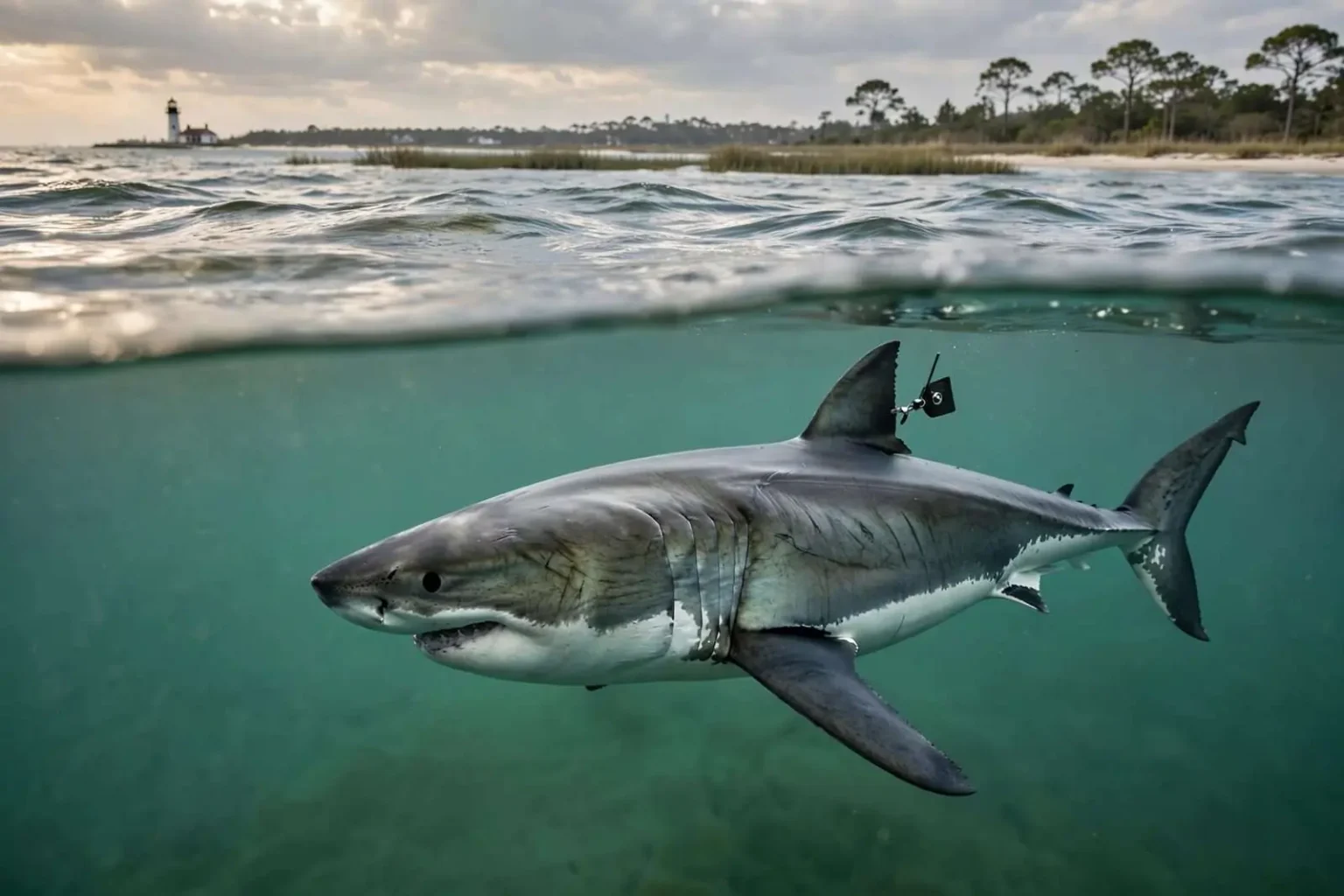
Great white sharks are not very common in the Gulf of Mexico, but they do occasionally visit the region, according to marine experts.
That distinction matters for anyone who swims, fishes or boats along the Alabama coast. Great whites occupy a towering place in the popular imagination — fed by decades of movies and dramatic headlines — but the Gulf of Mexico is not their home range in any meaningful sense. The sharks that cruise the northern Gulf in any numbers are familiar coastal species: bull sharks, blacktips, spinner sharks and the like. Great whites appear as visitors, not residents, and understanding that difference changes how residents should read every shark story that surfaces.
Dr. Sean Powers, director of the University of South Alabama School of Marine and Environmental Sciences and senior marine scientist at the Dauphin Island Sea Lab, says great white sharks are rarely seen in the Gulf. “We get them occasionally. We have a lot of trackers on sharks and the most we’ve ever seen is about nine in the entire Gulf of Mexico,” Powers said. “There could be much further offshore.”
The tracking data Powers references represents one of the quieter revolutions in marine science. Satellite and acoustic tags attached to great whites over the past two decades have transformed what scientists know about the species, revealing migration patterns that were invisible to earlier generations of researchers. Where once a great white sighting was an anecdote, researchers can now follow individual animals across ocean basins, and those tracks are what allow a scientist on Dauphin Island to state with confidence how many tagged whites have entered the Gulf at any given time.
Size and Diet
Great white sharks can grow to about 20 feet long and are the largest predatory fish in the ocean. Their diet includes marine mammals like seals, as well as large tunas.
That diet is the key to the species’ distribution. Great whites are built to hunt energy-dense prey — seals, sea lions and substantial fish like tuna — and their range tracks the availability of that prey. The cold-water seal colonies of the North Atlantic and Pacific coasts anchor the species’ well-known aggregations. In the Gulf of Mexico, seal populations are essentially absent, which removes the primary food source that draws great whites to other regions and explains why the animals that do appear are transients rather than residents.
Not a Threat to Gulf Coast Swimmers
While great white sharks are often portrayed as dangerous in movies, they are not considered a significant threat to swimmers in the Gulf Coast region because they prefer deeper, cooler waters. “In the Gulf of Mexico now, there’s places in the North Atlantic and things where they’ll move shallow. But here, these guys like really cool waters. So our warm kind of beaches aren’t ideal for them,” Powers said.
The contrast Powers draws is between two very different coastal environments. In the North Atlantic, great whites routinely hunt in shallow water close to shore, following seal populations that haul out on beaches and islands. The northern Gulf offers no comparable draw: its warm, shallow coastal waters — the very waters where Alabama families swim off Gulf Shores and Dauphin Island — sit far outside the temperature and prey profile that pulls a great white inshore. A great white in the Gulf is more likely to be several miles offshore, following deep, cooler water and the large fish that live there.
For swimmers along the Alabama coast, the practical takeaway is that the species dominating the national imagination is not the species sharing their swimming areas. The sharks encountered close to shore in the northern Gulf are smaller coastal species, and even those rarely pose problems for people. The great white’s rare Gulf appearances are of interest to scientists and anglers, not a warning to beachgoers.
The species’ rarity in the Gulf also reflects its conservation status. Decades of overfishing and bycatch drove great white populations down worldwide, and the species is now protected in U.S. waters, with federal rules prohibiting the take of great whites in the Atlantic and Gulf. As populations have slowly begun to recover in the Northwest Atlantic, scientists have documented more young-of-the-year and juvenile great whites along the northeastern coast — and correspondingly more interest in where those animals travel, including the occasional excursion into the Gulf.
The Gulf’s Real Giant
The largest shark species is the whale shark, which can grow to 40 feet long, but it feeds on plankton and is not dangerous to humans.
The whale shark is, ironically, the Gulf’s most spectacular shark encounter — and the gentlest. These enormous filter feeders appear in the northern Gulf during summer months, swimming near the surface and feeding on dense patches of plankton and fish eggs. Boaters who come across one are usually treated to an unhurried giant cruising alongside, entirely indifferent to human company. The species’ size — twice the length of a large great white — combined with its harmless diet makes it the perfect corrective to the movie-fed image of what a big shark means.
Marine educators at the Dauphin Island Sea Lab, where Powers serves as senior marine scientist, use that contrast in their public programs: the biggest shark in the Gulf eats plankton, while the most feared shark barely visits at all. The message lands with visitors who arrive expecting the Gulf to resemble the ocean of cinema. The Gulf’s shark community is real and important — coastal species performing their role as predators in a healthy estuarine and offshore ecosystem — but it is not the community of the films.
Powers’ dual role illustrates how Alabama’s marine science community is organized. The University of South Alabama’s School of Marine and Environmental Sciences trains students and conducts research in partnership with the Dauphin Island Sea Lab, the state’s marine science consortium that hosts researchers and educators from institutions across Alabama. Work on sharks, fish populations, oyster reefs and coastal ecosystems flows through that partnership, and the scientists who do it are the same people the public encounters at the Estuarium and in media interviews when a shark story breaks.
So when a great white’s tracker pings from the Gulf of Mexico, the news deserves attention — as science, not as alarm. The tagged animals are few, their visits are transient, and the warm beaches where millions swim each summer hold no attraction for them. The ocean’s largest predatory fish passes through Gulf waters the way a traveler passes through a country whose climate does not suit him: briefly, quietly, and far from the crowded shoreline.
Tracking studies have revealed surprising breadth in great white movement. Individual animals tagged off the northeastern United States and Atlantic Canada have shown up along the Carolina coast, in deep water off Florida, and occasionally into the Gulf itself, following routes scientists are still mapping. The nine tracked whites in the entire Gulf represent the documented minimum — the number of tagged animals whose signals registered in Gulf waters — and Powers’ caution that there could be more much further offshore reflects both the limits of the tracking array and the vast, little-sampled deep waters of the central Gulf. Even so, the numbers are minuscule compared with the populations of coastal shark species that genuinely inhabit the region.
Anglers in offshore waters occasionally cross paths with great whites, and those encounters generate most of the Gulf’s white shark headlines. A white shark investigating a hooked fish or lingering near a boat is behaving typically for the species, which is curious and opportunistic around potential prey. Fishermen who report such encounters provide scientists with valuable sighting data that complements the tracking record. The encounters also serve as reminders that while the Gulf’s warm beaches hold no appeal for great whites, the offshore Gulf — cooler, deeper and full of large fish — sits within the species’ occasional range.
For coastal residents, the scientists’ advice reduces to perspective. Sharks of several species live in the northern Gulf and always have; swimmers share the water with them the way land users share trails with snakes. Ordinary precautions — swimming in groups, avoiding dawn and dusk, staying near lifeguards, leaving schools of bait fish alone — address the actual, small risk from coastal species. The great white, meanwhile, remains what the tracking data shows it to be in the Gulf of Mexico: a rare visitor to far-off waters, counted by scientists one tag at a time.
Education is where that perspective gets built. The Sea Lab’s Estuarium and the university’s marine programs reach thousands of Gulf Coast students each year, teaching them to distinguish the Gulf’s actual shark fauna from its reputation. Those lessons do double duty: they calm unwarranted fear at the beach, and they build public support for the research and conservation that keep Gulf ecosystems productive. A community that understands its sharks — which ones live here, which ones merely pass through, and why — is a community better equipped to value the waters it swims in.